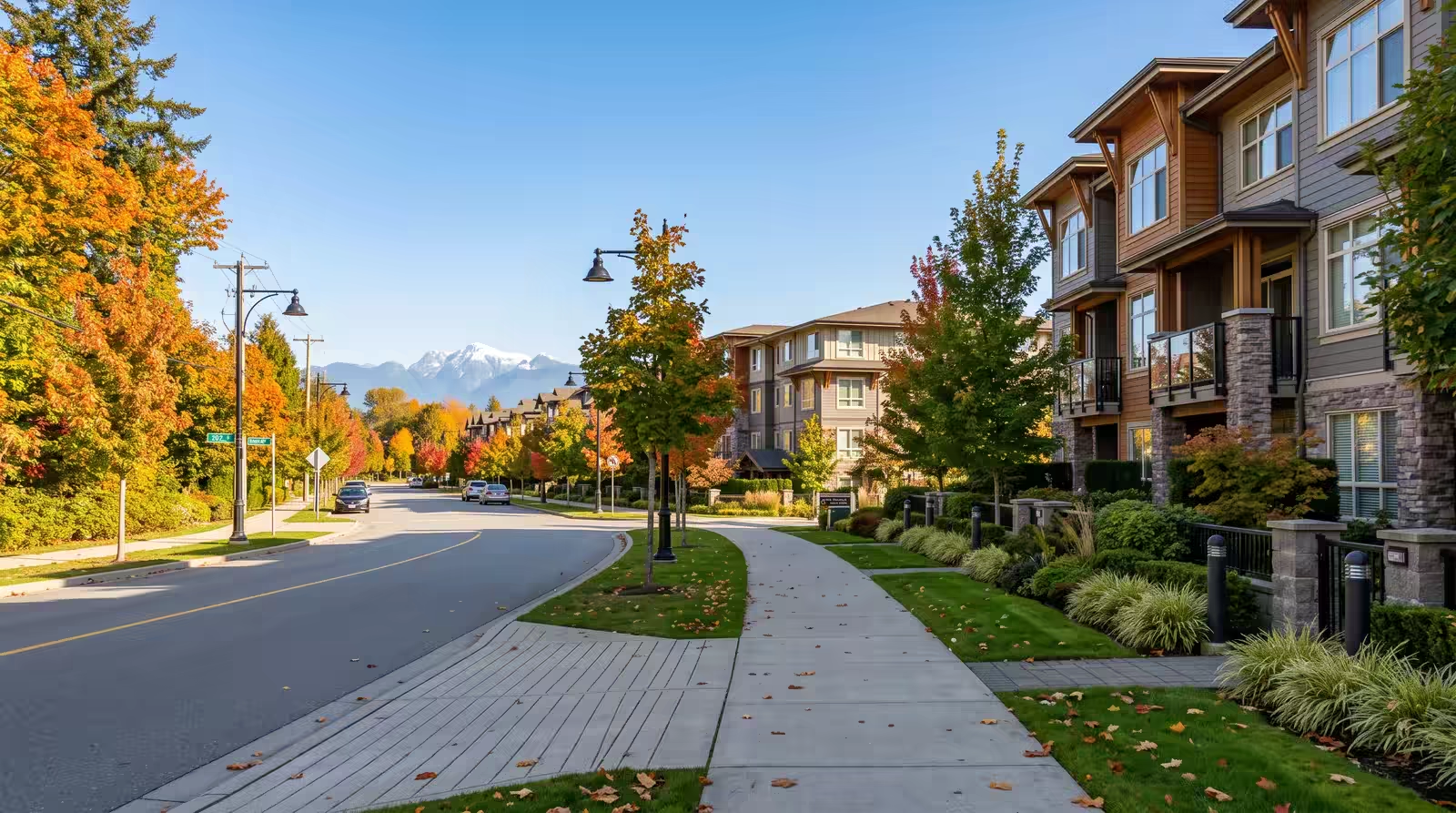

You've already made the big decision: you're leaving Vancouver or Burnaby. Now comes the harder one, which Fraser Valley city actually fits you? Langley comes up early in almost every buyer conversation the FRIVE team has, but it tends to get simplified in ways that lead people to the wrong part of it.
This guide is for the buyer who has decided on the Fraser Valley but hasn't yet committed to a city, or who has Langley on the short list and wants to understand it properly before booking showings.
Langley is two different places, you need to pick one
The first thing to understand is that "Langley" refers to two separate municipalities: the City of Langley and the Township of Langley. They share a name and a border, but they feel and function very differently.
The City of Langley is a small, compact urban core, roughly 25 blocks across. It has a walkable downtown on Fraser Highway and Glover Road, older character buildings, a mix of condos and smaller residential buildings, and a genuine town-centre feel. It's also where the Surrey-Langley SkyTrain extension terminates (more on that below). As of mid-2026, FVREB data put the condo benchmark in Langley City in the roughly $525,000 to $530,000 range, which makes it one of the more accessible condo markets in the corridor.
The Township of Langley is a much larger suburban municipality that wraps around the city. It includes the high-growth Willoughby area, the established Walnut Grove neighbourhood to the north, the agricultural Aldergrove area in the southeast, and historic Fort Langley to the north. Most of the new townhouse development that people associate with Langley happens here.
If you're shopping Langley without knowing which municipality you're in, you're essentially shopping two cities at once. It's worth deciding early which one you're targeting. Our City vs Township guide covers the comparison in depth.
What the SkyTrain extension changes, and what it doesn't
The Surrey-Langley SkyTrain extension is a 16-kilometre extension of the Expo Line running along the Fraser Highway from King George station in Surrey to Langley City Centre. TransLink puts the anticipated in-service date at 2029; the Province has used "late 2028 to 2029" in its project communications. Eight stations are planned, from 152 Street in Surrey to Langley City Centre at the western edge of the City of Langley.
For buyers in the City of Langley, that's a meaningful change. A walkable Langley City condo within a few blocks of the future terminal is a genuinely different transit proposition than what exists today. Buyers considering Langley City for lifestyle reasons now also have a transit story to go with it.
For buyers in the Township, the extension matters less directly. Willoughby already uses the Carvolth Transit Exchange as its main transit connection to Surrey and Metro Vancouver. Walnut Grove commuters lean on Highway 1. Neither neighbourhood gets a SkyTrain station of its own, though the improved south-of-Fraser transit network will be a benefit over time. Don't buy a Willoughby townhouse expecting to walk to the station, you won't be.
We'd encourage treating 2029 as the planning date, and checking TransLink directly for updates as construction progresses. Transit timelines on projects of this scale can shift, and any purchase decision that depends tightly on a specific opening date deserves fresh verification.
Willoughby: the townhouse buyer's default, and for good reason
Most first-time buyers who come to us saying "Langley" mean Willoughby, even if they don't know the name yet. It's the neighbourhood the Township is most associated with among buyer searches, and it's earned that reputation.
Willoughby has been one of the busiest areas for new townhouse construction in the entire Metro Vancouver region for more than a decade. The Yorkson and Routley sub-areas have deep supply of newer complexes, several recently built schools, and quick access to the Carvolth Transit Exchange for bus service over the Port Mann Bridge toward Surrey and beyond. It's built for family-sized buyers who want space and newer finishes in a community that's still adding amenities.
The trade-offs are real. Traffic on main routes like 200 Street can be slow at peak hours. Some complexes are large and amenity-heavy, which can mean higher strata fees. And parts of Willoughby are still mid-construction, which means noise, disruption, and the usual risks of a still-developing area.
For anyone looking seriously at Willoughby, our full Willoughby neighbourhood guide for first-time buyers is the place to start.
Walnut Grove: the established alternative north of the highway
Walnut Grove sits north of Willoughby, closer to Highway 1 and the 200 Street interchange. It's one of Langley's most established residential neighbourhoods, mature trees, settled streets, schools and parks that have been there for decades, and a quieter, lower-turnover feel than the fast-growing areas to the south.
For some buyers, that's exactly what they want. The neighbourhood has already grown up, which means you move into a community that's finished rather than still figuring itself out. The housing mix leans toward established single-family homes, townhouses, and some condos in older complexes, less new construction, more character.
Walnut Grove's commute story is different from Willoughby's. Its strength is highway access north: quick on-ramp to Highway 1 via the 200 Street interchange, which suits commuters heading toward the Port Mann Bridge or anywhere north and west by car. It does not have a SkyTrain station, and the Surrey-Langley extension runs along the Fraser Highway to the south, not through Walnut Grove. For car commuters that's usually fine. For transit-dependent commuters it requires a separate connection.
Our Walnut Grove neighbourhood guide covers the housing mix, the commute, and who the neighbourhood tends to fit.
One thing worth noting with established strata complexes anywhere in Langley: read the depreciation report and contingency reserve fund carefully. Older buildings have more history, and the reserve fund tells you whether that history has been properly maintained. It's not a reason to avoid established complexes, it's just the right homework.
Aldergrove: the more affordable option, with trade-offs
Aldergrove sits in the southeast corner of the Township of Langley, near the US border. In our experience, it tends to be one of the more affordable areas in the Township for detached homes, buyers who have stretched their budget hunting for that extra bedroom sometimes find more room to work with here than in Willoughby or Walnut Grove.
The trade-off is distance. Aldergrove is one of the more remote parts of Langley from the existing transit network, and the SkyTrain extension doesn't reach it. Commuting from Aldergrove relies heavily on a car. Buyers who work locally, commute at off-peak hours, or simply prioritise space over transit proximity are the ones we see find it a good fit. Buyers who are counting on a short transit commute to Vancouver will likely find the math harder.
Aldergrove has its own character, a smaller-town feel, a developing commercial district, and a quieter residential pace, that some buyers actively want. It's worth a look if your budget is tight and your commute is flexible, but go in clear-eyed about the distance.
Schools, services, and everyday life in Langley
Both the City and the Township are served by the Langley School District (School District 35). The district runs elementary, middle, and secondary schools across both municipalities. Specific catchment boundaries vary quite a bit by address, so confirm the school assigned to any property directly with SD35 before making a decision, this is especially important in high-growth areas like Willoughby, where school capacity has been a recurring pressure point.
For day-to-day services, the Township's infrastructure varies a lot by neighbourhood. Willoughby has a developing town centre with grocery stores, restaurants, and retail within a reasonable drive, though some residents still make the trip to Langley City or to Surrey for a wider range of services. Walnut Grove has its own commercial nodes. Langley City's compact walkable core means more of daily life is reachable on foot than in most of the Township.
Parks and outdoor access are generally good across Langley. The Township has a network of walking and cycling trails, the Nicomekl and Salmon rivers, and a mix of community recreation centres. The City has Portage Park and Rotary Stadium, plus its own recreation programs. If outdoor space matters to you, Langley tends to deliver without much searching.
Who Langley actually suits, and who it doesn't
Langley works well for buyers who want more space per dollar than Metro Vancouver offers, who are ready for a car-dependent or car-primary commute, and who want a settled, family-oriented community. Willoughby suits buyers who want the newest finishes and don't mind a neighbourhood still under construction. Walnut Grove suits buyers who want an established feel and commute north. Langley City suits buyers who want walkable urban life and can wait for the SkyTrain to complete.
Langley tends to disappoint buyers who are hoping to stay fully transit-dependent. Outside of the coming SkyTrain corridor in the City, most of Langley runs on a car. It also tends to disappoint buyers who expect Vancouver-scale urban density, even Langley City is a small town compared with what most people mean when they say "urban."
The buyers we've seen settle happiest in Langley usually arrive knowing which part they want, why they want it, and what they're trading for it. That's true everywhere in the Fraser Valley, but in Langley the split between City and Township makes the up-front homework especially worth doing.
Where to go from here
If you're still deciding between Langley and another Fraser Valley city, our Surrey vs Langley guide and our Langley vs Abbotsford guide lay out the specific trade-offs without pushing you either way.
If you've narrowed it down to Langley and you're working through the neighbourhood question, our best neighbourhoods in Langley for first-time buyers is the right next read, along with the specific guides for Willoughby and Walnut Grove.
And if you want to browse what's actually on the market in Langley right now, the Langley neighbourhoods page is a good starting point, or go directly to our Langley first-time buyer guide for the qualifying numbers, programs, and a full worked example specific to the Langley market.
When you're ready to talk through specifics, reach out to the FRIVE team. We'll never push you to write an offer before you're ready, but we can help you get clear on which part of Langley makes sense for you a lot faster than touring six neighbourhoods without a plan.
Frequently asked questions
Is Langley a good place for first-time buyers in 2026?
- Langley is one of the strongest markets for first-time buyers in the Fraser Valley, with condos, townhouses, and detached homes across two municipalities with different price points and characters. The Township, including high-growth Willoughby, suits buyers wanting newer family-sized townhouses. The City suits buyers wanting a denser, walkable feel closer to the planned SkyTrain terminal.
What is the difference between the City of Langley and the Township of Langley?
- They are two separate municipalities that share a name. The City of Langley is a small, dense urban core with a walkable downtown and older buildings. The Township is a larger municipality surrounding the city, including Willoughby, Walnut Grove, Aldergrove, and Fort Langley. Most new townhouse development happens in the Township, but the SkyTrain extension terminates in the City.
Sources
- Surrey Langley SkyTrain, TransLink
- Monthly Market Report, Fraser Valley Real Estate Board
- Langley School District 35, Langley School District
Related guides
- Relocation GuidesMoving to Abbotsford BC: What First-Time Buyers Actually Need to Know
- Relocation GuidesMoving to Chilliwack BC: What First-Time Buyers Actually Need to Know
- Relocation GuidesMoving to Mission BC: What First-Time Buyers Actually Need to Know
- Neighbourhood GuidesSouth Surrey and White Rock for First-Time Buyers: The Seaside End of the Market
Found this useful? Share it.
A neighbour, a partner, a friend who's two FHSA contributions away, send it their way.