
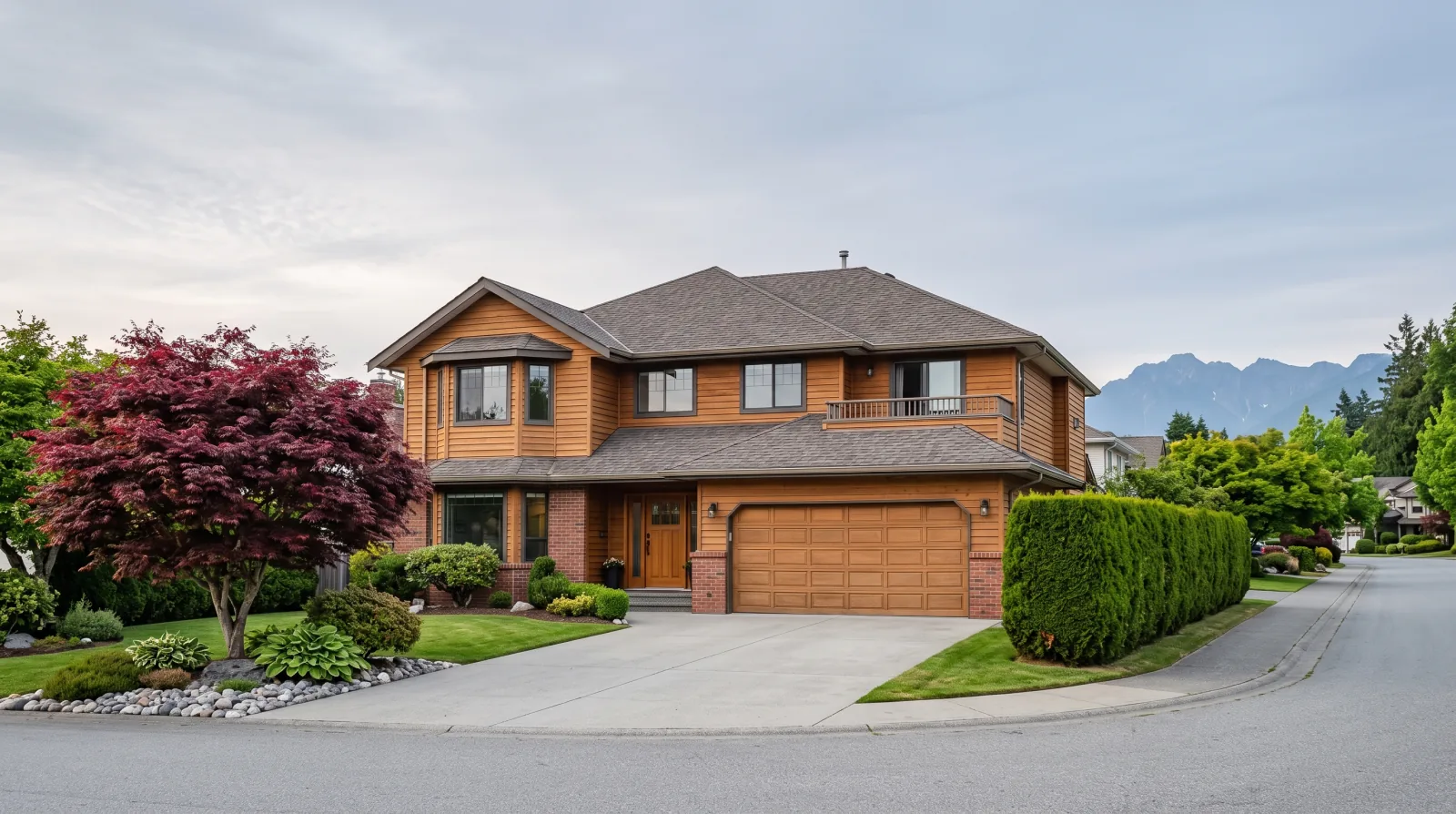
You bought the house years ago. The mortgage is small or gone, the children have left, and the house is worth more than you paid for it. This guide shows what a house like yours sells for today, what you keep after costs and tax, and how to choose the smaller home.
What your house is worth today
The benchmark price of a single-family detached house in the Fraser Valley was $1,300,000 in September 2026, according to the Fraser Valley Real Estate Board. A benchmark is the board's price for a typical home in an area. It is the best public number for a first check. It leaves out the condition of your kitchen, the age of your roof and the size of your lot.
The board also publishes a price index, set to 100 in January 2005. For detached houses the index stood at 370.5 in September 2026. A typical detached house costs 3.7 times what it cost in January 2005.
Prices have come down from their highest point. The board's chair said the single-family benchmark is now $460,000 below its March 2022 peak, and it fell 8.8% in the last year. Both facts are true for a long-time owner: the house is worth less than it was in 2022, and it is worth 3.7 times the January 2005 price.
| City | House | Townhouse | Condo | House to townhouse gap |
|---|---|---|---|---|
| Surrey | $1,386,200 | $758,600 | $447,600 | $627,600 |
| Langley | $1,471,100 | $802,600 | $525,900 | $668,500 |
| Abbotsford | $1,087,000 | $592,600 | $370,200 | $494,400 |
| Chilliwack | $859,200 | $582,900 | $401,000 | $276,300 |
| Mission | $889,200 | $618,000 | $411,500 | $271,200 |
| Maple Ridge | $1,155,900 | $700,800 | $513,400 | $455,100 |
Benchmark prices. Surrey, Langley, Abbotsford and Mission: FVREB, September 2026. Maple Ridge: GVR, September 2026. Chilliwack: CADREB, August 2026, the latest month posted. Surrey is the City of Surrey combined figure. The gap is price difference only, before any cost of selling or buying.
Your own number depends on things a benchmark leaves out: the size of the lot, the age of the roof and furnace, a suite, a view, the street. Send us the address through the form at the bottom of this page and we will email you a price range from recent sales of homes like yours. It is free, and you do not have to sell with us.
What you keep after you sell and buy
Downsizing is two deals, and each one has costs. Here is an example with the two Fraser Valley benchmarks: sell a house at $1,300,000 with no mortgage, and buy a townhouse at $745,300.
| Sale price of the house | $1,300,000 |
| Commission at 3% (an example, BC has no set rate) | − $39,000 |
| GST on the commission, 5% | − $1,950 |
| Lawyer or notary for the sale (an example) | − $1,500 |
| Cash from the sale | $1,257,550 |
| Price of the townhouse | − $745,300 |
| BC property transfer tax | − $12,906 |
| Lawyer or notary for the purchase (an example) | − $1,800 |
| Moving, repairs and cleaning (an example) | − $8,000 |
| Money left over | $489,544 |
Benchmark prices from FVREB, September 2026. Commission, legal and moving amounts are examples for the math and will differ for you.
Three of those lines follow published rules. BC Financial Services Authority, the regulator, says there is no standard commission and that any amount can be negotiated. The commission carries 5% GST. And the buyer of the next home pays BC property transfer tax: 1% of the first $200,000, 2% from $200,000 to $2,000,000, and 3% above that.
Put your own numbers into the downsizing calculator. It also has a field for a mortgage you still owe and for property tax you deferred.
Will you pay tax on the sale?
For most long-time owners the answer is no. The Canada Revenue Agency says that if the home was your principal residence for every year you owned it, you do not have to pay tax on any gain from the sale. "Principal residence" is the tax term for the home you live in.
You still report the sale. The CRA requires Schedule 3 with your tax return for the year you sell, and Form T2091 with it. A late designation can be accepted, with a penalty of the lesser of $8,000 or $100 for each complete month.
Three situations need an accountant before you list. You rented out the house, or part of it, for some years. You own a second property, such as a cabin. Or the lot is large: the CRA says the land you can count as part of your home is usually limited to half a hectare, which is 1.24 acres, unless you can show you need more to use and enjoy the home. Our post on tax when you sell your home explains each case.
Should you sell first or buy first?
If you sell first, you know exactly what you can spend. You may also need somewhere to live for a few months. If you buy first, you move once, when you are ready. You also pay for two homes until the house sells.
The market in September 2026 matters to that choice. The board counted 9,763 active listings of all property types, 31% above the 10-year seasonal average, and said the Fraser Valley has spent most of the last two years in a buyer's market. That count included 1,630 townhomes and 2,153 condos. A detached house took 45 days to sell on average, and 337 of the 3,261 detached houses for sale sold in the month. With that many smaller homes for sale, finding one is the easier task. Selling the house is the task that takes time. That is why we suggest most downsizers get the house sold, or at least under a firm contract, before they commit to a purchase.
A bridge loan covers the weeks between the two dates. RBC describes it as a temporary loan and says a firm sale agreement must be in place on your existing home to qualify. TD says its bridge financing typically lets a buyer carry two properties for up to 90 days. When you do buy, BC gives you up to three business days to cancel an accepted offer on most resale homes, for a fee of 0.25% of the offer price. More in sell first or buy first.
Which smaller home fits you
The three common choices are a condo, a townhouse and a rancher, which is a house on one level. A condo removes the yard and usually the stairs, if the building has an elevator. A townhouse keeps a front door of your own and often a small yard, and many have stairs inside. A rancher has no stairs. It is a detached house, and the detached benchmark is higher than the townhouse and condo benchmarks in each of the six cities in the table above. Our post on condo, townhouse or rancher compares them room by room.
55 and over buildings
Many downsizers ask about adult buildings. BC changed the law in 2022. The Province says strata corporations can only have age-restriction bylaws that restrict residents to age 55 and older. Older limits such as 19 and over or 45 and over ended on November 24, 2022. Each building writes its own bylaw: it can ask for one resident aged 55 or older, or for every resident. In both cases a younger spouse or partner, children, and a live-in caregiver are exempt. Read 55 and over buildings in BC before you visit one.
Strata fees and the building's savings
A strata is the owners' group that runs a condo or townhouse complex. Every owner pays a monthly fee. For a buyer on a pension, two things matter along with the fee: the reserve fund, and the report that lists the large repairs ahead. A low fee with an empty reserve fund can turn into a large one-time bill for each owner. Start with strata fees on a fixed income and our BC strata guide.
A new home has a different tax result
BC's newly built home exemption removes the property transfer tax on a new home with a fair market value of $1,100,000 or less that you live in. The Province's page does not ask for first-time buyer status. You must move in within 92 days and stay for the rest of the first year. A new home from a builder carries GST. A resale home is generally exempt from it, so compare the two totals.
If you would prefer to stay
Moving is one way to use the value of a house. There are others, and a fair guide should name them.
- Defer your property tax. The Province's regular deferment program is open to owners aged 55 and over. The Province pays your yearly tax and registers a claim on the title. For tax deferred for 2026 and later, interest compounds monthly at 2% above the prime rate, which was 6.45% from October to December 2026. You repay the full amount when you sell. See property tax deferment and the seniors grant.
- Take a reverse mortgage. The Financial Consumer Agency of Canada says borrowers are usually 55 or older and can generally borrow up to 55% of the home's current value. The lender adds interest to the loan, so the amount you owe grows until you sell, move out or die.
- Change the house. BC Rebate for Accessible Home Adaptations helps eligible low-income households pay for changes such as grab bars and stairlifts. The lifetime maximum is $20,000 per household.
- Share the house with family. The federal multigenerational home renovation tax credit returns 14.5% of up to $50,000 spent to build a self-contained second unit for a senior or an adult with a disability, to a maximum of $7,250 for tax year 2025.
Deferred tax and a reverse mortgage both grow with interest every month. Compare that with the one-time cost of moving before you decide.
Where to move: six city guides
The same house buys a different smaller home in each city. Each guide below has the local prices, the price gap, and what to check before you choose.
- Downsizing in SurreyHouse $1,386,200, townhouse $758,600, condo $447,600. FVREB, September 2026.
- Downsizing in LangleyHouse $1,471,100, townhouse $802,600, condo $525,900. FVREB, September 2026.
- Downsizing in AbbotsfordHouse $1,087,000, townhouse $592,600, condo $370,200. FVREB, September 2026.
- Downsizing in ChilliwackHouse $859,200, townhouse $582,900, condo $401,000. CADREB, August 2026.
- Downsizing in MissionHouse $889,200, townhouse $618,000, condo $411,500. FVREB, September 2026.
- Downsizing in Maple RidgeHouse $1,155,900, townhouse $700,800, condo $513,400. GVR, September 2026.
Helping your children buy
Some of the money often goes to the next generation. A gift toward a down payment is allowed: CMHC, the federal housing agency, lists a non-repayable financial gift from a relative among the usual sources of a down payment. The lender will ask for a signed letter that says the money is a gift. Our post on helping your children buy covers the letter, the timing, and the questions to settle inside the family first. Your children will find the programs for a first purchase in our first-time buyer guides.
The order of steps
- Get a price range for the house. Use the form on this page.
- Run the calculator with that price and the price of the home you want.
- Ask an accountant about tax if you rented the house out or own a second property.
- Choose the type of home and the city. Visit a few buildings before you list.
- Fix what a buyer's inspector will find. Leave the rest.
- List the house. Ask for a payout letter if you deferred property tax.
- Buy the smaller home once the sale is firm, and set the two completion dates close together.
- Report the sale on your next tax return.
The full list, month by month, is in the downsizing checklist.
The full guide
Ten posts cover each part of the move in detail.
- Sell first or buy firstThe two orders, what each one risks, and how a bridge loan covers the gap.
- Getting a 30-year-old house ready to sellWhat to fix, what to leave, and what buyers of older houses check.
- Tax when you sell your homeWhen the gain is tax free, the forms you still file, and the cases that need an accountant.
- 55 and over buildings in BCThe one age rule BC still allows, who is exempt, and how it affects resale.
- Condo, townhouse or rancherStairs, upkeep, fees and price for each type of smaller home.
- Strata fees on a fixed incomeHow to read the fee, the reserve fund and the repair plan before you buy.
- Property tax deferment and the seniors grantWho qualifies, the 2026 interest change, and what you repay when you sell.
- Moving east to free up moneyThe price gap from Surrey and Langley to Abbotsford, Mission and Chilliwack.
- Helping your children buyHow a gifted down payment works and what the lender asks for.
- The downsizing checklistTwelve months of steps, from the first price check to moving day.
Common questions about downsizing
- What does downsizing mean?
- Downsizing means selling the house you own and moving to a smaller or cheaper home. Most people do it to remove stairs and yard work, to lower monthly costs, or to turn part of the value of the house into savings. The money left after both deals is yours to keep.
- How much is a typical house worth in the Fraser Valley?
- The benchmark price of a single-family detached house was $1,300,000 in September 2026, according to the Fraser Valley Real Estate Board. The benchmark for a townhouse was $745,300 and for an apartment $461,800. A benchmark describes a typical home, so your house can sell above or below it.
- Is 2026 a good time to downsize?
- Prices are lower than a year ago for houses, townhouses and condos alike, so a downsizer sells for less and also buys for less. The Fraser Valley Real Estate Board reported 9,763 active listings of all property types in September 2026, 31% above the 10-year seasonal average. That count included 1,630 townhomes and 2,153 condos for a buyer to choose from.
- Do I pay capital gains tax when I sell my house?
- If the house was your principal residence for every year you owned it, you do not pay tax on the gain, according to the Canada Revenue Agency. You must still report the sale on Schedule 3 of your tax return and file Form T2091. Talk to an accountant if you rented the house out or own a second property.
- Do I pay property transfer tax on the smaller home?
- Yes. The buyer pays BC property transfer tax at 1% of the first $200,000, 2% from $200,000 to $2,000,000, and 3% above that. On a $745,300 townhouse the tax is $12,906. A newly built home worth $1,100,000 or less that you live in can be exempt.
- Can I buy in a 55 and over building?
- Yes, if your household meets that building's bylaw. Since November 24, 2022, a BC strata can restrict residents by age only at 55 and over. The Strata Property Act lets a bylaw require one or more residents to be 55, so some buildings ask for one resident of that age and some ask for every resident. A younger spouse or partner, children, and a live-in caregiver are exempt.
- Should I sell before I buy?
- Selling first gives you an exact budget, and it means you may need a short-term rental. Buying first lets you move once, and it can leave you paying for two homes. A bridge loan covers the gap when your purchase completes before your sale. RBC requires a firm sale agreement on your existing home to qualify.
- What happens to property tax I deferred?
- You repay it when you sell. The Province of BC lists selling your property as an event that requires full repayment of a property tax deferment loan. Interest is added on the 23rd of each month, so ask for a payout letter close to your completion date.
- Can I stay in my house and still use its value?
- Yes. Owners aged 55 and over can defer property tax with the Province. A reverse mortgage lets owners, usually aged 55 or older, borrow up to 55% of the home's value according to the Financial Consumer Agency of Canada, and the debt grows until the home is sold. Compare both with the cost of moving before you decide.
- How long does it take to sell a house in the Fraser Valley?
- In September 2026 the average single-family detached house took 45 days to sell, a townhome 38 days, and a condo 46 days, according to the Fraser Valley Real Estate Board. Add the weeks before listing for repairs and photos, and the weeks between an accepted offer and completion.
- What does a home value from FRIVE cost?
- Nothing. Send us the address through the form on this page. A BC-licensed REALTOR® looks at recent sales of homes like yours and emails you a price range. You do not have to sell with us.
Sources
- Fraser Valley Real Estate Board, September 2026 statistics package. fvreb.bc.ca
- Greater Vancouver REALTORS®, September 2026 statistics package (Maple Ridge). members.gvrealtors.ca
- Chilliwack and District Real Estate Board, August 2026 statistics, published by CREA. creastats.crea.ca
- Province of BC, Property transfer tax. gov.bc.ca
- Province of BC, Newly built home exemption. gov.bc.ca
- Canada Revenue Agency, Reporting the sale of your principal residence. canada.ca
- Canada Revenue Agency, Principal residence. canada.ca
- BC Financial Services Authority, Consumer Guide to Remuneration. bcfsa.ca
- BC Financial Services Authority, Home Buyer Rescission Period. bcfsa.ca
- RBC Royal Bank, What is bridge financing. rbcroyalbank.com
- TD Canada Trust, Financing between homes. td.com
- Province of BC, Strata age-restriction bylaws. gov.bc.ca
- Province of BC, Property tax deferment program. gov.bc.ca
- Province of BC, Property tax deferment, current and previous interest rates. gov.bc.ca
- Province of BC, Interest and fees for property tax deferment. gov.bc.ca
- Province of BC, Repaying your property tax deferment loan. gov.bc.ca
- Financial Consumer Agency of Canada, Reverse mortgages. canada.ca
- BC Housing, BC Rebate for Accessible Home Adaptations. bchousing.org
- BC Housing, BC RAHA maximum rebate schedule, effective April 2024. bchousing.org
- Canada Revenue Agency, Multigenerational home renovation tax credit. canada.ca
- Canada Mortgage and Housing Corporation, General requirements for homeowner mortgage loan insurance. cmhc-schl.gc.ca
Sources read on October 10, 2026. Prices and program rules change. This page is general information. Talk to your lawyer, accountant and mortgage broker about your own sale.