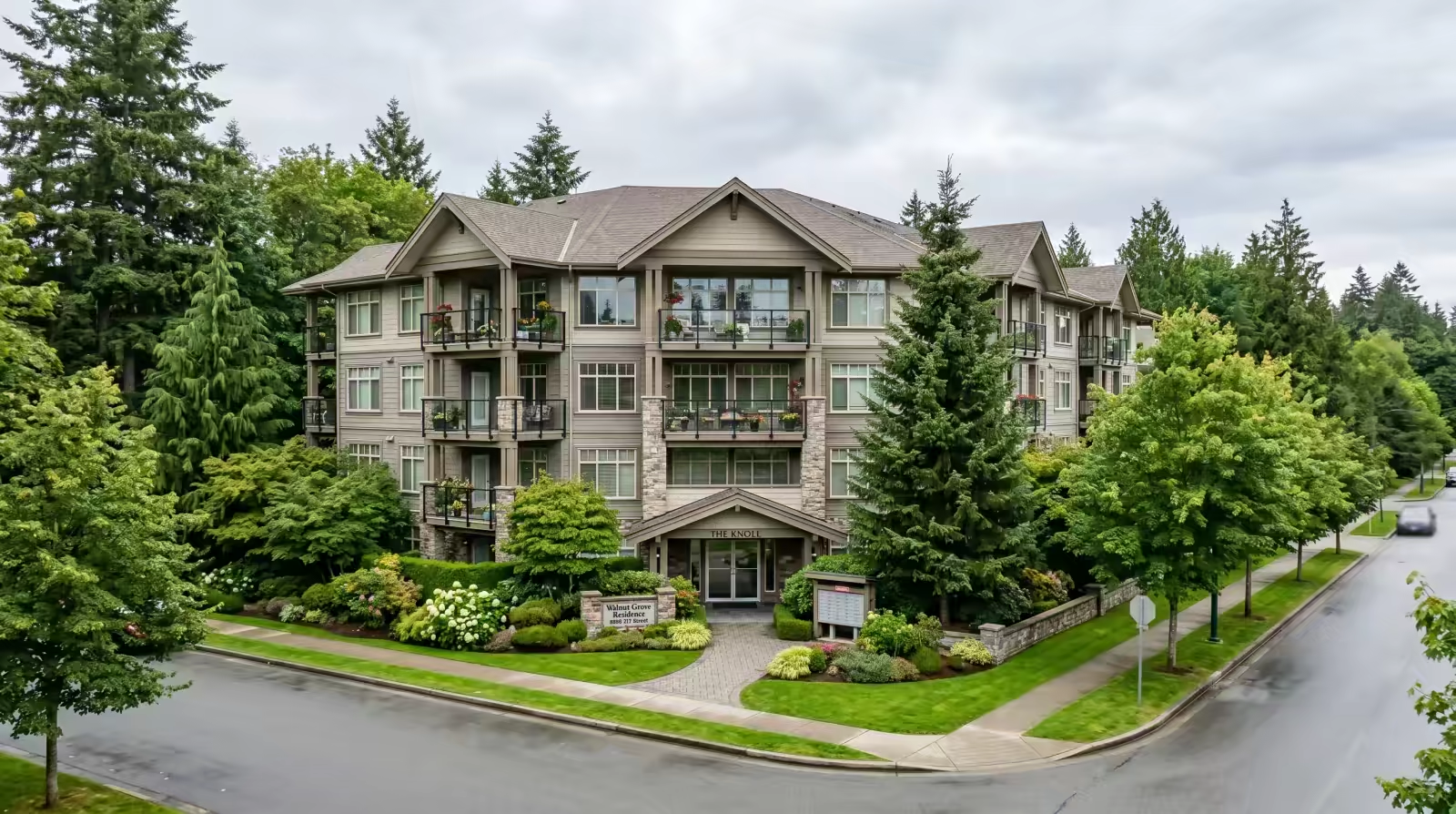

Most Langley conversations the FRIVE team has right now are about Willoughby and its townhouse boom. Walnut Grove gets less airtime, and for a certain first-time buyer that's exactly why it's worth a look. Walnut Grove is north Langley's established neighbourhood, mature trees, settled streets, schools and parks already built, and it offers something the new-construction areas can't: a neighbourhood that has already finished growing up.
This is a first-time buyer's guide to Walnut Grove in 2026, the feel, the housing mix, the commute direction, and who it suits.
Where Walnut Grove sits
Walnut Grove is in the northern part of the Township of Langley, close to Highway 1 and the 200 Street interchange, north of Willoughby and the Langley town centre. It developed earlier than the southern townhouse districts, which is why it reads as established rather than emerging, mature trees, settled streets, schools and parks already built. Its commute strength is quick highway access onto Highway 1 via the 200 Street interchange, which suits car commuters heading north toward the Port Mann Bridge or west toward Surrey and Vancouver. What it doesn't have is a SkyTrain station: the Surrey-Langley extension runs along the Fraser Highway corridor to the south, toward the Langley town centre, not through Walnut Grove (Government of British Columbia). For a car commuter that's a good fit; for a transit-dependent one, it means connecting to a station elsewhere.
Walnut Grove versus Willoughby: the real trade
Most Langley first-time buyer decisions come down to this comparison: Walnut Grove is older, more established, and sits on the Highway 1 corridor to the north, while Willoughby is newer, denser, townhouse-heavy, and positioned on the Fraser Highway corridor close to the coming SkyTrain extension. Walnut Grove gives you a finished neighbourhood, schools running, parks filled in, trees tall, and strong car access to the west. Willoughby gives you newer construction, lower strata age risk, and transit proximity. Neither is better in the abstract; the right answer depends on whether you commute by car or transit, how much you value a settled feel, and what your budget unlocks.
Willoughby is the fast-growing, townhouse-heavy area to the south, denser, newer, and closer to the coming transit corridor. It's where much of Langley's new construction and pre-sale activity is concentrated. Our Willoughby guide covers it in full.
Walnut Grove is the opposite end of that spectrum: older, more established, with mature landscaping and a settled, lower-turnover feel. The trade is straightforward. Willoughby gives you the newest finishes and transit proximity. Walnut Grove gives you a neighbourhood whose schools, parks, and amenities are already built and proven, and whose trees are tall rather than freshly planted.
Neither is better in the abstract. A buyer who wants the latest layout and is betting on the transit corridor leans Willoughby. A buyer who wants to feel settled now, in a finished neighbourhood, and commutes north by car, leans Walnut Grove. Be honest about which one you actually are.
The housing mix
Walnut Grove has a mix of established single-family homes, townhouses, and some condos, most of it built as the neighbourhood developed in earlier decades. You'll find more mature properties and established strata complexes here than brand-new builds, which suits buyers who'd rather walk into a finished home than wait on a pre-sale. The trade-off is that older strata buildings require more document due diligence: the depreciation report and reserve fund tell you whether the complex has done its major maintenance work already or still has it ahead. A well-maintained older complex is a reasonable place to buy; you just need to do the reading before you remove subjects.
For first-time buyers, the condo-versus-townhouse decision works the same way it does across the valley. Our guide to choosing between the two covers the fees, the maintenance, and the lifestyle fit.
One point matters more in an established neighbourhood: with older strata complexes, the depreciation report and contingency reserve fund deserve close attention, because the building has more history and more aging components. Our checklist for reviewing strata documents and our piece on reading a depreciation report walk through what to look for. An established complex isn't a problem, it just means doing the reading.
Schools, parks, and the community centre
For buyers with kids, or planning to have them, a built-out neighbourhood like Walnut Grove offers something a new-development area genuinely cannot match yet: you can see the schools, walk to the parks, and form a real opinion of the community before you buy.
Walnut Grove Secondary School serves students in the area at the secondary level. The elementary catchment picture is worth verifying directly with School District 35 (Langley) before you go firm on an offer, because catchment boundaries shift and what a listing says and what the district confirms are not always the same thing. We have seen buyers assume a school based on a postal code and then find out the actual catchment runs differently. Our school catchments guide for Fraser Valley buyers explains how to check and why to verify rather than assume.
Beyond schools, the Walnut Grove Community Centre is a genuine asset, recreation programming, fitness facilities, and community events built into the neighbourhood rather than promised in a sales rendering. That kind of established infrastructure is part of what you're paying for in a mature area, and it's worth treating as a real line item in your decision.
For families weighing Walnut Grove against a newer area that still has minimal park and school infrastructure, this is often the deciding factor. We have worked with buyers who preferred a smaller place in Walnut Grove specifically because the kids could walk to their school from day one, rather than being on a bus to a distant school while their new neighbourhood catches up.
The commute test: do it for real
The most common mistake we see Walnut Grove buyers make is calculating the commute on a map app on a Saturday afternoon and calling it done. That tells you the distance. It doesn't tell you the commute.
Walnut Grove's access to Highway 1 via the 200 Street interchange is genuinely good, one of the cleaner on-ramps in north Langley when traffic is light. The problem is the Port Mann Bridge in the morning. The bridge carries a very large volume of commuter traffic westbound toward Surrey and Vancouver, and the backup can start well before the interchange on heavy mornings. The distance from Walnut Grove to, say, a workplace in Burnaby looks fine on paper. At 8:00 a.m. on a weekday in autumn, it can be a different experience entirely.
Our standard guidance: drive it on a Tuesday or Wednesday morning at whatever time you'd actually be leaving. Not Friday, not the week before a long weekend. A real representative morning. Do the same on the way home. What you learn in that forty minutes is worth more than any mapping app's average estimate.
If you work somewhere you can reach without crossing the bridge, Walnut Grove's highway access genuinely works in your favour. Quick north onto Highway 1, good interchange geometry, and you're moving. The neighbourhood's location makes more sense for some commute patterns than others, and knowing yours early avoids a very expensive piece of buyer's remorse later.
For buyers who rely on transit rather than a car, the situation is different. There is no SkyTrain station in Walnut Grove itself. The Surrey-Langley SkyTrain extension runs along the Fraser Highway corridor to the south, and transit-dependent commuters would need to connect to that line from elsewhere. The Carvolth Exchange, a bus exchange on the north side of Highway 1, is the transfer point for Fraser Valley Express and other regional bus services that connect west toward the SkyTrain network and into Vancouver. It is worth mapping your specific transit route from Walnut Grove to Carvolth and then to wherever you're going. Some routes work reasonably well; others involve a lot of transfer time. Don't assume, check the actual schedule. Our full piece on commuting from the Fraser Valley to Vancouver covers this in detail, including the transit versus driving trade-off for different origin and destination combinations.
Strata fees and what older complexes cost to maintain
This is one of the most underweighted parts of the Walnut Grove decision for first-time buyers, and it's worth time on its own.
Strata complexes built in the 1990s and early 2000s, which describes a meaningful share of the townhouse and condo inventory in Walnut Grove, tend to carry higher monthly strata fees than brand-new developments, all else being equal. The reason is simple: more of the building's original systems (roof, plumbing, envelope, elevators in high-rises, decks in townhouses) have aged, been repaired, or are approaching the end of their service life. A newer complex is still running on fresh infrastructure. An older one may have already completed expensive work and recovered it through a special levy, or it may have the work still ahead.
Neither is automatically a problem, but the numbers matter. A strata fee that looks manageable in isolation can look different when you account for what it's actually covering versus what a newer building charges. In our experience, buyers sometimes compare the list price of a Walnut Grove unit against a Willoughby unit without comparing the monthly strata costs, which is an incomplete picture of the real carrying cost.
The document that tells you where an older complex actually stands is the depreciation report, sometimes called a reserve fund study. It projects when major components will need replacement and whether the contingency reserve fund has enough in it to cover those costs without triggering a special levy. A healthy reserve fund in an older building is a green flag. A thin one, combined with aging components, is a warning. Our post on reading a depreciation report as a BC condo buyer walks through what to look for and what the numbers actually mean.
One specific question worth asking for any Walnut Grove strata complex you're seriously considering: when was the building envelope (the exterior walls and roof assembly) last inspected or repaired, and does the current contingency fund reflect that? Leaky condo syndrome affected a significant number of wood-frame buildings across BC built in a certain window, and while most of the worst cases were remediated years ago, the history of a specific building still matters. Your lawyer should review the strata documents, minutes, financials, and the depreciation report, before you remove subjects. That review is not optional, and "the seller says it's fine" is not a substitute.
A well-maintained older complex with a healthy reserve fund and a clear depreciation report is a reasonable place to buy. You just need to read the documents and know what you're getting into. That's true anywhere, but it's especially true in a neighbourhood where much of the inventory was built two or three decades ago.
Who Walnut Grove is right for
Walnut Grove suits first-time buyers who want an established, family-oriented neighbourhood with built-out schools and parks already in place, and who commute north or west by car and value quick highway access over SkyTrain proximity. It tends to suit buyers who'd rather move into a finished, settled neighbourhood, one where the infrastructure is real, not a rendering, than buy into a still-developing area with newer finishes but thinner community roots. In our experience, the buyers who choose Walnut Grove over Willoughby are often families planning to stay put for a decade, not buyers optimising for short-term appreciation on a transit corridor. Families planning to put down roots tend to appreciate the settled, low-turnover character, and the fact that the parks, the community centre, and the schools are real, not renderings.
It tends to disappoint buyers set on the newest possible construction or counting on a SkyTrain station nearby, since the line runs to the south. And it requires more due diligence on strata documents than a new build does, because the buildings have history worth understanding.
The newest complex isn't automatically the right one. For some buyers, a neighbourhood that has already grown up, with the trees, the schools, and the community to show for it, is the better first home. Walnut Grove is one of those neighbourhoods.
If you're weighing Walnut Grove against Willoughby or the rest of Langley, see our Langley neighbourhoods guide for a full comparison of what each area offers, or go straight to the Walnut Grove neighbourhood page for current listings and local market data. You can also reach out to the FRIVE team, we'll help you figure out which neighbourhood actually fits you, or browse current Langley listings to see what's available today.
Frequently asked questions
Where is Walnut Grove in Langley?
- Walnut Grove is a neighbourhood in the northern part of the Township of Langley, close to Highway 1 and the 200 Street interchange, north of Willoughby and the Langley town centre. It's one of Langley's more established residential areas, known for mature trees, family housing, and a settled suburban character.
Is Walnut Grove a good neighbourhood for first-time buyers?
- It can be, especially for buyers who want an established, family-oriented neighbourhood with built-out schools, parks, and amenities rather than a new-construction area. It tends to suit buyers commuting north via Highway 1 and those who value a finished neighbourhood feel over the newest finishes. The housing mix and prices vary.
Sources
- Surrey-Langley SkyTrain, Province of British Columbia, Government of British Columbia
- Monthly Market Report, Fraser Valley Real Estate Board
Related guides
- Neighbourhood GuidesBuying Near a Rail Line in the Fraser Valley: Noise, Setbacks, and Resale
- Neighbourhood GuidesSardis, Chilliwack: A First-Time Buyer's Guide to the Valley's Busiest Small-City Centre
- Neighbourhood GuidesWilloughby vs. Walnut Grove: Two Langley Neighbourhoods, Two Very Different First Homes
- Taxes & ProgramsBC Home Flipping Tax: What First-Time Buyers Need to Know Before They Close
Found this useful? Share it.
A neighbour, a partner, a friend who's two FHSA contributions away, send it their way.