
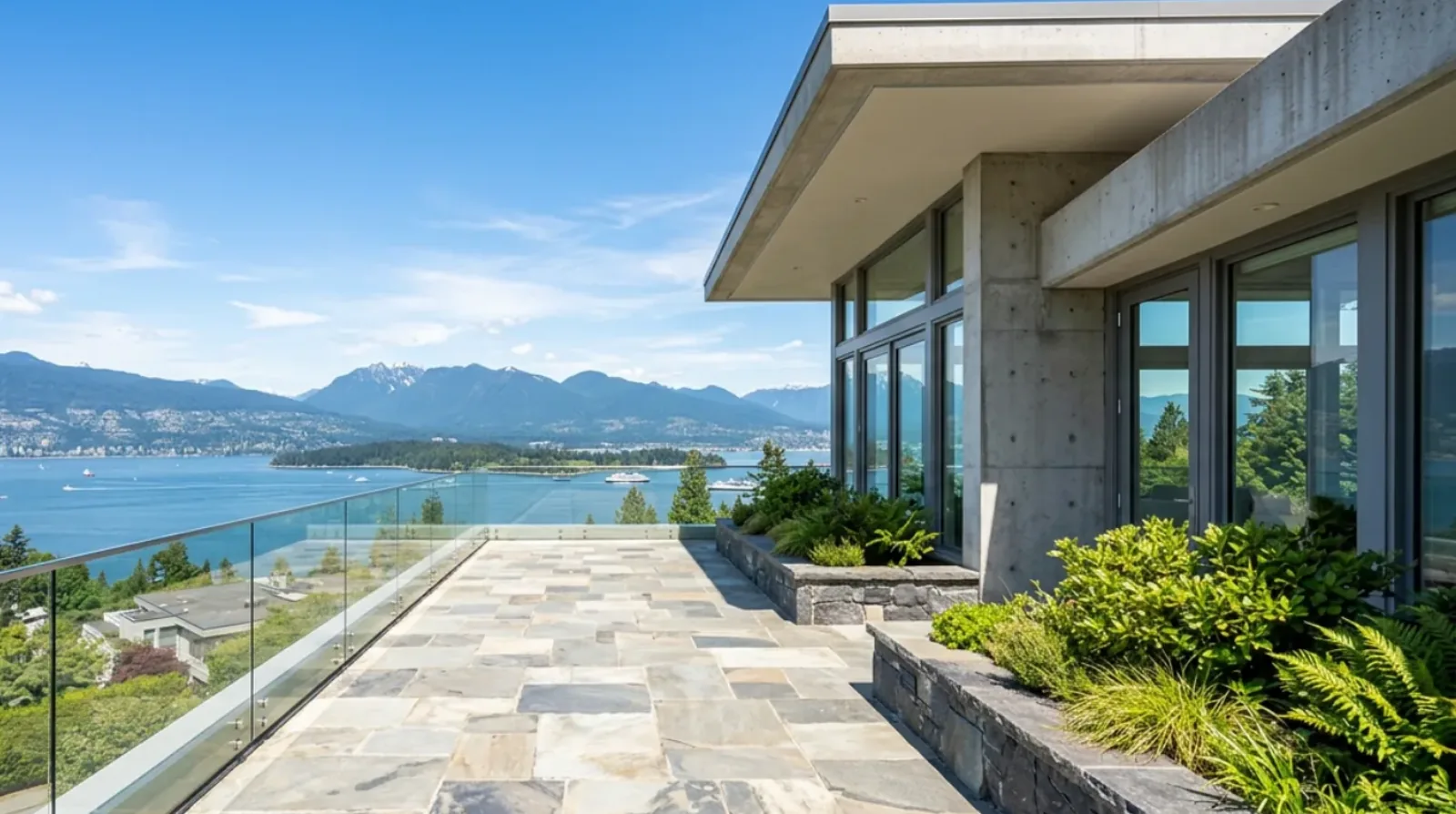
A West Vancouver house worth over $3,000,000 comes with its own tax rules. The big questions are the tax on your gain, the order in which you sell and buy, and what your buyer must pay. The benchmark price of a West Vancouver house was $2,822,900 in September 2026, by the figures of Greater Vancouver REALTORS®.
Will you pay tax on the gain?
A capital gain is the profit on a sale: the price you sell for, less what you paid and the cost of major improvements. The principal residence exemption can remove the tax on that gain for the years the house was your home. The Canada Revenue Agency asks you to report the sale on Schedule 3 of your tax return for the year you sell, even when no tax is owed.
Two things can leave part of the gain taxed. One is a year when the house was not your home, for example a year you rented it out and lived somewhere else. The other is land, below.
The half-hectare land rule
The Canada Revenue Agency says the land under and around your house is part of your principal residence up to one-half hectare, which is 5,000 square metres or 53,820 square feet. Land above that is not covered unless you can show it was needed to use the home, for example to reach a public road. By the CRA's own example, land kept for a hobby, for pets or for country living generally does not count.
A town rule can help. If a bylaw set a minimum lot size above half a hectare, or stopped you from dividing the lot, the CRA says the extra land normally counts as part of the home for those years. If your lot may be above half a hectare, ask your accountant before you list.
Sell first or buy first?
West Vancouver is in the area of BC's speculation and vacancy tax, a yearly tax based on how owners use their homes. It looks at who owns the home on December 31. An owner of two homes can claim the principal residence exemption only on the one they lived in longest that year.
So if you buy a condo, move in, and the house is still yours on December 31, the house can owe the tax when you lived longer in the condo that year. For 2026 the rate is 1% of the assessed value for a Canadian citizen or permanent resident who is not an untaxed worldwide earner. On a house assessed at $4,000,000, that is $40,000. The rate for foreign owners is 3% for 2026 and 4% from 2027.
Some exemptions help older owners. An owner who moves into a residential care home can be exempt for up to two years on the home they left. A home you just bought and paid transfer tax on is exempt in the year you buy it. Every owner must declare by March 31 each year, even when no tax is owed. In our view, the simplest plan is to sell first, or to set the closing dates so that you do not own both homes on December 31.
What it costs to hold the house while it is for sale
On top of regular property tax, a house assessed above $3,000,000 pays the Province's additional school tax every year. It is charged only on the value above $3,000,000: 0.2% up to $4,000,000 and 0.4% above that in 2026. From January 1, 2027 the rates rise to 0.3% and 0.6%.
| On a house assessed at $4,000,000 | Amount |
|---|---|
| Empty home tax for 2026, if it applies | $40,000 |
| Additional school tax, 2026 rates | $2,000 a year |
| Additional school tax, 2027 rates | $3,000 a year |
| Home owner grant | $0 |
Province of BC rates read on November 20, 2026. The empty home tax line uses the 1% rate for a Canadian citizen or permanent resident. Regular property tax is extra. Your own figures come from your assessment and tax notices.
A house at this price gets no home owner grant. A condo assessed at $2,075,000 or less gets the full grant again, up to $845 for an owner aged 65 or older. Our luxury condo page shows the grant at prices from $2 million.
What your buyer pays
Your buyer pays BC property transfer tax. Above $3 million it includes a further 2% on the value above that line, so on a $4,000,000 house the tax is $118,000. A buyer needs that cash on top of the down payment, which can change what they offer.
A foreign national or foreign company that buys a home in the Metro Vancouver Regional District pays another 20% of the price. A federal law has stopped most people who are not Canadian citizens or permanent residents from buying a home since January 1, 2023. The federal budget of November 16, 2026 proposes to keep that ban on existing homes until January 1, 2029. So most buyers will be Canadian citizens or permanent residents.
Which steps come first?
- Find your lot size and the years the house was your home. Take both to your accountant.
- Ask us for a price range based on recent sales of similar houses.
- Decide whether to sell first or buy first, with the December 31 rule above in mind.
- Look at condos: see luxury condos for sale or all West Vancouver condos.
- List the house. Buy after your own sale is firm, or set both closing dates together.
To see what else is for sale at this price, open West Vancouver luxury homes for sale. Our West Vancouver downsizing guide covers the move to a smaller home at any price.
Questions about selling a West Vancouver house over $3 million
- Do I pay tax on the gain when I sell my West Vancouver house?
- If the house was your principal residence, the home you lived in, for every year you owned it, the principal residence exemption can remove the tax on the gain. You still report the sale on your tax return for that year. Land above half a hectare can be taxed, and a year when the house was not your home can be taxed. Ask your accountant before you sell.
- What is the half-hectare rule for a principal residence?
- The Canada Revenue Agency says land above one-half hectare, 5,000 square metres or 53,820 square feet, is not part of your principal residence unless you show it was needed to use the home. The gain on that extra land can be taxed. A law that stopped you from dividing the lot can count.
- Will I pay the speculation and vacancy tax if I buy a condo before my house sells?
- It can. An owner of two homes can claim the principal residence exemption only on the one they lived in longest that year. If you still own the house on December 31 and lived longer in the condo, the house can owe the tax: 1% of its assessed value for 2026 for a Canadian citizen or permanent resident. Every owner must declare by March 31.
- How much is the additional school tax on a $4 million house?
- $2,000 a year at the 2026 rates and $3,000 at the rates that start on January 1, 2027. It is charged on the assessed value above $3,000,000.
- What does the buyer of my house pay in transfer tax?
- On a $4,000,000 house, $118,000 by BC's rates. A foreign national or foreign company also pays the 20% additional property transfer tax.
- Can I sell to a buyer from outside Canada?
- A federal law has stopped most non-Canadians from buying a home since January 1, 2023, with exceptions. The federal budget of November 16, 2026 proposes to keep it on existing homes until January 1, 2029. Ask your lawyer about a buyer from outside Canada before you accept the offer.
Sources
- Canada Revenue Agency, Income Tax Folio S1-F3-C2, Principal Residence (paragraphs 2.33 to 2.35). canada.ca
- Canada Revenue Agency, Reporting the sale of your principal residence. canada.ca
- Province of BC, Speculation and vacancy tax: exemptions for individuals. gov.bc.ca
- Province of BC, Speculation and vacancy tax: tax rates. gov.bc.ca
- Province of BC, Speculation and vacancy tax: taxable areas. gov.bc.ca
- Province of BC, Speculation and vacancy tax. gov.bc.ca
- Province of BC, Additional school tax rate. gov.bc.ca
- Province of BC, Property transfer tax. gov.bc.ca
- Province of BC, Additional property transfer tax. gov.bc.ca
- Province of BC, Home owner grant. gov.bc.ca
- Department of Finance Canada, Budget 2026 news release, November 16, 2026. canada.ca
- Greater Vancouver REALTORS®, September 2026 statistics package. members.gvrealtors.ca
Sources read on November 20, 2026. Prices and program rules change. This page is general information. Talk to your lawyer, accountant and mortgage broker about your own sale.