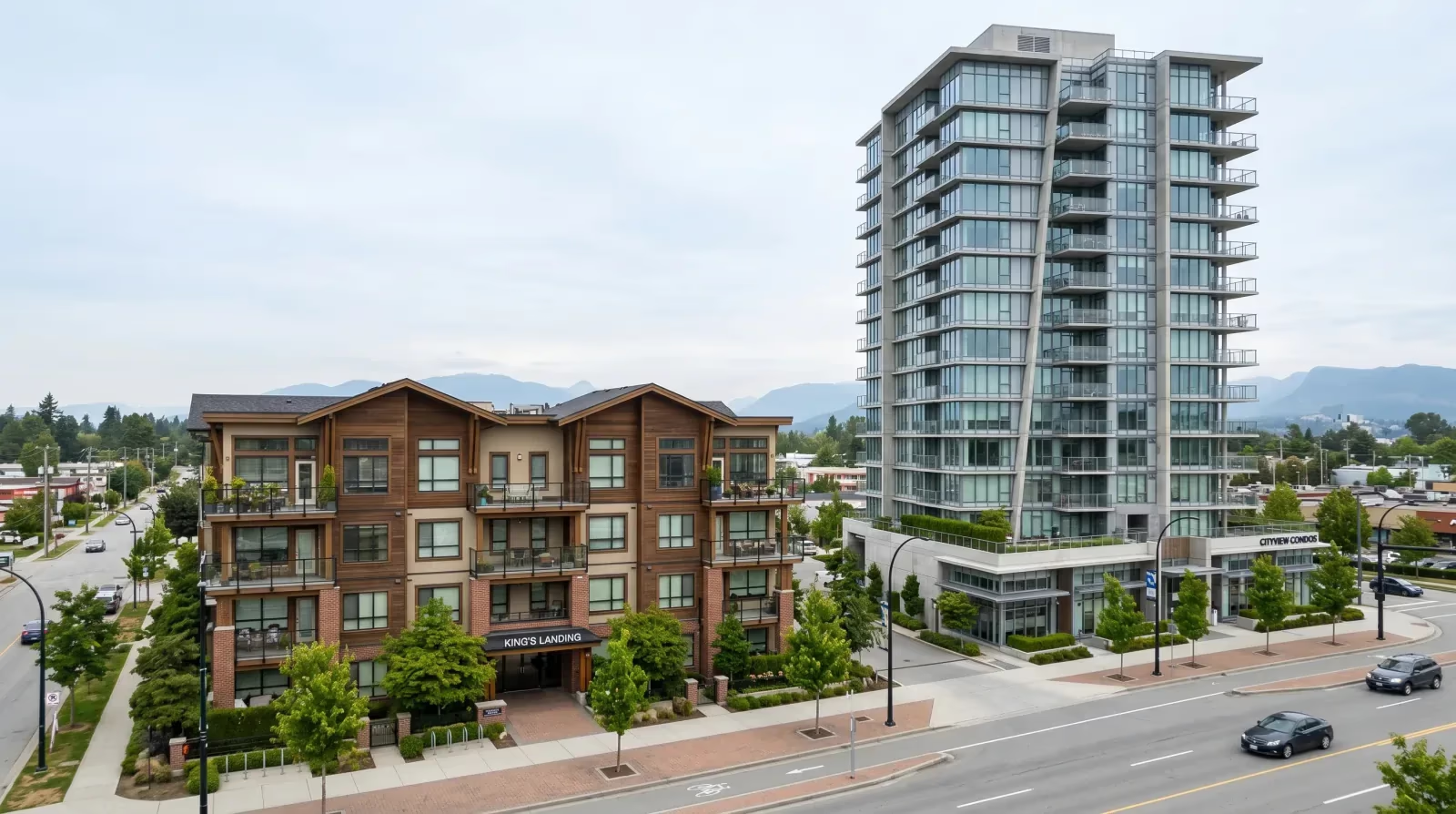

"Is it wood-frame or concrete?" It's one of the first questions an experienced condo buyer asks, and one the FRIVE team adds when first-timers forget to. In the Fraser Valley the answer is usually wood-frame, the low-rise buildings across Surrey, Langley, and Abbotsford are overwhelmingly wood-frame, while the concrete towers cluster near the SkyTrain corridor and the denser cores. The construction type quietly shapes things you'll live with every day: how much you hear your neighbours, what the fees and insurance look like, and what you pay per square foot.
This is a plain-English guide to what construction type means for a first-time buyer choosing a condo.
The two kinds, and what they look like here
A wood-frame condo is built primarily with a wood structure. It's the standard method for low-rise buildings, typically up to around four to six storeys, and it's what the great majority of Fraser Valley condos are. A concrete condo has a reinforced concrete structure, the method used for high-rise towers. Out here, concrete is the exception, concentrated where density is highest, near transit hubs and in the more urban cores.
So in practice, a first-time buyer searching for a condo in most of the Fraser Valley is mostly looking at wood-frame buildings, with concrete towers appearing as a pricier, less common option in specific locations. That's the opposite of a downtown Vancouver search, where concrete dominates, and it's part of why valley condos tend to be more attainable.
Sound: the difference you feel daily
The most noticeable practical difference is sound. Concrete generally offers better separation between units, because the denser material transmits less noise. If hearing your neighbour's footsteps, music, or conversation is something you're sensitive to, concrete has a real edge.
That said, it's not absolute. Soundproofing also depends on the specific building's design, its insulation, floor assemblies, and construction quality. A well-built modern wood-frame building can be genuinely quiet, and a poorly designed concrete one less impressive than you'd expect. The rule of thumb favours concrete on sound, but the individual building matters, so visit at different times and, if you can, ask current residents about noise.
Price: where wood-frame wins
Wood-frame is generally cheaper to build, and that flows through to price, wood-frame condos usually cost less per square foot than concrete towers in the same area. In the Fraser Valley, where most stock is wood-frame, this is a big part of what keeps condos relatively attainable for first-time buyers. If your priority is the lowest realistic entry price, the wood-frame low-rise is usually where you'll land, and there's far more of it to choose from out here.
Concrete's premium buys the sound separation, the tower feel, and often a more central, transit-adjacent location. Whether that's worth it is a personal call against your budget.
Fees and amenities: read the building, not the material
It's tempting to assume concrete means higher strata fees, but the construction itself isn't the main driver. The bigger factor is what the building includes. Concrete buildings are often taller towers with elevators, parkades, and sometimes pools or gyms, and all of that costs money to run, which lifts the fees. A simple low-rise wood-frame building with minimal amenities often has lower fees precisely because there's less to maintain.
So compare fees based on what's actually being maintained, not on the material. Our guide to strata fees explains how to read them, and the lesson applies here: a higher fee on an amenity-rich, well-funded building can be better value than a low fee that's underfunding the reserve. Whatever the construction type, read the depreciation report and the contingency reserve fund before you buy.
The leaky condo era and why wood-frame vintage matters
There's a version of this question that gets short-circuited before it starts. A buyer hears "wood-frame" and immediately thinks of the 1990s leaky condo crisis in BC, the widespread building envelope failures that created enormous financial hardship for thousands of owners. That was a real and serious problem, and wood-frame buildings were disproportionately affected.
But not all wood-frame is the same. The 1990s leaky condo problem was driven by specific construction methods, inadequate flashing, moisture-trapping cladding, poor drainage design, that were common in buildings constructed from roughly the mid-1980s through the late 1990s. After the crisis, BC's building code and construction practices changed significantly. Post-2000 wood-frame construction uses different techniques and has a substantially better track record.
A 2023 wood-frame building and a 1993 wood-frame building are not comparable products. The construction type is the same; the risk profile is not. We've worked with buyers who ruled out all wood-frame buildings based on stories their parents told about 1990s condos, and in doing so eliminated the majority of attainable Fraser Valley inventory for no real reason. The right question isn't "is it wood-frame?", it's "when was it built, and what does the depreciation report say about the envelope?" Our guide to strata depreciation reports walks through how to read that document and what the envelope-related items tell you.
If you're looking at any building from the 1990s, wood-frame or otherwise, that's when you pay close attention to the building envelope history. Pre-2000 wood-frame deserves scrutiny. Post-2005 wood-frame generally does not carry the same set of concerns.
Wood-frame is the Fraser Valley norm, not a compromise
This is worth stating plainly, because some buyers come to the valley with a concrete-first mindset from reading about Vancouver markets. Most Fraser Valley first-time buyers will end up in a four-to-six storey wood-frame building. That's not a consolation prize, it's the market here, and it's why prices are more accessible than in the concrete-tower markets closer to the city.
Concrete towers in the Fraser Valley are concentrated in specific areas: along the King George Boulevard corridor in Surrey, parts of Langley City near transit, and a few denser pockets in Abbotsford. If you're searching for a two-bedroom under a price point that works for a first-time buyer, your realistic options are almost always wood-frame buildings spread across a wider geography. The choice you're actually making most of the time is not "wood-frame or concrete", it's "which wood-frame building in which neighbourhood."
Framing it that way changes the question. Instead of asking whether wood-frame is acceptable, the question becomes which wood-frame buildings are well-maintained, well-funded, and in a location that works. That's a better use of your research time, and our depreciation report guide and strata fee explainer are the starting point for answering it.
Fire safety evolves with the building code
Another question that comes up, usually when a buyer has just had a conversation with a cautious parent or read something online, is whether wood-frame is less fire-safe than concrete. The honest answer is that the construction type isn't the whole story, and the year the building was constructed matters as much as the material.
BC's building code has tightened wood-frame fire safety requirements substantially over the decades. A building constructed in 2018 has fire-resistance ratings, sprinkler systems, and compartmentalization requirements that are meaningfully different from a building constructed in 1985 under the code of that era. When you ask "is it concrete?" because you're worried about fire safety, the more useful question is actually "when was it built, and what does its fire safety infrastructure look like?"
We've had buyers come in asking for concrete-only buildings because of fire safety concerns, and in a couple of those conversations it emerged that the specific incident they were thinking of involved a 1980s building, before modern sprinkler requirements were standard in BC wood-frame residential construction. A post-2010 wood-frame building with a full sprinkler system and proper fire separations is not the same risk as a 1985 building without those protections. Ask about the building's vintage and its life-safety systems rather than relying on material alone as a proxy for safety.
Safety, height, and insurance
A worry we sometimes hear from first-time buyers is whether wood-frame is "safe." It is. Wood-frame is a standard, code-compliant building method used across BC and Canada, and modern wood-frame buildings meet current building and fire codes. BC has also allowed taller wood and mass-timber buildings than it used to, with encapsulated mass-timber construction permitted to greater heights, though most Fraser Valley wood-frame condos remain in the traditional low-rise range. As with any building, what matters most is the quality of construction and how well it's been maintained, which is exactly what your document review is for.
Construction type is one of the factors insurers weigh, and it can influence the strata's building insurance and sometimes your own unit policy. But insurance also depends heavily on the building's claims history, location, and systems. When you assess a building, look at its insurance picture alongside the construction type rather than assuming the material alone tells the story. Our piece on water damage and strata insurance deductibles covers the insurance angle in more depth.
Who should choose which
In our experience, wood-frame suits first-time buyers focused on entry price and on having more options to choose from, which in the Fraser Valley is most buyers. Concrete suits buyers who prioritize sound separation and a tower lifestyle, usually near the transit corridor, and who can carry the premium. Neither is better in the abstract, they're different products at different price points.
The point isn't to rule one out. It's to know which you're looking at and what that means, so you can read a building clearly before you fall for the kitchen finishes. A buyer who understands the construction type asks better questions and buys with fewer surprises.
If you want help weighing a wood-frame low-rise against a concrete option in your budget, reach out to the FRIVE team, we'll talk through the trade-offs for your situation, or browse current Fraser Valley listings to compare.
Frequently asked questions
What's the difference between a wood-frame and concrete condo?
- A wood-frame condo has a structure built primarily of wood, typical of low-rise buildings (usually up to about four to six storeys). A concrete condo has a reinforced concrete structure, typical of high-rise towers. The difference affects sound transmission, building height, durability characteristics, insurance, and price. In the Fraser Valley, most condos are wood-frame.
Are concrete condos quieter than wood-frame?
- Generally, concrete tends to offer better sound separation between units than wood-frame, because the denser material transmits less noise. That said, soundproofing also depends on the specific building's design, insulation, and floor assemblies. A well-built wood-frame building can be quiet, and a poorly designed concrete one less so, but as a rule concrete has the edge on sound.
Sources
- Strata housing, Province of British Columbia, Government of British Columbia
- The contingency reserve fund (CRF) in strata corporations, Province of British Columbia
Related guides
- First-Time BuyersLeasehold vs Freehold in BC: The Ownership Difference That Changes Everything
- First-Time BuyersCondo or Half-Duplex? The First-Time Buyer Comparison Nobody Explains
- First-Time BuyersGifted Down Payments in BC: How the Gift Letter Works and What Lenders Need
- Financing & AffordabilityCMHC Premiums Explained: What Mortgage Default Insurance Actually Costs in BC
Found this useful? Share it.
A neighbour, a partner, a friend who's two FHSA contributions away, send it their way.