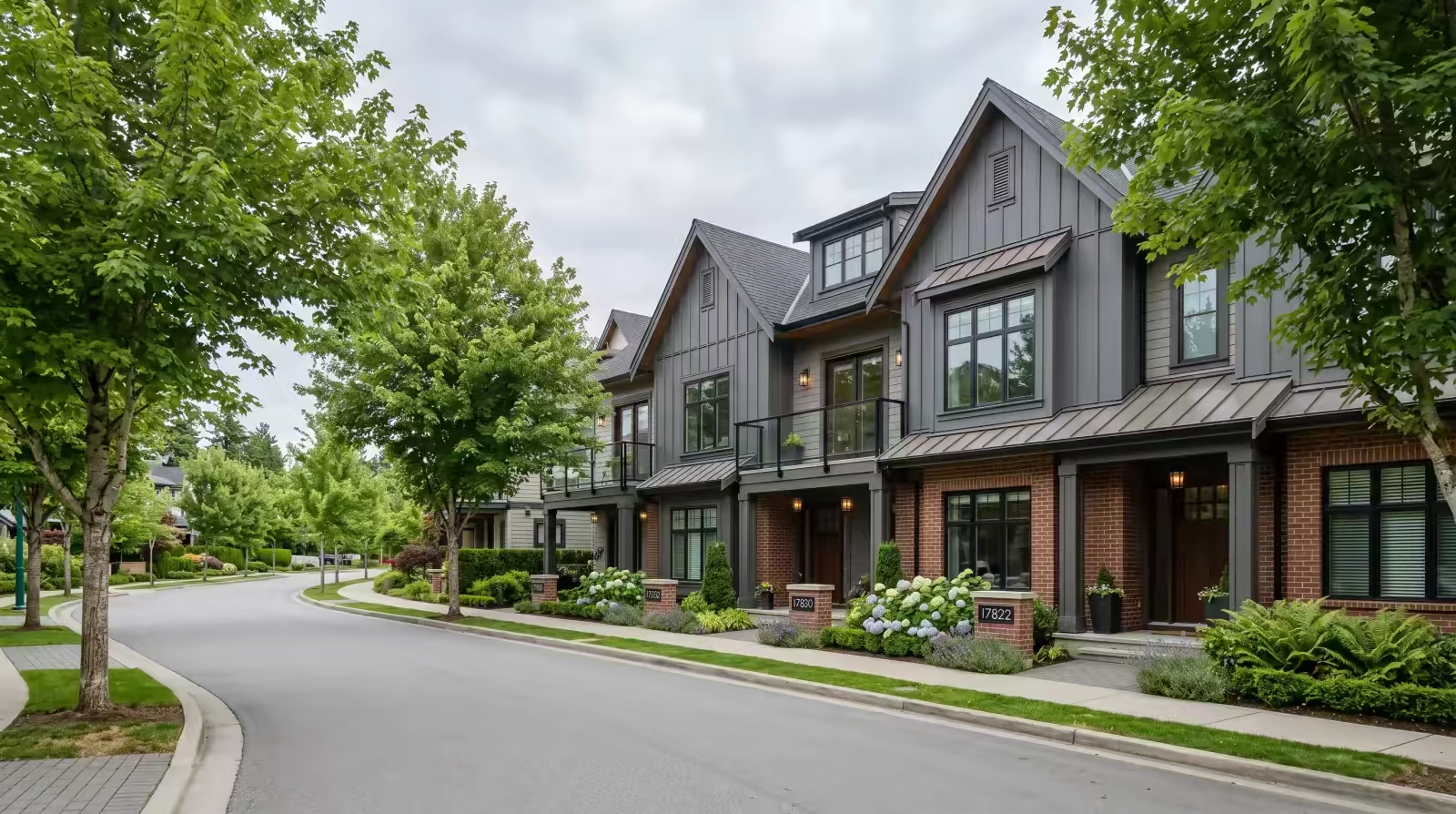

Cloverdale is the Surrey neighbourhood the FRIVE team gets asked about most often, and it's one that doesn't quite feel like Surrey. It has a heritage downtown, a famous rodeo, and streets with a small-town rhythm that's rare in a city growing as fast as Surrey is. For a first-time buyer, that distinctiveness is most of the appeal, and the thing to think hardest about, because Cloverdale's character comes with a different commute story than the SkyTrain-corridor neighbourhoods that get most of the attention.
This is a first-time buyer's guide to Cloverdale in 2026, the character, the housing mix, the commute, and who the neighbourhood actually suits.
Where Cloverdale sits and what makes it different
Cloverdale is in the eastern part of Surrey, between Newton and Langley, built around a preserved heritage town centre near 176 Street and Highway 10. It's home to the Cloverdale Rodeo and Country Fair, and the older core has a genuine main-street feel, something a lot of suburban neighbourhoods talk about and few actually have.
That town-centre character is why people fall for Cloverdale. It reads more like a town than a fast-growing pocket of a half-million-person city. For a first-time buyer who wants a neighbourhood with a heart, rather than a cluster of towers around a station, it's one of Surrey's more appealing options.
The transit question you have to answer first
Here's the catch, and it's worth getting straight before you tour anything: Cloverdale is not on the SkyTrain. The Expo Line doesn't reach it, and the Surrey-Langley SkyTrain extension runs to its south, along the Fraser Highway corridor, rather than through Cloverdale itself (Government of British Columbia).
That changes the calculation depending on who you are. If your work is local, in Langley, or you commute by car anyway, Cloverdale's lack of a station may not matter at all, and you get the character without paying the premium that station-adjacent neighbourhoods carry. If you're counting on rapid transit into Vancouver, you'll be driving or bussing to a station to the south or west, and that's a real daily cost. Our Surrey-Langley SkyTrain buyer's guide lays out which neighbourhoods actually benefit from the line, and Cloverdale proper is not one of the direct winners.
So answer the transit question honestly before the town centre charms you. The character is real; so is the commute.
Cloverdale versus Clayton
People often mention Cloverdale and Clayton in the same breath, but for a buyer they're different. Clayton, on Cloverdale's western and northern edge, is a fast-growing, townhouse-heavy area closer to the Fraser Highway corridor and denser with newer development. Cloverdale proper centres on the older heritage core with a more established feel.
If you want newer townhouse stock with better proximity to the transit corridor, Clayton may be the better target, our Clayton, Surrey guide covers it in detail. If you want the town-centre character and don't mind being a little further from transit, Cloverdale proper is the draw. They're adjacent, and many buyers end up looking at both.
The housing mix
Cloverdale is less condo-dominated than the SkyTrain-corridor parts of Surrey. You'll find heritage and established single-family homes near the town centre, newer townhouse developments in the growing areas around it, and some condos, but the balance tilts more toward townhouses and detached homes with yards.
For a first-time buyer, that mix can be a feature. If your goal is a townhouse with a bit of outdoor space rather than a one-bedroom condo, Cloverdale and its edges give you more to work with than the densest neighbourhoods. Our breakdown of how first-time buyers choose between a condo and a townhouse is a good starting point if you're still deciding.
As always with strata properties, do the homework. Read the depreciation report and the contingency reserve fund, and scan recent meeting minutes, our strata documents review checklist covers what matters. The town-centre charm doesn't change the fact that you're buying into a strata's finances.
What the community actually feels like day to day
The Cloverdale Rodeo and Country Fair, held every May, is a legitimate community event, one of the oldest in BC, and it's a useful way to understand the neighbourhood before you buy. A lot of the buyers we've worked with in Cloverdale discovered it that way. They came for the rodeo, walked the heritage main street, and came away with a feeling that's hard to manufacture in a fast-growth suburb. The charm came first. The transit map came second.
That order of discovery is fine, but we'd encourage you to keep both things in mind at the same time. The community feel is real. The rodeo draws a genuinely local crowd. There are parks, a farmers' market, and a walkable town centre in a way most of Surrey's newer areas just don't have yet. For buyers who want to put down roots somewhere that already has roots, Cloverdale often makes immediate emotional sense.
Where it catches people is when the day-to-day commute reality sinks in a few months after possession. The neighbourhood's character doesn't change. The drive to a SkyTrain station doesn't get shorter either. Make peace with that trade-off before you write an offer, not after.
Prices, affordability, and the BC PTT exemption
Cloverdale's townhouse prices tend to run lower than the SkyTrain-adjacent corridors in Surrey, because the transit premium is real and Cloverdale doesn't have it. That gap matters practically for first-time buyers, because BC's property transfer tax (PTT) first-time-buyer exemption has a price ceiling, and a more affordable townhouse is more likely to sit under it or near it.
The PTT first-time-buyer exemption removes the property transfer tax on the first $500,000 of the price for qualifying buyers on purchases up to a threshold (with a partial exemption for properties priced from $835,000 to $860,000). The thresholds have changed over the years and the exact current figures sit on the Government of BC's PTT page, always check there before relying on any number in an article, including this one. Our full breakdown of how the exemption works is at /journal/bc-property-transfer-tax-first-time-buyer-exemption.
What this means practically in Cloverdale: if a townhouse here is priced meaningfully below a comparable unit near a SkyTrain station, the gap can keep you under the ceiling and keep the $8,000 exemption. That's a real dollar difference at possession time, not just a lower sticker price. Confirm where the current exemption ceiling sits with the FVREB's latest release and with your lawyer before you firm up your offer, the ceiling matters and it has moved before.
In our experience, this is one of the genuinely underappreciated financial arguments for Cloverdale among first-time buyers. The transit-corridor premium is baked into prices whether you use rapid transit or not. Cloverdale's lower transit score comes with a lower price. If you commute by car or work in Langley, you're not giving up the transit, you just never had it. And you might be saving a meaningful amount at purchase as a result.
Strata due-diligence in Cloverdale: older core versus newer edge
Cloverdale's strata situation is not uniform, and the due-diligence work looks different depending on which part of the neighbourhood you're buying into.
Near the heritage town centre, you'll find older strata complexes. Some of these have been well-run for decades. Others have deferred maintenance, underfunded contingency reserve funds, or aging common-property items that are going to need replacement. For these properties, the depreciation report is your first read. A depreciation report (sometimes called a "depreciation study" on older documentation) is a third-party assessment of the strata's buildings and common property, what needs replacing, and whether the reserve fund has enough money to cover it. BC's strata legislation requires most stratas to have one, and if you're looking at an older complex near the heritage core, that report will tell you more about the real cost of ownership than the list price does.
The newer townhouse complexes on Cloverdale's growing edges, toward Clayton and the newer development areas, are a different situation, but not without their own questions. A young building with a young reserve fund may look healthy on paper simply because the fund hasn't had time to accumulate. Check the current balance against the depreciation report's projection schedule. If the fund is already off-track in year three, that matters. And if the contingency reserve fund disclosure statement shows a special levy in the minutes, a one-time assessment charged to all strata unit owners to cover an unexpected repair, ask what it was for and whether similar expenses are on the horizon.
One scenario we see: a buyer falls for a newer Cloverdale townhouse complex, skips the depreciation report review because the building is only six years old, and misses that the envelope has an issue flagged in the most recent depreciation study. A well-run strata will have started the reserve fund contribution to cover it. A less-well-run strata will not. The price looks right until the special levy lands.
Our strata documents review checklist walks through what to read and in what order. It applies equally to the older complexes near the heritage core and the newer townhouse rows at the edges. The forms are different; the questions you're trying to answer are the same.
Cloverdale for families: space, schools, and the question of catchment
Cloverdale is genuinely popular with families, and the reasons are fairly practical. The neighbourhood's housing mix, more townhouses and detached homes with yards than the transit-corridor density further west, gives families more room at a lower price point than some of the SkyTrain-adjacent areas. Yards, playgrounds, and parks are part of the fabric here in a way that a mid-rise condo district isn't.
Schools are part of the conversation too, and the honest answer is that school quality and catchment assignments change. School District 36 (Surrey) covers this area, and which school a specific address feeds into depends on the exact street, not the neighbourhood name. We've had buyers assume they were in a particular school's catchment based on being "in Cloverdale" and discover their townhouse fell into a different zone. Always check the current catchment for the specific address you're considering, our school catchments guide for Fraser Valley buyers explains how to do that and what to look for.
What we can say about Cloverdale generally: families who move here often cite the community feel as the thing they didn't fully expect to matter as much as it does. The human scale of the town centre, the parks, the sense that people are settled here rather than transient, these aren't easily measured but they show up in how long families stay. In our experience, Cloverdale is one of the Surrey neighbourhoods with lower buyer regret among the families we work with, as long as the commute worked out. That last part carries the same caveat it always does.
Who Cloverdale is right for
In our experience, Cloverdale suits first-time buyers who want a neighbourhood with a real centre and a settled, family feel, who work locally or in Langley or commute by car, and who would rather have a townhouse or starter home with a yard than be steps from a station. Families in particular tend to like the parks, schools, and the human scale of the place.
It tends to disappoint buyers who count on rapid transit into Vancouver and only afterward reckon with the fact that the line runs to the south, not through it.
Cloverdale is one of the few Surrey neighbourhoods where the character is genuinely the point. Just make sure the commute works for the life you actually live before you let the heritage downtown make the decision for you.
If you're weighing Cloverdale against Clayton or other Surrey neighbourhoods, see our Surrey neighbourhoods guide for a full side-by-side of the city's areas, or go straight to the Cloverdale neighbourhood page for current listings and local market data. You can also start a conversation with the FRIVE team, we'll help you balance the character against the commute, or browse current Surrey listings to see what's available now.
Frequently asked questions
Where is Cloverdale in Surrey?
- Cloverdale is a neighbourhood in the eastern part of Surrey, between Newton and Langley, centred on a heritage downtown around 176 Street and Highway 10. It's known for its preserved town centre, the Cloverdale Rodeo and Country Fair, and a mix of established and newer residential areas. It has a more small-town feel than much of Surrey.
Is Cloverdale on the SkyTrain line?
- No. Cloverdale is not on the Expo Line, and the Surrey-Langley SkyTrain extension runs to its south along Fraser Highway rather than through Cloverdale itself. Commuters relying on transit to Vancouver would drive or bus to a station. If rapid transit is central to your plan, this is the main thing to weigh about Cloverdale.
Sources
- Surrey-Langley SkyTrain, Province of British Columbia, Government of British Columbia
- Monthly Market Report, Fraser Valley Real Estate Board
Related guides
- Neighbourhood GuidesSardis, Chilliwack: A First-Time Buyer's Guide to the Valley's Busiest Small-City Centre
- Neighbourhood GuidesWilloughby vs. Walnut Grove: Two Langley Neighbourhoods, Two Very Different First Homes
- Neighbourhood GuidesPitt Meadows for First-Time Buyers: The Smallest City on the West Coast Express Line
- First-Time BuyersSchool Catchments in the Fraser Valley: What Families Need to Know Before They Buy
Found this useful? Share it.
A neighbour, a partner, a friend who's two FHSA contributions away, send it their way.