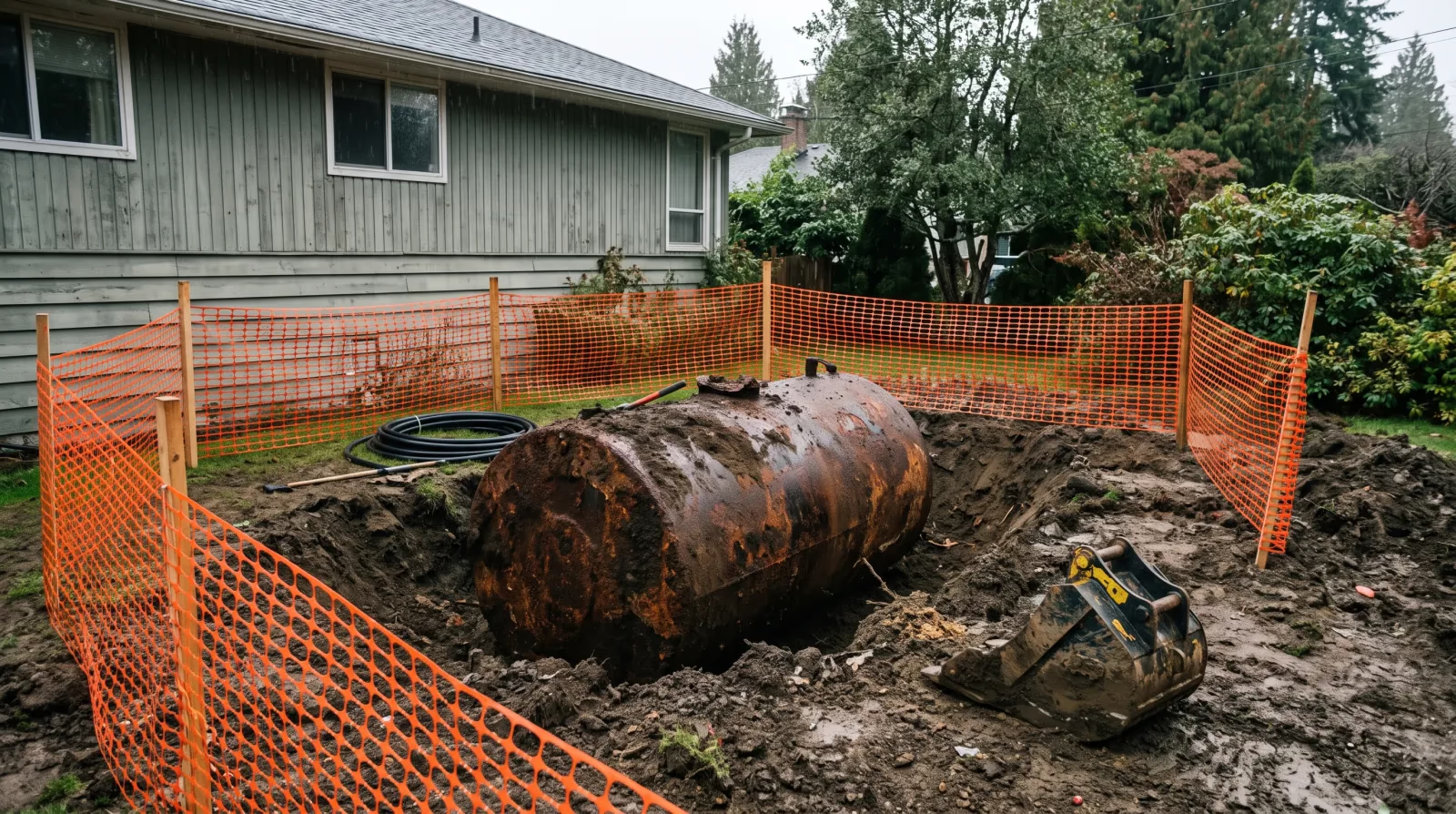

Plenty of homes built in the era when oil heated houses still have the tank in the ground. When owners converted to gas or electric heat, the common practice was to disconnect the tank and leave it buried. Decades later a buyer purchases the house with no idea it's there. That matters more in British Columbia than most buyers realize, because of how our contaminated-sites law assigns responsibility.
What is actually buried out there
An underground storage tank on a residential lot is usually a steel tank that once held heating oil. It sat in the side yard or under the driveway, connected by copper lines to a furnace in the basement, and filled through a pipe at the surface.
Steel buried in wet Fraser Valley soil corrodes. A tank that has been in the ground for fifty or sixty years can perforate, and whatever oil remained inside leaks into the surrounding soil. There is often nothing visible at the surface to indicate it. No stain, no smell, no dip in the lawn. The lawn looks like a lawn.
This is not a rare curiosity. It's a routine finding on older housing stock across the Lower Mainland and Fraser Valley, which is why an entire service industry exists to scan for these tanks and remove them.
The part of BC law that should get your attention
Here is why a buried tank is a buyer's problem and not just a seller's.
Under British Columbia's Environmental Management Act, a person who is responsible for remediation of a contaminated site is absolutely, retroactively, and jointly and severally liable for reasonably incurred costs of remediation, whether those costs are incurred on or off the contaminated site.
Those three terms do specific work, and they're worth understanding individually.
Absolute means liability attaches without anyone proving fault, negligence, or wrongdoing. You do not have to have done anything wrong.
Retroactive means a responsible person can be liable for contamination that occurred in the past, including long before they had any connection to the property.
Joint and several means that if other responsible parties cannot or will not pay their share, one responsible person can be pursued for the entire cost.
And the statutory definition of an owner reaches broadly: a person in possession, with the right of control, or who occupies or controls the use of land, including a person holding a legal or equitable interest in it. A current owner falls squarely inside that.
Put those together and the buyer's exposure is clear. You can buy a 1960s house, discover a corroded tank installed before you were born, and be a responsible person for the cleanup. The person who put it there may be long dead. The liability stayed with the land.
The Contaminated Sites Regulation sets out the numerical standards that determine whether a site meets the definition of contaminated. Whether a particular property crosses those thresholds is a question for a qualified environmental professional, not for an agent or an article.
Finding out before you own it
The reassuring counterweight to all of the above is that this is a findable problem. Unlike some risks in a home purchase, a buried tank can be detected before you commit.
Companies scan for tanks using ground-penetrating radar or magnetometer equipment. It's a short site visit, the cost is modest next to everything else in a purchase, and the report tells you whether there's metal buried where metal shouldn't be. On older homes we think it belongs on the due-diligence list next to the home inspection.
There are visual clues too, and they're worth knowing so you can spot them at a showing. Look for a filler pipe or a vent pipe sticking out of the ground or the exterior wall near the foundation. In the basement, look for capped copper lines running toward an exterior wall, or an old furnace footprint with abandoned supply lines. A home that was converted from oil heat has a history, and that history usually left marks.
Age of the home is your strongest single indicator. Newer townhouse and condo construction across Surrey, Langley, and Abbotsford was never heated by oil. Older detached housing stock is where this question belongs.
What to do if a scan finds a tank
A tank is not automatically a deal-breaker. It's a negotiation with a specific shape.
The standard resolution is that the seller removes the tank at their cost before completion, has the soil assessed, and provides documentation confirming the site is clean. If contaminated soil is found, it gets excavated and replaced with clean fill, and the documentation should reflect that too.
The important word is documentation. A verbal assurance that "the tank was taken out years ago" is worth very little when the liability framework is as broad as BC's. You want the removal report and the soil results in writing, and you want your lawyer or notary to review them before you remove subjects.
Get your agent to write the condition so the obligation is unambiguous: what gets removed, who pays, what testing is done, what standard the results have to meet, and what happens if contamination turns out to have migrated to a neighbouring property. That last scenario is the expensive one, because remediation obligations can extend off-site.
Our guide to subject removal covers how conditions work generally. This is a case where the wording genuinely matters and where a lawyer's input is worth paying for.
Insurance and financing get involved fast
Buyers tend to think of a buried tank as an environmental issue. It's also an insurance issue and, through insurance, a financing issue.
Some insurers decline to write a policy on a property with a known, unremoved tank. Others exclude contamination from coverage entirely. Since your lender requires property insurance as a condition of funding, an insurance refusal discovered a few days before completion becomes a financing failure very quickly.
Call your insurance broker as soon as a tank is suspected, not after subjects are removed. Ask directly whether they will insure the property as it stands, and what changes if the tank is removed with clean soil documentation. Our closing timeline guide lays out where insurance normally slots into the process, and this is a situation where you want to be ahead of that schedule rather than on it.
Where disclosure helps and where it doesn't
The Property Disclosure Statement asks about the seller's awareness of property conditions, and a seller cannot misrepresent something they know to be true.
But awareness is the limit of it. An owner who bought the house in 2005, thirty years after someone else converted it to gas heat, may genuinely have no idea a tank is sitting in the side yard. Their disclosure can be entirely honest and entirely uninformative on this point.
So read a clean PDS as what it is: a statement about what the seller knows. It's not a scan, and it's not a substitute for one. This is the same logic we apply to radon testing, where a seller who never tested has nothing to disclose either.
What we'd tell a buyer looking at older homes
If you're buying newer construction, this is not your problem and you can stop worrying about it. If you're looking at older detached housing anywhere in the Fraser Valley, add a tank scan to your due diligence and treat it as routine rather than alarming.
The cost of scanning is small. The cost of discovering a leaking tank as an owner, with absolute and retroactive liability attaching to you, is not. That asymmetry is the whole argument, and it's a strong one.
None of this is legal or environmental advice, and we're not qualified to give either. Talk to a BC lawyer about the liability framework as it applies to your specific purchase, and to a qualified environmental professional about the condition of a specific site.
Key takeaways
- Older homes converted from oil heat may still have a steel tank buried in the yard, often with no visible sign.
- BC's Environmental Management Act makes a responsible person absolutely, retroactively, and jointly and severally liable for remediation costs, and current owners fall within the definition.
- A scan using ground-penetrating radar or magnetometer equipment can find a tank before you commit, for a modest cost.
- If a tank is found, make removal, soil testing, and written documentation a seller obligation before completion.
- Call your insurance broker early, because an uninsurable property becomes an unfinanceable one.
Frequently Asked Questions
What is an underground storage tank on a residential property?
It is a steel tank buried in the yard that once stored heating oil, common on homes built before oil heating was replaced by natural gas or electricity. Many were abandoned in place when the heating system was converted, left in the ground and forgotten by later owners.
Why is a buried oil tank a problem for a buyer?
Buried steel corrodes. A leaking tank releases oil into surrounding soil and potentially groundwater, often with no visible sign at the surface. Under BC law, the property owner can be responsible for the cost of investigating and cleaning that up.
Who is liable for oil contamination in BC?
Under the Environmental Management Act, a person responsible for remediation of a contaminated site is absolutely, retroactively, and jointly and severally liable for reasonably incurred remediation costs. The definition of a responsible person includes current owners, not only whoever caused the contamination.
What does absolute and retroactive liability mean?
Absolute means no fault or negligence needs to be proven for liability to attach. Retroactive means a responsible person can be liable for contamination that occurred before they were involved. Together they mean a new owner can inherit responsibility for a leak from decades ago.
How do I find out if a property has a buried oil tank?
Hire a company that scans for tanks using ground-penetrating radar or magnetometer equipment. It is a fast, relatively inexpensive site visit. Visual clues like a filler pipe, a vent pipe near the foundation, or capped copper lines in the basement can also point to one.
Which homes are most likely to have one?
Older homes built when oil heating was common, before conversion to gas or electric. In the Fraser Valley that generally means older housing stock rather than newer townhouse and condo construction. Age of the home is the strongest single indicator.
What happens if a tank is found before closing?
It becomes a negotiation. Buyers commonly ask the seller to remove the tank, confirm the soil is clean, and provide documentation before completion. Your agent and your lawyer or notary should structure the condition so the obligation is clear and verifiable.
How much does oil tank removal cost?
Removing a clean tank is a manageable expense. Costs rise substantially when soil is contaminated and must be excavated and replaced, and rise further if contamination has migrated onto a neighbouring property. Get a quote from a qualified environmental contractor for the specific site.
Does home insurance cover buried oil tank contamination?
Often not, and some insurers decline to write a policy at all on a property with a known unremoved tank. Ask your insurance broker before subject removal, because an insurance problem discovered late can also become a financing problem.
Is the seller required to disclose a buried tank?
A seller cannot misrepresent what they know, and the Property Disclosure Statement asks about the seller's awareness. But an owner who bought the house decades after the tank was abandoned may genuinely not know it exists. Do not treat a clean disclosure as proof there is no tank.
Does a standard home inspection look for buried tanks?
Generally not. A home inspection assesses visible and accessible components of the building. Detecting buried metal requires scanning equipment and a separate specialist. Ask your inspector what their scope covers, and arrange the scan separately if the home's age warrants it.
Sources
- Government of British Columbia - Environmental Management Act, SBC 2003, c. 53
- Government of British Columbia - Contaminated Sites Regulation, BC Reg 375/96
Data verified August 31, 2026. This is general information, not legal or environmental advice. Consult a BC lawyer and a qualified environmental professional about a specific property.
Related FRIVE guides
- Property Disclosure Statement explained, what a seller's disclosure does and does not establish
- Home inspection guide for BC first-time buyers, what a standard inspection covers
- Subject removal in BC, how to structure a condition that actually protects you
- Title insurance for BC buyers, what it covers and where its limits sit
- Radon testing for Fraser Valley buyers, another risk a seller's disclosure will not surface
Next Steps: Work with FRIVE
Older Fraser Valley homes offer things newer construction can't: bigger lots, established neighbourhoods, and often a lower price per square foot. They also come with a due-diligence list that a five-year-old townhouse doesn't have, and a buried tank is near the top of it.
If you're looking at older housing stock and want help building that list, get in touch with the FRIVE team, start a conversation or browse current Fraser Valley listings. We'll tell you which checks are worth paying for on the specific home you're considering.
Sources
- Environmental Management Act, SBC 2003, c. 53, Government of British Columbia
- Contaminated Sites Regulation, BC Reg 375/96, Government of British Columbia
Older homes and building condition
8 pieces that fit together. Read them in order, or jump to the one you need.
- Start hereThe Condition Problems That Change a Fraser Valley Offer
- GuideRadon Testing for Fraser Valley Home Buyers: What to Ask Before You Close
- Guide · you are hereBuried Oil Tanks: The BC Liability That Follows the Property, Not the Person
- GuidePoly-B Plumbing in BC Homes: What Buyers Should Do When They Find It
- GuideKitec Plumbing in BC Condos: How to Spot It Before You Buy
- GuideLeaky Condo Era Buildings: How to Read a Rainscreen Remediation
- GuideAsbestos in Older Fraser Valley Homes: What Buyers Should Know
- GuideKnob-and-Tube and Aluminum Wiring: When Insurance Says No
Related guides
- Home Inspection & Due DiligenceWells and Septic Systems: What Changes When You Buy Outside the Sewer Line
- Home Inspection & Due DiligenceRadon Testing for Fraser Valley Home Buyers: What to Ask Before You Close
- Home Inspection & Due DiligenceFormer Grow-Op Homes in BC: Why the Discount Is Bigger Than It Looks
- Hub - Closing the DealFrom Accepted Offer to Keys: How Closing Actually Works in BC
Found this useful? Share it.
A neighbour, a partner, a friend who's two FHSA contributions away, send it their way.