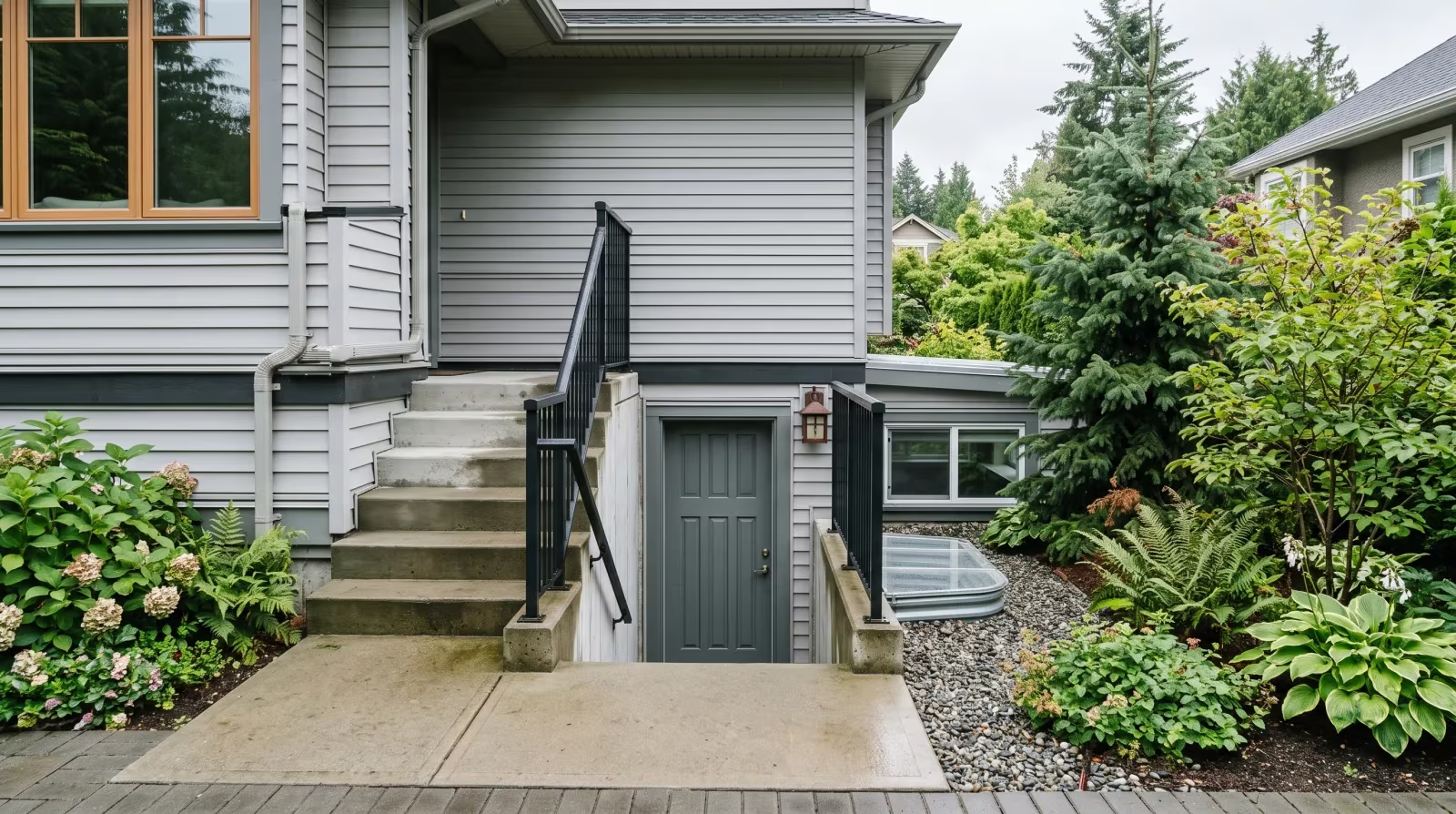

A parent can sell the family house and move in with a grown child, into a suite with its own door and its own kitchen. In other families the parent stays, and the child's family moves in. This guide explains the federal tax credit for building that suite, what makes a suite legal in BC, and the money and ownership questions a parent and child should settle in writing before any money is paid.
What is this way of downsizing?
Our downsizing guide covers selling a house and buying a smaller home. This page covers another route. The parent sells and moves into a self-contained suite in a child's home, and part of the sale money pays to build it. A self-contained suite is a living space with its own entrance, kitchen, bathroom and sleeping area.
If your family plans to buy one home to share, read our page on multi-generational home buying as well.
What does the federal multigenerational credit pay?
The Canada Revenue Agency (CRA) runs the Multigenerational Home Renovation Tax Credit. CRA calls it "a refundable tax credit". Refundable means you receive a refund if the credit is more than the tax you owe.
CRA's page showed the 2025 tax year when we read it on October 10, 2026. For that year the credit is 14.5% of your qualifying costs, and the costs are limited to $50,000. The most one renovation can pay is $50,000 × 14.5% = $7,250. Check the page for the rate in the year your renovation ends.
Who counts as the senior and the relative?
CRA's who can claim page calls the senior a "qualifying individual". That person is either "65 years of age or older at the end of the renovation period tax year", or "18 to 64 years of age and eligible for the disability tax credit".
The relative is a "qualifying relation". That is a person aged 18 or older who is a "parent, grandparent, child, grandchild, brother, sister, aunt, uncle, niece or nephew" of the senior, or of the senior's spouse or common-law partner.
The home must be in Canada, and the senior or the relative must own it. Both must live there, or be reasonably expected to, within 12 months after the renovation ends. Either one can live in the new unit.
CRA allows the claim once for each senior: "Only one renovation can be claimed for a qualifying individual during their lifetime."
What must the new unit have?
CRA says a secondary unit:
- "Is a self-contained housing unit with a private entrance, kitchen, bathroom and sleeping area"
- "Is newly constructed or created from an existing living space that did not already meet local requirements to be considered a secondary dwelling unit"
- "Meets applicable local requirements, permits, codes and by-laws"
The third line connects the credit to your city's building permit. In another CRA example, a son converts a sunroom into a bedroom and bathroom for his mother and adds no kitchen, and he cannot claim the credit. The unit may be a separate building on the same land.
Which costs count, and who claims them?
CRA's expenses page counts reasonable costs that come directly from the renovation, such as building materials, permits, and the work of electricians, plumbers and carpenters. It excludes household appliances, routine repairs, financing costs, the value of your own labour, and any cost with no receipt. Work by a relative counts only if that relative is registered for GST/HST, the federal goods and services tax.
On who claims, CRA's how to claim page says the claim belongs to the eligible person "who incurred the renovation expenses". Family members who share the cost can split the credit if each one is eligible. Each claims only their own costs, and the total stays within $50,000.
Decide who pays the contractor before the work starts, and ask your accountant first.
You claim in the tax year the renovation period ends, "even if the renovation took more than one year".
Which other credits can apply to the same work?
Two more credits cover changes that make a home safer for a senior, such as grab bars. The federal Home Accessibility Tax Credit covers up to $20,000 of eligible expenses a year for a person who is 65 or older, or who is eligible for the disability tax credit. BC's home renovation tax credit for seniors and persons with disabilities is 10% of up to $10,000 of expenses, a maximum of $1,000 for a tax year.
For the multigenerational credit, CRA says: "You cannot claim the same expense for more than one credit." An expense in that claim cannot also go into a home accessibility claim or a medical expense claim. Our post on aging in place explains both credits.
What makes a suite legal in BC?
The Province of BC says a secondary suite is "a private self-contained living space within the main home". A self-contained unit elsewhere on the same property, such as a garden suite or a laneway home, is called an accessory dwelling unit. The Province adds that the main home and the suite "cannot be stratified or otherwise legally divided". For a family, this means the suite cannot be owned separately from the house.
The Province's Home Suite Home guide explains what the BC Building Code requires:
- Building permit. A new dwelling unit needs one, unless you live in a part of BC with no building inspection services. The suite counts as legal after it passes its inspections.
- Ceiling height. The minimum is "generally no less than 2.1 m".
- Fire separation. A new suite must be "completely separated from the rest of the house by fire-protected walls, doors, floors, and ceilings".
- Alarms. Each unit and the shared spaces need smoke alarms.
The guide warns that "not every home is suitable for a secondary suite". Your local government's zoning, its set of rules for what may be built on each lot, decides where a suite may be built. Provincial rules now require that zoning to allow a secondary suite or an accessory dwelling unit, or more homes, on single-family lots across BC, with some exemptions. Our post on selling a house to a builder explains those rules.
BC Housing's Secondary Suite Incentive Program gave loans for new suites rented below market rates, and forgave a loan if the owner followed the program's terms. BC Housing says that as of March 31, 2025 it "is no longer accepting applications". Its terms also said the tenant could not be an immediate family member of the homeowner.
What do Fraser Valley cities add?
Each city adds rules and fees. We read these three city pages on October 10, 2026.
- City of Surrey. All secondary suites must be registered, and the City bills $1,000 to the property for each unregistered suite it becomes aware of. Its table of annual payments lists a Secondary Suite Service Fee of $893. The City says that whether a suite "is occupied by family, rented out or vacant makes no difference in determining if a secondary suite exists".
- Township of Langley. A building permit is required for all secondary suites. Properties with a suite pay an Annual Secondary Suite Infrastructure Fee, collected with property taxes.
- City of Chilliwack. The City's policy permits a secondary suite in any single detached house, regardless of the zone of the lot, with a building permit. New secondary suites are not permitted below the flood construction level, a level set in the City's Floodplain Regulation Bylaw.
Our post on legal and unauthorized suites explains how to check an existing suite.
How will the parent's money go into the home?
Settle this part before the build starts. This page covers three ways to pay, and each gives a different result if the house is sold or the family's plans change.
| Way of paying | For the parent | For the child | Who to ask |
|---|---|---|---|
| A gift | The parent owns no part of the house | CRA does not tax most gifts as income | A lawyer for each of you |
| The parent becomes an owner (goes on title) | The parent owns a share of the house | Property transfer tax applies unless an exemption fits | A lawyer and the child's lender |
| Rent or shared costs | The parent owns no part of the house | Rent is income to report | An accountant |
Source: FRIVE team summary. The sections below give the rule and the official source for each row.
A gift
The parent pays the contractor, or gives the child the money, and asks for nothing back. CRA lists "most gifts and inheritances" among the amounts you do not report as income.
A gift is final. A parent who wants money back if the house is sold needs a different arrangement, in writing. Our post on helping your children buy compares a gift with a loan.
The parent goes on title
Going on title means the parent becomes a registered owner of a share of the child's house. The Province says that when you "gain an interest in property" registered at the Land Title Office, you pay property transfer tax unless you qualify for an exemption.
One exemption covers the transfer of a principal residence within a family. A principal residence is the home a person lives in. The Province sets conditions, and three of them follow. The new owner must be a "related individual" of the previous owner, and the Province's glossary lists a child and a parent among them. The new owner must be a Canadian citizen or a permanent resident. The home must have been the principal residence of the new owner or the previous owner "for a continuous period of at least six months immediately before the transfer". The exemption also applies to a partial interest. Have a lawyer confirm that it fits your transfer.
If the child has a mortgage, ask the lender before anything is signed. If the parent keeps the house and adds a child to its title, the Province says a parent who has deferred property tax through its loan program must repay that loan in full. Our post on joint tenancy and tenancy in common explains what happens to a share when one owner dies.
Rent or shared costs
The Province's suite guide says a person who rents out a suite must report the income to CRA and comply with the Residential Tenancy Act, the BC law for renters and landlords.
CRA's rental income guide says that if you lose money because you rent to a person you know for less than you would charge a person you do not know, "you cannot claim a rental loss". It also describes cost sharing, in which a person living with you pays "a small amount for the upkeep of your house or to cover the cost of groceries". CRA says you do not report that amount as income, and you cannot claim rental expenses. Ask an accountant which description fits your family.
A tax question to ask before you build
CRA says you do not pay tax on the gain from selling a home that was your principal residence for every year you owned it. A new self-contained unit can affect that result when the child sells the house years later. CRA's technical guide to the principal residence rules has a rule for a part of a home that is converted to earn income through a structural change. One of its examples is "the conversion of a portion of a house into a self-contained domestic establishment for earning rental income". CRA then treats that part as sold at fair market value, the price a willing buyer would pay in the open market, on the date of the change, and a taxable gain can arise for the years in which it earned income.
That text describes a unit that earns rent. We could not find CRA text on a self-contained unit where a parent lives and pays no rent. Take the question to an accountant before the work starts. Our post on tax when you sell your home explains the principal residence rules.
What should a written family agreement answer?
In our opinion, a spoken plan is the main risk in this arrangement, because each person can remember it differently years later. Write the plan down and have a lawyer turn it into a signed agreement. It should answer these questions:
- Who owns the house, and in what shares?
- Was the parent's money a gift, a loan or the price of a share?
- What does the parent receive if the house is sold?
- What happens if the child and the child's spouse separate?
- What happens if the parent needs care the family cannot give?
- What happens when the parent dies, or if the child dies first?
If the child's relationship ends
BC's Family Law Act says that on separation each spouse has a right to a half interest in all family property. Section 85 excludes some property, including "gifts to a spouse from a third party". A spouse who claims an exclusion "is responsible for demonstrating that the property is excluded property". And section 84 counts as family property "the amount by which the value of excluded property has increased". How those rules apply to a parent's money spent on a family home is a question for a family lawyer.
Separate lawyers, and the other children
We suggest one lawyer for the parent and a different lawyer for the child, so that each of you gets advice of your own. A parent who puts a large part of the sale money into one child's house has also changed what the other children may inherit. Ask your lawyer to review your will in the same visit. Our post on gifts has a section on keeping a gift fair to your other children.
Who provides care at the new address?
Fraser Health runs public home and community care in our area. New clients call the Fraser Health Access Line at 1-855-412-2121, open seven days a week from 7:00 a.m. to 9:00 p.m. A parent who already receives care should tell the home health office about the move. Our downsizing checklist lists the other offices to tell when your address changes.
In what order should you do things?
- Call the city's building department. Ask whether your house and lot can have a suite.
- See an accountant and your two lawyers before any money is paid.
- Get written quotes from contractors.
- Get the building permit, build, and pass the inspections.
- Keep every invoice and proof of payment for the tax return of the year the renovation ends.
The parent needs a place to live until the suite passes its final inspection. Our post on selling first or buying first explains how the dates of a sale are set.
This guide is general information about published rules. Confirm tax questions with your own accountant, legal questions with your own lawyer, and building questions with your city before you spend money.
Next step
The plan starts with one number: what the parent's house would sell for. Ask us for a free home value. Then enter that price in the downsizing calculator. A parent who will not buy a home can enter 0 as the purchase price, and the result is the cash left after the sale. You do not have to sell with us.
Frequently asked questions
What is the Multigenerational Home Renovation Tax Credit?
- It is a refundable federal tax credit for the cost of building a self-contained secondary unit so that a senior, or an adult eligible for the disability tax credit, can live with a relative. The Canada Revenue Agency says the credit for the 2025 tax year is 14.5% of up to $50,000 of qualifying costs, a maximum of $7,250 for each claim. You claim it on line 45355 of your tax return, using Schedule 12.
How much is the multigenerational home renovation tax credit worth?
- The most it pays is $7,250 for one renovation, based on the Canada Revenue Agency's page for the 2025 tax year. The credit is 14.5% of qualifying costs, and the costs are limited to $50,000: $50,000 multiplied by 14.5% is $7,250. A renovation with $30,000 of qualifying costs gives $4,350. Because the credit is refundable, you receive a refund if the credit is more than the tax you owe.
Sources
- Multigenerational home renovation tax credit (MHRTC), Canada Revenue Agency (Accessed 2026-10-10)
- Who can claim (Multigenerational home renovation tax credit), Canada Revenue Agency (Accessed 2026-10-10)
- Expenses you can claim (Multigenerational home renovation tax credit), Canada Revenue Agency (Accessed 2026-10-10)
- How to claim (Multigenerational home renovation tax credit), Canada Revenue Agency (Accessed 2026-10-10)
- Home accessibility expenses, line 31285, Canada Revenue Agency (Accessed 2026-10-10)
- Home renovation tax credit for seniors and persons with disabilities, Province of British Columbia (Accessed 2026-10-10)
- Add a secondary suite or accessory dwelling unit, Province of British Columbia (Accessed 2026-10-10)
- Home Suite Home: Guidelines on How to Add and Manage a Secondary Suite or Accessory Dwelling Unit in British Columbia, Province of British Columbia (Accessed 2026-10-10)
- Small-scale, multi-unit housing, Province of British Columbia (Accessed 2026-10-10)
- Secondary Suite Incentive Program, BC Housing (Accessed 2026-10-10)
- Secondary Suites, City of Surrey (Accessed 2026-10-10)
- Secondary Suites, Township of Langley (Accessed 2026-10-10)
- Secondary Suites, Coach Houses & Garden Suites, City of Chilliwack (Accessed 2026-10-10)
- Amounts that are not reported or taxed, Canada Revenue Agency (Accessed 2026-10-10)
- Property transfer tax, Province of British Columbia (Accessed 2026-10-10)
- Transfer of a principal residence, Province of British Columbia (Accessed 2026-10-10)
- Glossary for property taxes, Province of British Columbia (Accessed 2026-10-10)
- Repaying your property tax deferment loan, Province of British Columbia (Accessed 2026-10-10)
- T4036, Rental Income, Canada Revenue Agency (Accessed 2026-10-10)
- Income Tax Folio S1-F3-C2, Principal Residence, Canada Revenue Agency (Accessed 2026-10-10)
- Reporting the sale of your principal residence for individuals, Canada Revenue Agency (Accessed 2026-10-10)
- Family Law Act, Part 5, Province of British Columbia, BC Laws (Accessed 2026-10-10)
- Home and community care, Fraser Health (Accessed 2026-10-10)
Related guides
- Hub - DownsizingGiving Your Child a Down Payment in BC: How a Gift Works After You Downsize
- Hub - DownsizingDownsizing Checklist for the Fraser Valley: Every Step From the First Price Check to After the Move
- Hub - DownsizingSell in Surrey or Langley, Buy Farther East: What Downsizers Gain and What It Costs
- Hub - DownsizingBC Property Tax Deferment and the Seniors Home Owner Grant: 2026 Rules and What You Repay When You Sell
Found this useful? Share it.
A neighbour, a partner, a friend who's two FHSA contributions away, send it their way.