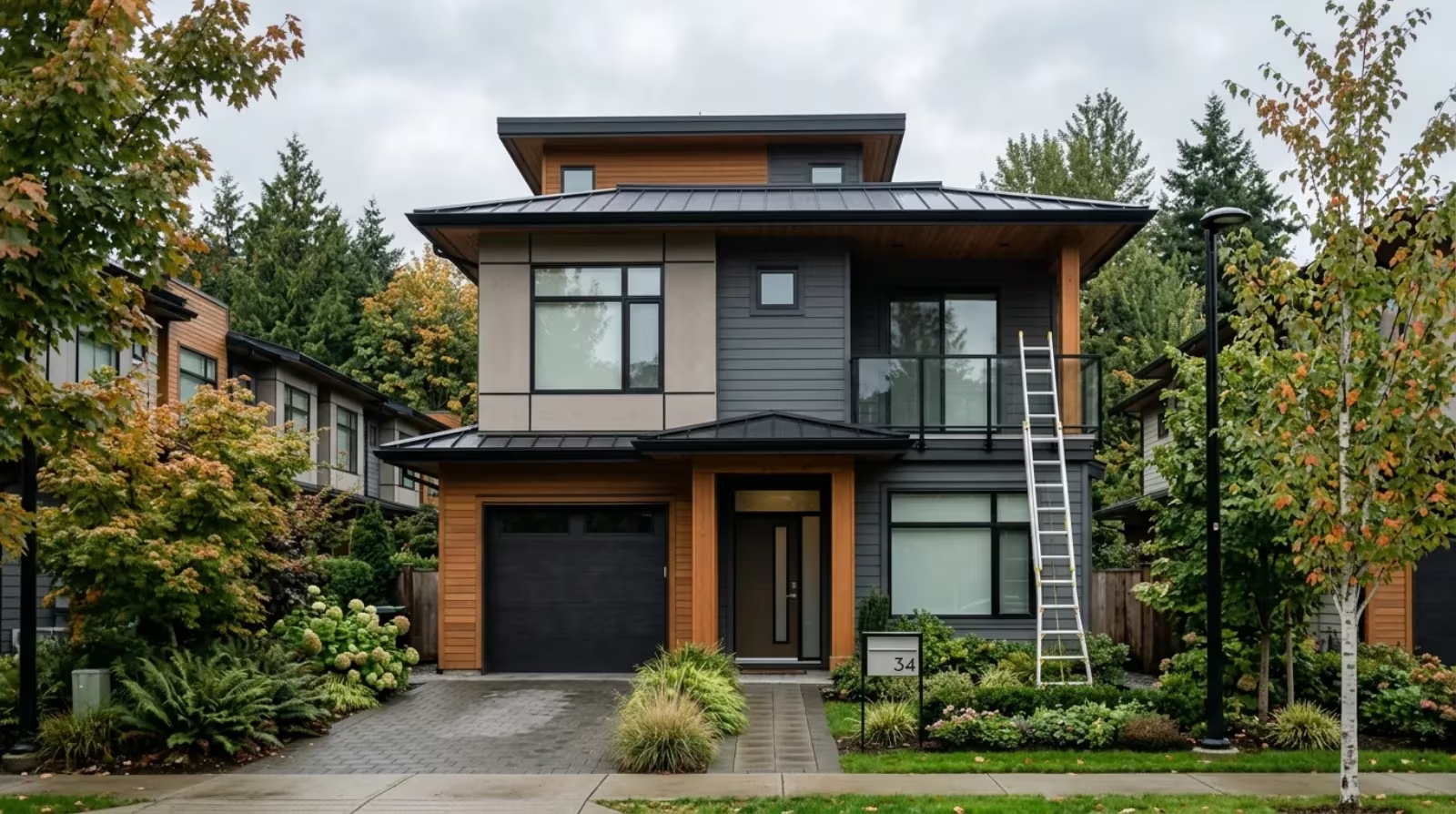

If the stairs and the bathtub in your house have become harder to use, you have a choice: change the house so that it works for you, or sell it and move to a home that already works. Staying in your own home as you get older has a name you may have seen: "aging in place". This guide lists the changes a two-storey house needs, the public programs that pay part of the cost, the care you can get at home, and a fair way to compare staying with moving.
What is the choice, and who is giving this advice?
Both choices can be right. Staying keeps you in a house and a neighbourhood you know. You pay for changes now, and the house still needs repairs and yard work. Moving ends those costs and starts others: the costs of selling and buying, the work of a move, and a strata fee if the new home has one. A strata is the owners' group that runs a condo or townhouse complex, and each owner pays it a monthly fee.
The FRIVE team earns money only when a home is sold or bought, and earns nothing when an owner stays. Remember that when you read our opinions.
This page gives no medical advice. For questions about your health and safety at home, ask your family doctor or an occupational therapist, a health professional who can watch how you do daily tasks and recommend changes.
What has to change in a two-storey house?
BC Housing, the provincial housing agency, runs a rebate program for home changes. Its Maximum Rebate Schedule, effective April 2024, names the common changes, so we use its item names. Each dollar figure is the most the program pays back for that item. The contractor's price is a separate number, and you learn it from a written quote.
- Steps at the entrance. Exterior ramp: up to $6,000. Hand railings, interior or exterior: up to $130 per foot.
- Stairs to the bedrooms. Straight stairlift: up to $10,000. Curved stairlift: up to $15,000. A stairlift is a seat on a rail that carries a person up the stairs.
- Bathroom. Grab bar or bathtub safety rail: up to $275 each. Converting a tub to a walk-in or wheel-in shower: up to $9,100.
- Doors. Widening an interior door: up to $1,100 each.
- Laundry. Relocation of the washer and dryer: up to $1,320.
- Switches and lighting. Moving an electrical switch, outlet or thermostat to an accessible height: up to $165 each. Light fixtures appear in the BC tax credit below.
- Paths and yard. Levelling uneven surfaces or widening exterior walkways: up to $6,000. The schedule has no item for yard work.
BC Housing says some adaptations need an assessment by an occupational therapist, a physical therapist or another medical professional. The schedule marks an exterior ramp and a tub-to-shower conversion as needing one, and a grab bar as needing none.
Which public programs help pay for the changes?
BC Rebate for Accessible Home Adaptations
BC Housing describes the BC Rebate for Accessible Home Adaptations, or BC RAHA, as "financial help in the form of rebates to eligible low-income households to complete home adaptations for independent living". The lifetime maximum is $20,000 per household, and the program pays the lesser of the maximum rebate or the actual cost. The homeowner page lists the conditions, which include:
- Someone in the household has a disability or a lasting loss of ability, and the change relates to it.
- Total household income before tax is less than $146,270.
- Household assets, with your share of the home's value left out, are less than $100,000.
- The home's BC Assessment value, shown on the notice you receive each January, is below the limit for your area. For 2026/27 that limit is $1,324,999 in Surrey and White Rock. It is $1,049,999 in Langley, Abbotsford, Mission, Chilliwack and Maple Ridge. A home valued below the average assessed value for its area also meets this condition.
Three rules concern timing.
- Apply before the work. The homeowner page says "Adaptations completed before approval from BC Housing are not eligible", except emergency adaptations required before a hospital release. The April 2024 schedule has one sentence saying earlier work "may be eligible", and its note 3 repeats the rule on the current pages. Wait for written approval.
- Finish within 180 days of the written approval. BC Housing pays after the work is finished.
- Apply early. BC Housing accepts applications "first-come, first-served, prioritizing complete ones" until funding runs out. Intake renews on April 1 of each year.
BC Housing also rebates up to $300 of the fee for a private assessment. You can ask for an application by mail at 604-433-2218 or 1-800-257-7756. On October 10, 2026, the BC Housing website carried a notice that content updates were suspended because of the BC election, with content current as of September 22, 2026. Read the pages again before you apply.
Home Accessibility Tax Credit (federal)
The Canada Revenue Agency (CRA) calls the Home Accessibility Tax Credit "a non-refundable tax credit": it lowers the income tax you owe, down to zero at most. For tax year 2025, you qualify if you are 65 or older at the end of the year, or eligible for the disability tax credit. The renovation must be a lasting part of the home. Routine repairs, appliances, housekeeping and gardening are excluded.
You can claim up to $20,000 per year in eligible expenses. The 2025 federal return multiplies non-refundable credits by 14.5%. Our arithmetic: $20,000 × 14.5% = $2,900, the most this credit can lower federal tax for 2025. CRA says the credit "is not reduced by government assistance, including grants". Ask your accountant how that applies with a BC RAHA rebate.
BC home renovation tax credit for seniors and persons with disabilities
The Province's home renovation tax credit for seniors and persons with disabilities is for BC residents who are 65 or older, persons with a disability, and family members who live with them. The page, last updated April 29, 2025, sets the credit at "10% of the qualifying renovation expense (maximum $10,000 in expenses)", so the most you can receive is $1,000 per tax year. It is refundable: if the credit is higher than the tax you owe, you receive the difference. Its examples include grab bars, light fixtures, ramps and stair lifts.
Medical expenses on your tax return
CRA's list of eligible medical expenses includes "renovation or construction expenses". These are changes that give a person access to the home, or greater mobility within it, because the person has "a severe and prolonged mobility impairment". CRA says an expense that qualifies here and for the Home Accessibility Tax Credit can be claimed as both. Ask your accountant whether you meet CRA's conditions.
A suite for living with family
Living with family is a third choice. CRA's Multigenerational Home Renovation Tax Credit is a refundable credit for building a self-contained secondary unit so that a senior, or an adult eligible for the disability tax credit, can live with a qualifying relative. For tax year 2025 it is 14.5% of up to $50,000 of costs, to a maximum of $7,250 per claim. See our guide to a suite for parents and our page on homes for several generations.
| Program | Who it is for | The most it gives | How to apply |
|---|---|---|---|
| BC RAHA | Households under the program's limits | $20,000 per household, lifetime | BC Housing form, before the work |
| Home Accessibility Tax Credit | Age 65 or older, or eligible for the disability tax credit | $2,900 a year (2025) | Federal return, line 31285 |
| BC home renovation tax credit | BC residents 65 or older, or with a disability | $1,000 per tax year | Schedule BC(S12) |
| Multigenerational Home Renovation Tax Credit | A senior moving in with a relative | $7,250 per claim (2025) | Federal return, line 45355 |
Source: BC Housing, Canada Revenue Agency and Province of British Columbia pages, read on October 10, 2026. Each amount is a maximum.
What care can you get at home?
Home support through Fraser Health
The Province says publicly subsidized home and community care services "help you to remain independent and in your own home for as long as possible". The health authority here is Fraser Health, with Home Health offices in Surrey, Langley, Abbotsford, Mission, Chilliwack and Maple Ridge.
Home support is one of those services. Community health workers help with daily activities such as mobility, bathing and dressing. You must meet the Province's general conditions, and a health care professional from the health authority must assess that you need personal assistance. There can be a cost: the Province says "you will pay a daily rate based on your income (and the income of your spouse, if applicable)". People who receive the federal Guaranteed Income Supplement pay no daily rate.
To ask for an assessment, contact the Fraser Health Access Line: Home and Community Care at 1-855-412-2121. Fraser Health says the line is open 7 days a week from 7:00 a.m. to 9:00 p.m. Its rehabilitation therapy service includes occupational therapy.
Better at Home
Better at Home helps older adults "with simple non-medical, day-to-day tasks". Its website says the program is "funded by the Government of B.C. and managed by United Way British Columbia Healthy Aging". Services vary by community. The program's list includes light housekeeping, light yard work, minor home repairs, snow shovelling and grocery shopping. You may pay a fee based on your income, and you apply through the provider in your community.
Housing with support, if you need more later
The Province describes three kinds of seniors' housing. Independent housing "typically refers to seniors who may live in retirement communities or other housing geared towards seniors". Assisted living is "for adults who can live independently and make decisions on their own behalf but require a supportive environment". Long-term care provides "24-hour professional supervision and care" for people who can no longer be cared for at home or in assisted living.
What do the programs leave unsolved?
These three points are our opinion.
The house still needs upkeep. BC Housing's schedule says the rebate does not fund the repair or replacement of deteriorated items, or work on windows, roofs, hot water systems and heating systems. You still pay for the roof, the furnace and the yard, and you still arrange the work.
The house stays where it is. If you stopped driving, how would you reach the grocery store, the pharmacy and your doctor? Write down the answer for each one.
One person may live there alone later. Ask who would visit or call each week.
Two loans that can pay for staying
Owners aged 55 or older can ask the Province to pay their property tax through the property tax deferment program. The Province then holds a legal claim on the home until the debt is paid. For tax deferred in 2026 and later, the interest rate from October 1 to December 31, 2026 is 6.45%. You repay the loan in full when you sell. Our post on property tax deferment has the details.
A reverse mortgage is a loan based on the value of your home. The Financial Consumer Agency of Canada says reverse mortgages are usually for owners aged 55 or older, who can generally borrow up to 55% of the current value of the home. Interest is added to the loan, so the amount you owe grows. The loan must be repaid when you sell or move out, or when the last borrower dies. Our post on a reverse mortgage or downsizing compares the two.
How do you compare staying with moving?
Use your own numbers. Each figure depends on your house and your quotes, so fill in the two columns yourself.
| If you stay and adapt | If you sell and move |
|---|---|
| Cost of the changes, from written quotes | Money left after you sell and buy, from the downsizing calculator |
| Minus rebates approved in writing | Cost of the move, from a mover's written quote |
| One year of property tax, insurance, heat, power and repairs | One year of strata fee, property tax, insurance, heat and power |
| One year of yard work and help at home you pay for | One year of help you would still pay for |
Source: FRIVE team worksheet. Every figure is your own.
Then choose a number of years, for example five. The changes and the move are paid once. Multiply each yearly line by that number. Our post on strata fees on a fixed income explains how to read a strata fee.
Signs that staying is working, in our opinion
- You can sleep, wash and cook on one floor, or the changes that let you reach the other floor are done.
- You can pay the house bills and one large repair from your income and savings.
- Someone sees or calls you each week, and you could reach shops and appointments without driving.
Signs that it is time to plan a move, in our opinion
- You have stopped using one floor of the house.
- Repairs wait because of their cost, or because arranging them has become hard.
- The quotes for the changes, after rebates, come to more than you want to spend on a house you may leave in a few years.
For the health side of the decision, involve your family doctor or an occupational therapist.
What should you do after you decide?
If you stay
Start with the assessment. BC Housing tells applicants to review their adaptations with the therapist and to put them in order of priority, because of the $20,000 lifetime maximum. Do the changes in that order, and wait for BC RAHA's written approval before the contractor starts.
Keep every invoice and receipt. For the Home Accessibility Tax Credit, CRA asks for documents that identify the contractor, describe the work, and show the date, the amount and proof of payment. We suggest you review the choice every year or two, with the two columns above.
If you move
Look for a home with the bedroom, the bathroom and the laundry on the entry floor, or reached by an elevator. Our posts on a condo, a townhouse or a rancher and on 55 and over buildings in BC compare the types of home.
Ask whether a unit in a newer building was built as an adaptable unit. The Province says that under BC Building Code rules, one in every five units in large residential buildings, and in ground-floor suites of smaller apartments, must be adaptable. The rule covers projects that apply for a building permit on or after March 10, 2025. An adaptable unit has accessible doorways and bathroom walls reinforced for grab bars.
BC RAHA can also apply to the home you move to. BC Housing's list of eligible properties includes a row home or townhouse and an individual unit in a strata property. An entire strata property is ineligible, and tenants apply jointly with their landlord. The same income, asset and home value limits apply. The program pages are silent on approval from the strata, so ask your strata council in writing before you hire a contractor.
This guide is general information about published programs and rules. Confirm tax questions with your own accountant, legal questions with your own lawyer or notary, and health questions with your doctor.
Next step
Both columns need one number first: what your house would sell for. Ask us for a free home value, and a BC-licensed REALTOR® will email you a price range based on recent sales of homes like yours. Enter it in the downsizing calculator with the price of the home you would buy. If the numbers favour staying, stay. Our downsizing guide covers tax, strata fees and six Fraser Valley cities.
Frequently asked questions
Is it cheaper to stay in my house and adapt it, or to downsize?
- It depends on your own numbers, so compare them on one page. For staying, write down the cost of the changes from written quotes, minus rebates approved in writing, plus one year of house bills and paid help. For moving, write down the money left after you sell and buy, plus one year of costs in the smaller home, including any strata fee. Compare the two over the number of years you expect to stay.
Does BC have a grant for seniors to make a home accessible?
- Yes. BC Housing runs the BC Rebate for Accessible Home Adaptations, called BC RAHA. It pays rebates for home changes to eligible households where someone has a disability or a lasting loss of ability. The lifetime maximum is $20,000 per household. The program has limits on household income, household assets and the assessed value of the home, and it reviews applications in the order it receives them until the year's funding runs out.
Sources
- BC Rebate for Accessible Home Adaptations (BC RAHA), BC Housing (Accessed 2026-10-10)
- Homeowner Eligibility and Application, BC Housing (Accessed 2026-10-10)
- BC RAHA Maximum Rebate Schedule, effective April 2024, BC Housing (Accessed 2026-10-10)
- BC RAHA 2026/27 Home Value Limits, BC Housing (Accessed 2026-10-10)
- Occupational Therapist or Physical Therapist Assessment for Home Adaptations, BC Housing (Accessed 2026-10-10)
- Approved Applicants, BC Housing (Accessed 2026-10-10)
- What Properties are Eligible or Ineligible under the BC RAHA Program?, BC Housing (Accessed 2026-10-10)
- Home accessibility expenses, line 31285, Canada Revenue Agency (Accessed 2026-10-10)
- T1 2025 Income Tax and Benefit Return, Canada Revenue Agency (Accessed 2026-10-10)
- Details of medical expenses, Canada Revenue Agency (Accessed 2026-10-10)
- Multigenerational home renovation tax credit (MHRTC), Canada Revenue Agency (Accessed 2026-10-10)
- Home renovation tax credit for seniors and persons with disabilities, Province of British Columbia (Accessed 2026-10-10)
- Home and community care, Province of British Columbia (Accessed 2026-10-10)
- Home Support, Province of British Columbia (Accessed 2026-10-10)
- Are You Eligible?, Province of British Columbia (Accessed 2026-10-10)
- Assisted Living, Province of British Columbia (Accessed 2026-10-10)
- Long-Term Care Services, Province of British Columbia (Accessed 2026-10-10)
- Types of rental housing situations, Province of British Columbia (Accessed 2026-10-10)
- Home and community care, Fraser Health (Accessed 2026-10-10)
- Rehabilitation therapy, Fraser Health (Accessed 2026-10-10)
- Better at Home, United Way British Columbia (Accessed 2026-10-10)
- Adaptable-dwelling, seismic provisions take effect March 10, Province of British Columbia (Accessed 2026-10-10)
- Property tax deferment program, Province of British Columbia (Accessed 2026-10-10)
- Reverse mortgages, Financial Consumer Agency of Canada (Accessed 2026-10-10)
Related guides
- Hub - DownsizingGiving Your Child a Down Payment in BC: How a Gift Works After You Downsize
- Hub - DownsizingDownsizing Checklist for the Fraser Valley: Every Step From the First Price Check to After the Move
- Hub - DownsizingSell in Surrey or Langley, Buy Farther East: What Downsizers Gain and What It Costs
- Hub - DownsizingBC Property Tax Deferment and the Seniors Home Owner Grant: 2026 Rules and What You Repay When You Sell
Found this useful? Share it.
A neighbour, a partner, a friend who's two FHSA contributions away, send it their way.