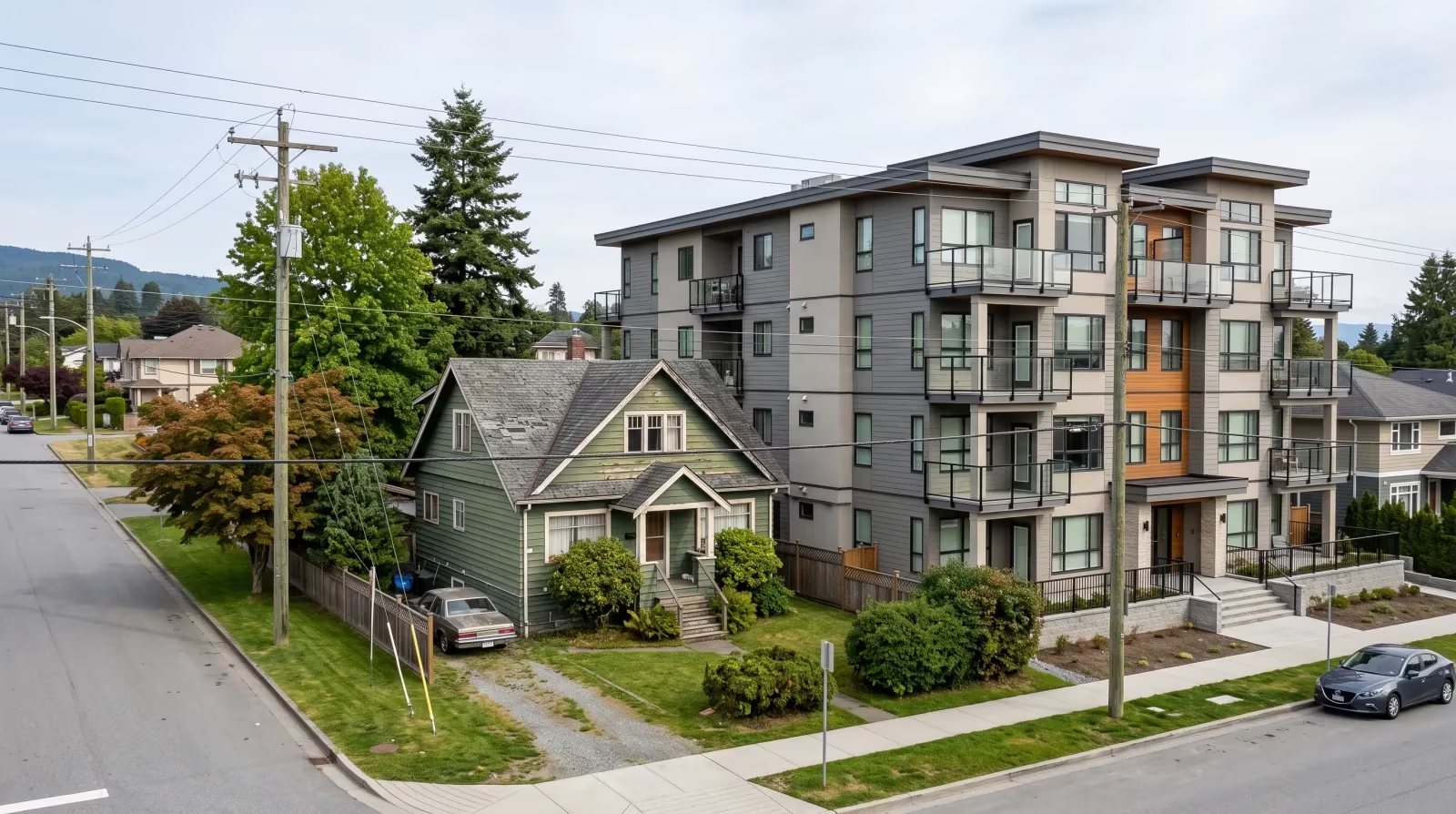

A letter arrives, or someone knocks on the door, with an offer to buy your house as it is and with no commission. The person may be a builder who wants the lot for the homes that can now be built on it. This guide explains what BC's rules allow, how to check your own lot, and how to avoid selling for less than the property is worth.
Why would a builder and a family value your house differently?
A family pays for the house and the land together. A builder who plans new homes pays mostly for the land and for what the city's rules allow on it. To that buyer, an older house can be something to remove.
Zoning is the set of city rules that says what may be built on each lot. BC changed its zoning law in the fall of 2023, and many lots that allowed one house now allow three or more homes.
Your BC Assessment notice gives a first clue. BC Assessment says the notice provides separated values for land and buildings. Compare the two figures, and treat the result as a clue only: BC Assessment adds that "separating land and building value in the real estate market is usually not needed." Our post on what your house is worth explains what the notice measures.
What do BC's small-scale multi-unit housing rules allow?
The Province of BC uses the name small-scale, multi-unit housing for homes such as secondary suites (a second home inside a house), garden suites, triplexes and townhomes. Provincial law requires cities to allow these homes in zones that were limited to a single-family house or a duplex. It sets a minimum.
| Your lot | Minimum number of homes zoning must allow |
|---|---|
| 280 square metres or smaller | 3 |
| Larger than 280 square metres | 4 |
| Larger than 280 square metres and near frequent bus service | 6 |
Source: Province of British Columbia, small-scale, multi-unit housing page, last updated January 20, 2026.
The minimums of 3 and 4 homes apply inside an urban containment boundary, a line on a regional or city plan that marks where urban growth is meant to go, and in a municipality with more than 5,000 people. The Township of Langley gives 280 square metres as 3,014 square feet.
Frequent bus service means a stop where at least one route has a bus every 15 minutes or less on average, from 7 a.m. to 7 p.m. on weekdays and from 10 a.m. to 6 p.m. on weekends. The Province's policy manual sets the distance at 400 metres.
The Province's page also says a 2025 law, Bill 25, widened the zones the rule covers. It says local governments "are required to update their bylaws by June 30, 2026 to comply with these new requirements (except in areas where they have applied for an extension)." Ask your city whether its zoning reflects this change.
Which lots are exempt?
The policy manual lists the land that is exempt from these minimums:
- land that is not connected to both a municipal or regional water system and sewer system
- a lot larger than 4,050 square metres (1 acre, in the Township of Langley's figure), and land in a zone where the smallest new lot allowed is that size
- land with heritage protection named in the manual
- land with a hazardous condition, where a qualified professional has certified to the city that more homes would raise the risk and that it cannot be practically reduced
- land inside a transit-oriented area, which has its own rules
What if your lot is near SkyTrain, West Coast Express or a bus exchange?
A separate provincial rule covers transit-oriented areas: areas within 800 metres of a SkyTrain station, and within 400 metres of a bus exchange or a West Coast Express station, at stations listed in regulation. Cities must allow taller buildings there. The Province's table puts Surrey, Langley (City and Township) and Maple Ridge in one group, and Abbotsford, Chilliwack and Mission in a second.
| Group and station | Minimum allowable height, by distance from the station |
|---|---|
| First group, SkyTrain | Up to 20 storeys at 200 metres or less, up to 12 from 200 to 400 metres, up to 8 from 400 to 800 metres |
| First group, bus exchange or West Coast Express | Up to 12 storeys at 200 metres or less, up to 8 from 200 to 400 metres |
| Second group, bus exchange | Up to 10 storeys at 200 metres or less, up to 6 from 200 to 400 metres |
Source: Province of British Columbia, Bill 47 table of distances, transit stations and densities.
The Township of Langley says the area within 800 metres of the Willowbrook SkyTrain station was designated on May 2, 2025. Ask your city whether your lot is inside a designated area.
What does your city's page say?
We opened each city's page on October 10, 2026.
| City | What its page says | Page |
|---|---|---|
| City of Surrey | In effect since July 8, 2024, for lots smaller than 4,050 square metres inside the Metro Vancouver Urban Containment Boundary. Council approved a review on July 27, 2026. | surrey.ca |
| Township of Langley | Zoning amended November 18, 2024. Lots need municipal water and sewer. | tol.ca |
| City of Langley | New zoning bylaw adopted March 9, 2026. Its posted R1 zone lists a maximum of 4 homes per lot, or 6 within 400 metres of a frequent transit bus stop. | langleycity.ca |
| City of Abbotsford | Up to 4 homes on properties inside the Urban Development Boundary zoned for a single detached house or a duplex. | abbotsford.ca |
| City of Chilliwack | Zoning updated June 2024. In two areas of Chilliwack Proper the rule does not apply until December 31, 2030. | chilliwack.com |
| City of Mission | Up to 3 homes on lots with municipal water and sewer that are smaller than 280 square metres, up to 4 on larger ones. | mission.ca |
| City of Maple Ridge | Up to 3, 4 or 6 homes on lots with City water and sewer inside the Urban Area. | mapleridge.ca |
Source: each city's own page. The City of Langley figures are from the bylaw posted there. The Chilliwack date is from the City's Quick Guide, last updated September 2024.
How do you find out what applies to your own lot?
1. Look up your zone and lot size. Surrey has a zoning lookup tool for these rules, Maple Ridge has a unit locator, and Abbotsford, Chilliwack and Mission tell owners to use a web map.
2. Ask the planning department. Give your address, ask the questions below, and ask for the answers by email.
3. Order a title search. A title is the official record of who owns a piece of land. The Land Title and Survey Authority of BC says a title lists the owners and the claims and restrictions registered against it, which it calls charges, liens and interests. A covenant is one of these: a written restriction on how the land may be used. The Province's manual says existing covenants under section 219 of the Land Title Act "are not affected" by the new law. It also says a valid building scheme, a set of restrictions registered on the lots of a subdivision, "will take precedence" over the zoning when it limits a property to one home.
Questions we suggest for the city:
- How many homes does the zoning allow on my lot?
- Is my lot inside a transit-oriented area, or within 400 metres of a frequent bus stop?
- How far from the property line must a building sit, how much of the lot may buildings cover, and how many parking spaces are required?
- Can the water and sewer pipes on my street serve more homes?
- Does a tree bylaw, a floodplain rule or a steep slope limit where a building can go?
- Is any part of my lot in the Agricultural Land Reserve, the land the Province protects for farming? The Agricultural Land Commission says a city cannot permit more housing on a reserve lot than the commission's own law allows.
Zoning may allow 4 homes while the lot's shape, a covenant or a sewer limit allows fewer in practice. Our post on development next door explains how to read a city's plans.
How is an offer from a builder different from an offer from a family?
We use guidance from BC Financial Services Authority (BCFSA), the provincial regulator of real estate. Each difference below is a possibility to ask about.
Conditions. An offer can depend on a condition, called a "subject" in BC: something that must happen before the sale goes ahead. A builder may ask for time to study the lot, or to confirm with the city what can be built. BCFSA says you may accept an offer with conditions and still consider other offers.
Dates. The completion date is the day ownership passes to the buyer in exchange for the price. A buyer who needs permits may ask for a later date than a family would. A long wait can suit you if you need time to find a smaller home, as our post on selling first or buying first explains.
Repairs. A builder who plans to remove the house does not need repairs, fresh paint or staging (furniture arranged for showings). A family looks at all of these. Get a price range first, then decide which jobs in our post on getting an older house ready to sell to do.
How do you protect yourself when the offer comes to your door?
The steps below are the FRIVE team's advice, with BCFSA's words where it has published them.
Take your time with the first offer
BCFSA says you are "under no obligation to accept a buyer's offer or to make a counter-offer". It also says that if you sign an offer without making any changes, "a legally binding contract has been formed". If an offer's deadline passes, BCFSA says it is as if you rejected the offer. You may let a short deadline pass.
Get a price range that considers both kinds of buyer
BCFSA's fact sheet on quick sales says "exposing your property to the market for a reasonable amount of time helps ensure that you get what your property is worth." It suggests you consider an appraisal (a written opinion of value) by a licensed home appraiser, and that you interview several licensed real estate professionals and ask each to advise you on a selling price.
We suggest you ask each one what a family would pay and what a builder would pay. A buyer who writes to you directly is the only bidder. When the property is offered openly, buyers of both kinds can bid.
Ask who the buyer is, and whether the contract can be assigned
Ask for the buyer's full legal name or company name, and whether the buyer holds a real estate licence. BCFSA's Find a Professional tool shows whether a person currently holds a valid BC licence. A licensed professional who buys for themselves must give you a Disclosure of Interest in Trade form, which says whether they plan to resell the property.
An assignment is the transfer of a buyer's rights under a purchase contract to another party before the completion date. BCFSA says that since May 16, 2016, every purchase contract prepared by a real estate professional must include two terms, unless the client instructs otherwise in writing. The contract must not be assigned without the seller's written consent, and the seller is entitled to any profit from an assignment. If an offer leaves those terms out, the buyer's real estate professional must give you a notice form. If the buyer wrote the contract alone, ask your lawyer what it says on assignment.
Understand what "no commission" means
A "no commission" offer describes a sale with no real estate agent working for you. BCFSA says there is no standard commission in BC and that any amount can be negotiated, so the saving is the amount you would have agreed to pay. In exchange, nobody is paid to get you a higher price.
BCFSA says consumers may represent themselves, and that "there are risks they may not realize". If the buyer has a real estate professional and you do not, information you give that person "will be shared with their client". BCFSA strongly recommends that you retain your own. FRIVE earns a commission when it represents a seller, so weigh our view with that in mind.
Have your own lawyer read the contract
Before you sign, pay a lawyer of your own choice to read the whole contract. BCFSA calls it best practice to ensure a buyer's deposit is held in trust, which means kept apart from the holder's own money, and to ask for a receipt.
Ask about tax before you sign
Take three tax rules to your accountant.
- Tax on the gain. The Canada Revenue Agency (CRA) says you do not have to pay tax on the gain if the property was solely your principal residence, meaning your main home, for every year you owned it. The land that counts is usually limited to half a hectare, or 1.24 acres. Our post on tax when you sell your home has the detail.
- Goods and services tax (GST). CRA says sales of used owner-occupied homes are usually exempt. It treats a home that is not used primarily as a residence as two properties when it is sold. Its memorandum on home sales says land beyond half a hectare is generally not part of the home, and that the sale of that land "could be taxable".
- BC home flipping tax. The Province says this tax applies to profit from selling a property owned for less than 730 days. A home owned for 20 years is outside that period.
When does the house matter more than the lot?
This section is our opinion. We would plan the sale around a family buyer in three cases:
- The multi-unit rule does not cover your lot. Examples are a lot with no municipal sewer and a lot larger than 4,050 square metres.
- A covenant on title, the shape of the lot or a hazard area limits building.
- The house is in good condition and suits a family as it is.
Even where the rule applies, a family may pay more than a builder for a well-kept house.
What happens to you after the sale?
Your own next steps are the same whichever buyer you choose. Compare a condo, a townhouse and a rancher, and follow the downsizing checklist. The rest of our downsizing guide covers tax, strata fees and six Fraser Valley cities.
This guide is general information about published rules. Zoning changes, so confirm what applies to your address with your city. Confirm legal questions with your own lawyer or notary, and tax questions with your own accountant, before you sign.
Next step
Before you answer a letter or a visitor, find out what the property would sell for if it were offered openly. Ask us for a free home value, and a BC-licensed REALTOR® will email you a price range based on recent sales of homes like yours. Then enter that price in the downsizing calculator. You do not have to sell with us.
Frequently asked questions
Someone offered to buy my house as is with no commission. Should I accept?
- Take your time, and have your own lawyer read the offer before you answer. BC Financial Services Authority says a seller is under no obligation to accept an offer or to make a counter-offer, and that signing an offer without changes forms a legally binding contract. An offer with no commission means no real estate agent is working for you. Ask for a price range that considers both a family and a builder before you decide.
How many homes can be built on a single-family lot in BC?
- The Province of BC says city zoning must allow at least 3 homes on a lot of 280 square metres or smaller, and at least 4 on a larger lot, in zones that were limited to a single-family house or a duplex. On lots larger than 280 square metres near frequent bus service, the minimum is 6. The rules apply inside urban containment boundaries and in municipalities with more than 5,000 people. Exemptions apply, so confirm with your city.
Sources
- Small-scale, multi-unit housing, Province of British Columbia (Accessed 2026-10-10)
- Provincial Policy Manual and Site Standards: Small-Scale, Multi-Unit Housing, Province of British Columbia (Accessed 2026-10-10)
- Transit-Oriented Areas, Province of British Columbia (Accessed 2026-10-10)
- Attachment 3: Bill 47 Transit-Oriented Development Areas. Distances, Transit Stations and Densities by Category, Province of British Columbia (Accessed 2026-10-10)
- Zoning for Small-Scale Multi-Unit Housing, City of Surrey (Accessed 2026-10-10)
- Small-Scale, Multi-Unit Housing, Township of Langley (Accessed 2026-10-10)
- Zoning Bylaw, City of Langley (Accessed 2026-10-10)
- Zoning Bylaw, 2025, No. 3300, City of Langley (Accessed 2026-10-10)
- Housing, City of Abbotsford (Accessed 2026-10-10)
- FAQ Small-Scale Multi-Unit Housing, City of Abbotsford (Accessed 2026-10-10)
- Small-Scale Multi-Unit Housing (SSMUH), City of Chilliwack (Accessed 2026-10-10)
- Small-Scale Housing Quick Guide, City of Chilliwack (Accessed 2026-10-10)
- Small-Scale Multi-Unit Housing (SSMUH), City of Mission (Accessed 2026-10-10)
- Small-Scale, Multi-Unit Housing, City of Maple Ridge (Accessed 2026-10-10)
- Housing Legislation in the ALR, Provincial Agricultural Land Commission (Accessed 2026-10-10)
- Search for a Title, Land Title and Survey Authority of British Columbia (Accessed 2026-10-10)
- Assessments and complaints (appeals) - frequently asked questions, BC Assessment (Accessed 2026-10-10)
- Offers from Buyers, BC Financial Services Authority (Accessed 2026-10-10)
- Real Estate Facts, BC Financial Services Authority (Accessed 2026-10-10)
- FAQs about Real Estate Transactions, BC Financial Services Authority (Accessed 2026-10-10)
- Consumer Guide to Disclosures, BC Financial Services Authority (Accessed 2026-10-10)
- Assignments Information, BC Financial Services Authority (Accessed 2026-10-10)
- Consumer Guide to Deposits, BC Financial Services Authority (Accessed 2026-10-10)
- Consumer Guide to Remuneration, BC Financial Services Authority (Accessed 2026-10-10)
- Principal residence, Canada Revenue Agency (Accessed 2026-10-10)
- Sales by Individuals of Owner-Occupied Homes, GST/HST Info Sheet GI-004, Canada Revenue Agency (Accessed 2026-10-10)
- Residential Real Property-Sales, GST/HST memorandum 19.2.1, Canada Revenue Agency (Accessed 2026-10-10)
- BC home flipping tax, Province of British Columbia (Accessed 2026-10-10)
Related guides
- Hub - DownsizingGiving Your Child a Down Payment in BC: How a Gift Works After You Downsize
- Hub - DownsizingDownsizing Checklist for the Fraser Valley: Every Step From the First Price Check to After the Move
- Hub - DownsizingSell in Surrey or Langley, Buy Farther East: What Downsizers Gain and What It Costs
- Hub - DownsizingBC Property Tax Deferment and the Seniors Home Owner Grant: 2026 Rules and What You Repay When You Sell
Found this useful? Share it.
A neighbour, a partner, a friend who's two FHSA contributions away, send it their way.