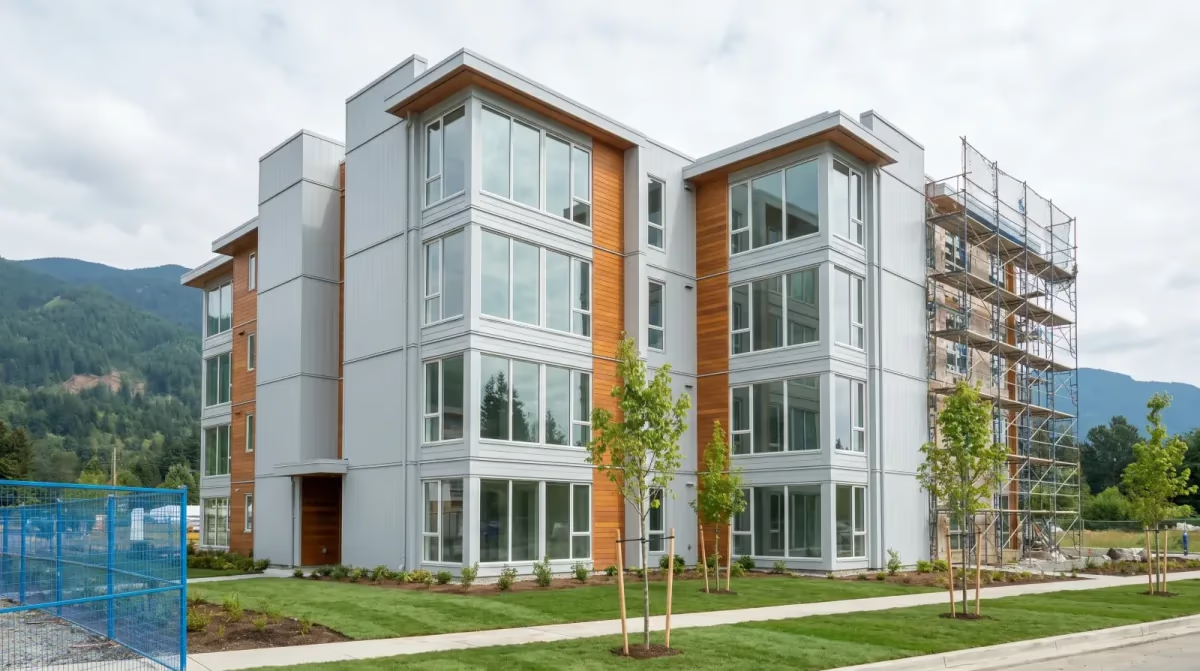

If you are selling a house to buy a condo or a townhouse, you can buy a newly built home or a resale home, which is a home that someone has lived in before. The two are taxed in different ways. This guide adds up both taxes at one price, explains which exemptions and rebates a long-time owner can use, and covers the warranty, the strata records and the dates.
Which taxes change when the home is new?
Two taxes on the purchase change. The first is BC's property transfer tax. The buyer pays it once, when the home is registered in the buyer's name. The Province of BC sets the rates: 1% of the fair market value up to $200,000, and 2% of the value from $200,000 to $2,000,000. Fair market value is the price a willing buyer would pay a willing seller in the open market. The buyer of a resale home pays this tax in full unless an exemption applies.
The second is the goods and services tax (GST), the federal sales tax. The Canada Revenue Agency (CRA) lists the GST rate in BC as 5%. CRA's memorandum on home sales says that in most cases a builder's sale of a newly constructed home is taxable, and that a sale of a previously occupied home is generally exempt.
Three reductions exist for these taxes. One is for first-time buyers only. The other two have conditions that a long-time owner can meet.
Can a long-time owner use the newly built home exemption?
Yes, if the owner meets the conditions. The Province says its newly built home exemption "reduces or eliminates the property transfer tax on qualifying purchases of a principal residence." Its glossary describes a principal residence as "the usual place that a person makes their home."
The page lists these conditions:
- The transfer is registered at the Land Title Office after February 16, 2016, and it is the first registration of the property with a completed home on it.
- You are a Canadian citizen or a permanent resident.
- The property is in BC, and you use it only as your principal residence.
- Its fair market value is $1,100,000 or less.
- The land is 0.5 hectares (1.24 acres) or smaller.
Past ownership of a home is absent from that list, so an owner who has bought and sold several homes can meet every line. A unit in a newly built condo building counts as a newly built home, the page says, as long as nobody has occupied it since its construction.
What you must do in the first year
To keep the exemption, the Province says you must move in within 92 days of the date the property was registered, and continue to occupy the home as your principal residence for the remainder of the first year. If you move out earlier, "you must repay a portion of the amount of the exemption based on the number of days you moved out before the end of the first year." The full exemption still applies if the owner dies, or if the property is transferred under a separation agreement or a court order under the Family Law Act, before the year ends.
This rule matters if a move to a care home within 12 months is possible for you.
What if the price is above $1,100,000?
A partial exemption applies to a fair market value greater than $1,100,000 and less than $1,150,000. The Province's exemption amounts page gives the equation for the exemption amount: the tax before the exemption × ((1,100,000 + 50,000 minus the fair market value) ÷ 50,000). In its table, a home at $1,125,000 has $20,500 of tax before the exemption, an exemption of $10,250, and $10,250 of tax payable.
You apply on the property transfer tax return, which a lawyer or notary files in most cases. Our post on the newly built home exemption has more detail.
Which GST rebates can a downsizer use?
A rebate is tax that is returned to you. CRA has two rebates for the GST on a new home. Their names say "GST/HST" because some provinces use a combined tax called HST.
The GST/HST new housing rebate
CRA's guide says this rebate "allows an individual to recover some of the GST" paid for a new house that is the primary place of residence of the buyer or of a relation. A primary place of residence, CRA says, "generally means the residence that the individual lives in on a permanent basis." The conditions concern the home, its use and its price, so a buyer who has owned homes before can meet them.
CRA's calculation worksheet (form RC7190-WS, on a CRA page dated March 16, 2026) sets the amounts for a home bought from a builder:
- The rebate is 36% of the GST paid, to a maximum of $6,300.
- If the purchase price before GST is $350,000 or less, you receive that amount in full.
- If the price is more than $350,000 and less than $450,000, that amount is multiplied by ($450,000 minus the price) ÷ $100,000.
- If the price is $450,000 or more, the rebate is zero.
The First-Time Home Buyers' GST/HST rebate
This larger rebate is for first-time buyers. CRA says it provides "a rebate of 100% of the GST" on a new home valued up to $1 million, and a reduced amount on a home valued between $1 million and $1.5 million.
CRA's definition of a first-time home buyer (page dated June 9, 2026) includes three tests. Two concern age (at least 18) and status (a Canadian citizen or permanent resident). The third reads:
"You have not lived in a home that you or your spouse or common-law partner owned, or jointly owned, whether in or outside of Canada, as your primary place of residence at any time in the calendar year or in the previous four calendar years"
For a home bought from a builder, CRA applies the test on the date ownership is transferred to you. The definition covers the calendar year of that date and the four calendar years before it.
CRA gives two examples of a person who sold a home in June 2022 and has rented since then. If that person takes ownership of a new home in August 2026, CRA says the person "is not considered a first-time home buyer", because 2022 is one of the previous four calendar years. With a transfer in February 2027, CRA says the person would be considered one, if all other conditions are met.
So the answer depends on the years in which you lived in a home you owned, and on the date you take ownership of the new one. CRA adds that a person who is not a first-time home buyer "may still be eligible for the GST/HST new housing rebate." We cannot tell you how the definition applies to you, so ask your accountant before you sign a contract with a builder.
What do the two taxes add up to at the same price?
The example price is $461,800, the benchmark price of an apartment in September 2026 at the Fraser Valley Real Estate Board (FVREB). A benchmark price is the board's price for a typical home of one type.
The example assumes that the buyer meets the conditions of the newly built home exemption, that $461,800 is the builder's price before GST, and that the buyer does not meet CRA's first-time definition.
| Resale condo | New condo from a builder | |
|---|---|---|
| Purchase price | $461,800 | $461,800 |
| BC property transfer tax | $7,236 | $0 |
| GST at 5% | $0 | $23,090 |
| GST/HST new housing rebate | None | $0 |
| Total of the two taxes | $7,236 | $23,090 |
Source: our arithmetic from the Province of BC's tax rates and exemption, CRA's GST rate for BC, and CRA worksheet RC7190-WS. Price: FVREB apartment benchmark, September 2026.
The arithmetic:
- Resale, property transfer tax: 1% × $200,000 = $2,000, plus 2% × $261,800 = $5,236, for a total of $7,236.
- New, property transfer tax: the price is under $1,100,000, so the exemption equals the tax.
- New, GST: 5% × $461,800 = $23,090. The resale condo is generally exempt.
- New, rebate: the price is $450,000 or more, so the new housing rebate is zero.
The tax on the new condo is higher by $23,090 minus $7,236 = $15,854.
The rebate applies at a lower price. The FVREB benchmark price of an apartment in Abbotsford was $370,200 in September 2026. GST at 5% is $18,510. 36% of that is $6,663.60, so the maximum of $6,300 applies. $6,300 × ($450,000 minus $370,200) ÷ $100,000 = $5,027.40, which leaves $13,482.60 of GST. The property transfer tax on a resale condo at that price is $5,404 ($2,000, plus 2% × $170,200 = $3,404), so the tax on the new condo is higher by $8,078.60.
A buyer who meets CRA's first-time definition could recover up to 100% of the GST at these prices, and the new home would then have the lower tax.
Ask whether the price includes GST. A builder can show a price before GST or with GST included. On a price of $461,800 before GST, the two differ by $23,090. Ask the builder, in writing, which one you are looking at.
Compare real listings. The table uses one price for both homes so that only the tax differs. In our opinion, a new home and a resale home of the same type in the same area are rarely priced the same. Add each tax to the two real prices before you compare them.
If you pay in cash from your house sale, either tax is paid from that money on the completion date, the day ownership passes to you. Our downsizing calculator assumes a resale purchase: it subtracts property transfer tax and adds no GST, so add the GST yourself for a new home. Tax on the sale of your house is a separate subject, covered in tax when you sell your home.
What does the warranty on a new home cover?
BC Housing, the provincial housing agency, says that "all new homes built by a Licensed Residential Builder must have home warranty insurance." It is known as 2-5-10 home warranty insurance, after its three periods:
- 2 years for materials and labour. Some items have shorter limits inside this period, such as 12 months for the parts of a strata unit outside the common property, which is the property all owners share.
- 5 years for the building envelope, the outside of a building that keeps rain and weather out.
- 10 years for structural defects, which are defects in load-bearing parts or the overall structure.
The most you can claim on a strata unit is the lesser of the first owner's purchase price or $100,000. BC Housing also says the remaining warranty transfers to the new owner when a home is sold. A resale condo that was first occupied less than ten years ago can still have part of its warranty, so ask the seller for the policy. Our post on the 2-5-10 warranty explains the coverage in more detail.
What changes if the building is new or not finished yet?
A completion date that is an estimate
A home sold before construction is complete is called a pre-sale unit. BC law gives a pre-sale buyer two protections. Under section 21 of the Real Estate Development Marketing Act, a buyer may cancel by written notice to the developer within 7 days after the later of two dates: the date the purchase agreement was made, and the date the developer obtained your written acknowledgment that you had an opportunity to read the disclosure statement, the document that describes the development. Under section 18, the developer must promptly place your deposit with a trustee, such as a brokerage, a lawyer or a notary public, who holds it in a trust account for you and the developer.
A pre-sale completion date is the developer's estimate. BC Financial Services Authority (BCFSA), the provincial regulator of real estate, publishes a guide to pre-sale purchases. It lists "Estimated construction dates" among the contents of the disclosure statement, and it says: "Completion of the development may be delayed, or the development may never be completed." In that last case the developer must return your deposit "but is not required to provide any additional compensation."
This matters when your house sale has a fixed date. BCFSA says that if construction is delayed, "you may be required to extend your current lodging situation or find short-term lodging." In our opinion, a downsizer whose house sale has a fixed date should prefer a finished new home or a resale home, because each has a date that can be written into a contract. See our posts on buying a pre-sale home and on selling first or buying first.
A strata with no history yet
A strata is the owners' group that runs a condo or townhouse complex, and each owner pays it a monthly fee. For a new building, the Province's page on new strata developments says the developer must "prepare a twelve-month interim budget and provide it to prospective purchasers before they sign an agreement of purchase and sale." An interim budget is the developer's estimate of the strata's costs, so the fee you are quoted is an estimate too. BCFSA warns that strata fees can be higher than expected after completion.
A resale building has records you can read: the minutes (written records) of the strata's meetings, and a depreciation report, which the Province says sets out the projected maintenance, repair and replacement costs of the shared property over 30 years. A new building has neither yet. The Province's depreciation report requirements say a strata corporation established on or after July 1, 2024, and before July 1, 2027, must get its first report within two years of its first annual general meeting, the owners' yearly meeting. Our post on strata fees on a fixed income explains how to read a fee.
Which practical points matter for a buyer aged 55 or older?
These points are the FRIVE team's opinion, except where a source is named.
Doorways, bathrooms and grab bars. The Province's building code release of March 10, 2025 says the rules for adaptable dwellings apply to projects that apply for a building permit on or after that date. In large residential buildings and in ground-floor suites of smaller apartments, one in every five units must have features such as accessible doorways, manoeuvring space in bathrooms and kitchens, and reinforced bathroom walls for future grab bars. Ask the developer when the permit application was made and which units are adaptable.
Elevators. If stairs may become hard for you, choose a building with an elevator or a home on the ground floor. Ask what residents do while an elevator is being repaired.
Energy bills. Ask a resale seller for 12 months of past bills. Ask a developer what heats and cools the unit and which utilities the strata fee includes.
Repair history. A resale building has records of past repairs and of any special levy, which is a one-time charge to owners for a large cost. A new building has the warranty in place of a repair history.
Our guide to a condo, a townhouse or a rancher compares the three types of home.
This guide is general information about published tax rules, laws and market figures. Confirm tax questions with your own accountant, and contract and legal questions with your own lawyer or notary, before you sign.
Next step
Either choice starts from one number: what your house would sell for. Ask us for a free home value, and a BC-licensed REALTOR® will email you a price range. Then enter that price in the downsizing calculator. You do not have to sell with us. The rest of our downsizing guide covers tax, strata fees and six Fraser Valley cities.
Frequently asked questions
Is the BC newly built home exemption only for first-time buyers?
- No. The Province of BC's conditions for the newly built home exemption are that you are a Canadian citizen or permanent resident, that the home is in BC and is used only as your principal residence, that its fair market value is $1,100,000 or less, and that the land is 0.5 hectares or smaller. It must also be the first registration of the completed home. Past ownership of a home is absent from the list.
Do I pay GST on a resale condo in BC?
- Generally, no. The Canada Revenue Agency says that generally a sale of a previously occupied residential complex is exempt from the tax. It also says that in most cases a builder's sale of a newly constructed home is taxable. So GST at 5% applies to a new condo bought from a builder, and a resale condo is generally exempt. The buyer of a resale condo pays BC property transfer tax.
Sources
- Property transfer tax, Province of British Columbia (Accessed 2026-10-10)
- Newly built home exemption, Province of British Columbia (Accessed 2026-10-10)
- Newly built home exemption amounts, Province of British Columbia (Accessed 2026-10-10)
- Glossary for property taxes, Province of British Columbia (Accessed 2026-10-10)
- GST/HST calculator (and rates), Canada Revenue Agency (Accessed 2026-10-10)
- Residential Real Property-Sales, Canada Revenue Agency, GST/HST memorandum 19.2.1 (Accessed 2026-10-10)
- GST/HST New Housing Rebate, Canada Revenue Agency, guide RC4028 (Accessed 2026-10-10)
- RC7190-WS GST190 Calculation Worksheet, Canada Revenue Agency (Accessed 2026-10-10)
- First-time home buyers’ (FTHB) GST/HST rebate, Canada Revenue Agency (Accessed 2026-10-10)
- Who can apply - First-time home buyers’ (FTHB) GST/HST rebate, Canada Revenue Agency (Accessed 2026-10-10)
- Fraser Valley Housing Market Statistics, September 2026, Fraser Valley Real Estate Board (Accessed 2026-10-10)
- Home Warranty Insurance: What Homeowners Need to Know, BC Housing (Accessed 2026-10-10)
- Consumer Guide to Pre-sale Real Estate Purchases, BC Financial Services Authority (Accessed 2026-10-10)
- Real Estate Development Marketing Act, Province of British Columbia, BC Laws (Accessed 2026-10-10)
- New strata developments, Province of British Columbia (Accessed 2026-10-10)
- Strata depreciation report requirements, Province of British Columbia (Accessed 2026-10-10)
- Adaptable-dwelling, seismic provisions take effect March 10, Province of British Columbia, BC Gov News (Accessed 2026-10-10)
Related guides
- Hub - DownsizingGiving Your Child a Down Payment in BC: How a Gift Works After You Downsize
- Hub - DownsizingDownsizing Checklist for the Fraser Valley: Every Step From the First Price Check to After the Move
- Hub - DownsizingSell in Surrey or Langley, Buy Farther East: What Downsizers Gain and What It Costs
- Hub - DownsizingBC Property Tax Deferment and the Seniors Home Owner Grant: 2026 Rules and What You Repay When You Sell
Found this useful? Share it.
A neighbour, a partner, a friend who's two FHSA contributions away, send it their way.