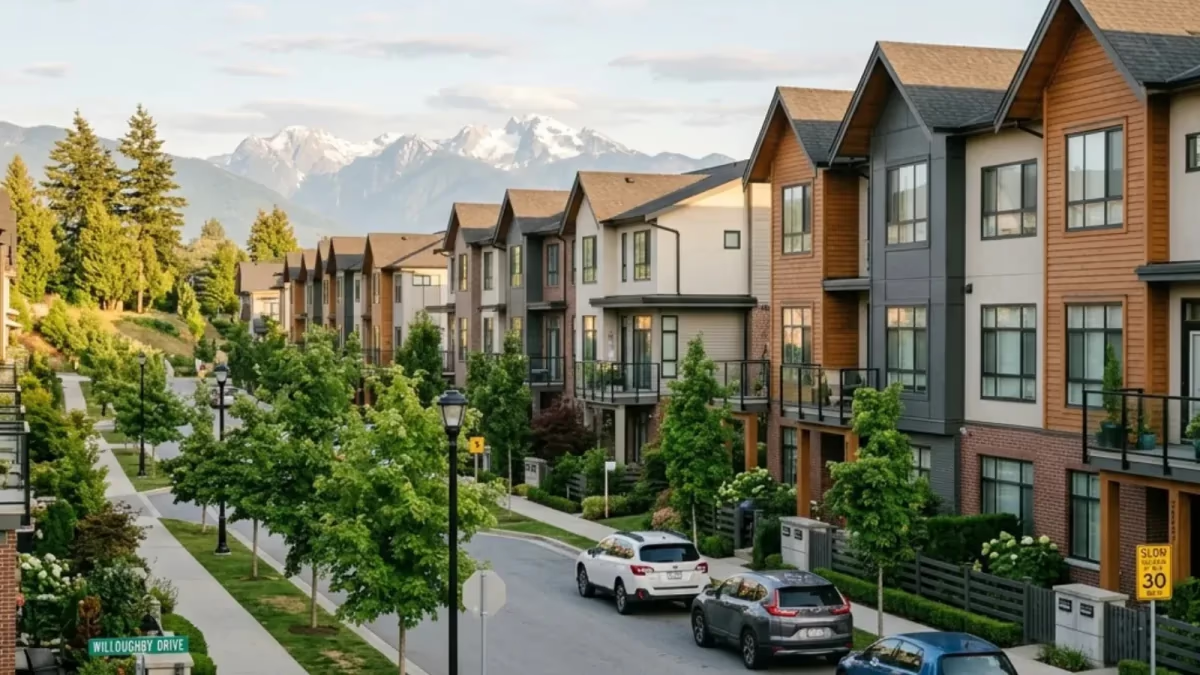

Pooling purchasing power works. In Surrey, Langley, and Abbotsford, the FRIVE team is seeing more first-time buyers team up, two friends splitting a Willoughby townhouse, siblings sharing a low-rise condo, a parent co-signing and taking a small share of title with their adult child. At Fraser Valley prices, the math sometimes only works with two incomes behind the mortgage.
The paperwork is where it gets complicated. How you register ownership at the Land Title Office, how the lender underwrites a mortgage with multiple buyers, and how the province calculates your Property Transfer Tax (PTT) all depend on decisions you make before the offer is signed. Most co-buyers don't think about those decisions until they're already mid-deal, and that's when the surprises happen.
Here's what the FRIVE team walks through with buyers before they go into a co-purchase.
Legal Title Options: Joint Tenancy vs. Tenancy in Common
When you buy real estate in BC, your lawyer or notary registers your ownership with the Land Title and Survey Authority of BC (LTSA). Before that happens, you need to pick one of two legal structures: Joint Tenancy or Tenancy in Common.
1. Joint Tenancy
In a joint tenancy, all co-owners hold an equal, undivided interest in the entire property. If two people buy a home as joint tenants, they each own an equal 50% share; if three people buy, they each own 33.3%.
- The Right of Survivorship: If one co-owner dies, their interest passes automatically to the surviving owner(s). It doesn’t go through their estate, which sidesteps probate fees and delays.
- Who uses it: Married couples and long-term partners who want the home to pass directly to each other.
2. Tenancy in Common
In a tenancy in common, co-owners hold distinct, separate shares in the property. These shares do not have to be equal. For example, Friend A could own a 70% share because they provided a larger down payment, while Friend B owns a 30% share.
- No Right of Survivorship: When a tenant in common dies, their share goes through their estate, to whoever's named in their will, or to provincial intestacy rules if there's no will. It doesn't flow to the other co-buyer.
- Who uses it: Friends, siblings, parent-child buyers, or any co-buyers with unequal contributions who want their individual equity to stay in their own estate.
Which structure fits depends on your relationship, your estate plans, and how you've split the down payment. Your real estate lawyer should review both before you finalize the offer.
The Mortgage Reality: Joint and Several Liability
The part that surprises most co-buyers: the lender doesn't care what your private 50/50 arrangement says. All buyers on the mortgage are jointly and severally liable, which means each of you is responsible for the full balance, not your half.
In practice:
- If your co-buyer stops paying, the bank comes after you for the full payment. Job loss, disability, relationship breakdown, the lender's position is the same in every scenario.
- The full mortgage appears on your credit report, not half of it. If you try to buy another property or get a car loan, future lenders see the whole obligation when calculating your debt ratios.
- Both incomes and all debts get pooled. If Friend A earns well but Friend B carries $40,000 in student loans and credit card debt, that debt load reduces what you can borrow together.
Go in with your eyes open. Pull credit reports and share them before the mortgage application. The bank will see everything, you should too.
BC Property Transfer Tax Exemptions for Co-Buyers
British Columbia assesses a Property Transfer Tax (PTT) on all real estate transactions, calculated at 1% on the first $200,000 of the fair market value and 2% on the portion between $200,000 and $2 million.
The BC First-Time Home Buyers' Program offers a full exemption from PTT on qualifying homes priced up to $835,000. But what happens if one co-buyer qualifies as a first-time buyer and the other does not?
In BC, the PTT exemption is prorated based on the percentage of eligible interest registered on title:
- The 50/50 split: If you’re a qualified first-time buyer buying a $700,000 home with a parent who already owns property, and you register equal 50% shares, you get a 50% exemption. You pay PTT on your parent’s half, roughly $6,000 in tax instead of $0.
- The 99/1 structure: Some buyers ask about registering the first-time buyer at 99% and the non-qualifying co-buyer at 1% to maximize the exemption. This is legal and the BC Ministry of Finance allows it, but the split has to reflect a genuine ownership arrangement. Lenders have to approve the structure, and the ministry audits deals that look like they’re structured purely to avoid tax.
The eligible buyer also has to actually live in the home as their principal residence. If a parent takes a share of title but doesn’t move in, their share is taxed at the full PTT rate.
The Co-Ownership Agreement: Your Exit Strategy
A co-ownership agreement is a legal contract, prepared by a lawyer before closing, that sets out how costs are shared, how decisions get made, and most importantly, how the co-ownership ends. It's not legally required. It's the thing we almost always recommend.
We've seen co-buys work well and we've seen them blow up. The difference, in almost every case, is whether the exit plan was written down before the two people bought the place, not after someone's relationship changed or a job moved. Here's what a good agreement covers:
1. Contribution Splits
Who put in what toward the down payment, legal fees, and moving costs. If the contributions weren't equal, the agreement should document how that equity gets distributed at sale. If Friend A put in $60,000 and Friend B put in $20,000, Friend A should get that extra $40,000 back from the sale proceeds before any profit split.
2. Monthly Expense Allocation
How the mortgage, property tax, strata fees, insurance, and utilities get split. Is it 50/50 across the board? Proportional to ownership share? By bedroom size? Whatever the arrangement, write it down, these are the things people argue about two years in.
3. Repairs and Maintenance
Who pays when the hot water tank fails or the roof needs replacing? Small repairs under a set threshold might be split evenly; bigger capital expenses should need both owners' sign-off. What happens if one person wants to renovate and the other doesn't care? Set the rules before the situation comes up.
4. The Exit Plan (The Buyout)
What happens when one co-buyer gets married, gets transferred for work, or just wants their equity back in five years? This is the clause most people skip, and it's the one that causes problems.
- Right of First Refusal: If Friend A wants out, they offer their share to Friend B first, at fair market value.
- Valuation: How do you determine "fair market value" without a dispute? Most agreements require an independent appraisal, some specify three appraisers, take the average.
- Forced sale trigger: If the remaining co-owner can't afford to buy out the departing one within a set window (90 days, 6 months), the property lists on the market for sale.
Write this down while everyone's still on the same side. That's when people are reasonable. Disputes start when the relationship changes, and by then, it's too late to agree.
Typical Co-Buying Scenarios We See in the Fraser Valley
Two co-purchase structures we see regularly in the Fraser Valley:
Scenario A: Sibling Partnership (Tenants in Common)
Two sisters buy a $550,000 condo in Surrey. Sibling A has been working for five years and has $40,000 saved. Sibling B is a recent university graduate with $10,000 saved. They register as tenants in common with Sibling A holding a 60% share and Sibling B holding a 40% share.
They write a co-ownership agreement stating that Sibling A pays 60% of the mortgage principal, while Sibling B pays 40%. They split the strata fees and utilities 50/50. If Sibling A decides to move in with a partner in the future, Sibling B has 90 days to arrange a buyout of Sibling A's 60% share before the condo must be listed for sale.
Scenario B: Parent-Child Co-Sign (Joint Tenancy vs. Tenants in Common)
A buyer in Langley wants to purchase a $750,000 townhouse in Willoughby. They have a solid income but need their parent to co-sign the mortgage to qualify. The parent does not want to own the home long-term but is registered as holding a 1% interest on title to satisfy the lender.
Because the buyer holds 99% of the interest and lives in the home, they claim a 99% exemption on the Property Transfer Tax. They register as tenants in common so that if the parent passes away, their 1% interest passes to the child via the parent's will, rather than triggering a complex transfer.
Summary Checklist for Co-Buyers
- Establish Title Early: Decide on Joint Tenancy (spouses/survivorship) vs. Tenancy in Common (friends/unequal shares) before meeting with your lawyer.
- Verify PTT Eligibility: Calculate the prorated Property Transfer Tax based on who will live in the home and who is a qualified first-time buyer.
- Review Credit Together: Pull credit reports and declare all debts before applying for a joint mortgage.
- Hire a Real Estate Lawyer: Each co-buyer should have independent legal review of the co-ownership agreement, the same lawyer can handle the conveyancing, but separate lawyers should review the agreement itself.
- Plan the Exit: Agree on a buyout and valuation process before you sign the purchase contract.
Frequently Asked Questions
Can two friends buy a house together in BC?
Yes. Two or more unrelated people can buy property together in BC, typically registering as tenants in common to hold different percentage shares. The legal and mortgage implications are real, plan those before you write the offer.
What's the difference between joint tenancy and tenancy in common in BC?
Joint tenancy means equal shares with a right of survivorship, when one co-owner dies, their interest passes automatically to the others, not through their estate. Tenancy in common allows unequal shares, and each person's interest goes through their own will on death. Joint tenancy is typical for married couples. Tenancy in common is typical for friends, siblings, or co-buyers with unequal contributions.
Are co-buyers jointly liable for a mortgage in BC?
Yes. All buyers on the mortgage are jointly and severally liable, each person is on the hook for the full amount, not just their share. If your co-buyer defaults, the lender pursues you for the full balance.
How does the BC PTT first-time buyer exemption work for co-buyers?
It's prorated. If you're a qualified first-time buyer holding a 50% share, you get 50% of the exemption. Your co-buyer's share is taxed at the regular PTT rate if they don't qualify. Talk to a lawyer about whether adjusting the ownership split makes sense for your situation.
Can a co-signer be removed from a mortgage in BC?
Only if the remaining borrower qualifies independently and the lender agrees to release them, which generally means refinancing. This isn't automatic and isn't guaranteed.
What happens if one co-buyer wants to sell and the other doesn't?
A co-ownership agreement should define this. Typically the departing owner offers their share to the remaining owner first (right of first refusal) with an agreed valuation process. Without an agreement, either owner can apply to BC Supreme Court under the Partition of Property Act to force a sale, which is expensive and tends to damage the relationship.
How does co-buying affect my future borrowing capacity?
The full mortgage appears on your credit report, not just your half. Future lenders calculate your debt ratios based on 100% of the co-purchased mortgage. That can reduce how much you can borrow for other things.
Can we buy 50/50 but have one person contribute a bigger down payment?
Yes. You can register as tenants in common with equal shares while documenting in a co-ownership agreement that one person contributed more at purchase and gets that extra amount back first when the property sells.
Do co-buyers need separate lawyers in BC?
The same lawyer or notary can handle the conveyancing for the purchase, but the co-ownership agreement is a different matter, each co-buyer should have their own independent legal review to make sure their individual interests are protected. It's not required, but we'd recommend it for any co-purchase between people who aren't married.
Sources
- Land Title and Survey Authority of British Columbia (LTSA) - Registering co-ownership
- Government of British Columbia - First-Time Home Buyers' Program details
- Society of Notaries Public of British Columbia - Tenancy structures and property purchase guides
- BC Financial Services Authority - Mortgage Broker and Co-Borrowing regulatory resources
Data verified May 28, 2026. Real estate laws, tax exemptions, and lending criteria are subject to change. Always consult a licensed BC real estate lawyer or notary public before registering property title.
Next Steps: Work with FRIVE
The co-buys we've seen work best share one thing: the co-ownership agreement was written before the deal closed, not after someone's life changed. If you're planning a co-purchase with a friend, sibling, or parent, reach out to the FRIVE team, we'll walk you through the structure, coordinate with your mortgage broker, and point you toward a BC real estate lawyer who does this regularly. Or browse current Fraser Valley listings to get a sense of what's in range for your combined budget.
Related guides
- How to write a competitive offer in a buyers' market, structuring an offer when you're co-buying alongside other buyers competing for the same home
Sources
- Registering co-ownership, Land Title and Survey Authority of British Columbia (LTSA)
- First-Time Home Buyers' Program details, Government of British Columbia
- Tenancy structures and property purchase guides, Society of Notaries Public of British Columbia
- Mortgage Broker and Co-Borrowing regulatory resources, BC Financial Services Authority (BCFSA)
Related guides
- First-Time BuyersLeasehold vs Freehold in BC: The Ownership Difference That Changes Everything
- First-Time BuyersWood-Frame vs Concrete Condos: What the Construction Type Means for Fraser Valley Buyers
- First-Time BuyersCondo or Half-Duplex? The First-Time Buyer Comparison Nobody Explains
- First-Time BuyersBuying a Pre-Sale Condo or Townhouse in the Fraser Valley: REDMA, Disclosures, and Completion Risks
Found this useful? Share it.
A neighbour, a partner, a friend who's two FHSA contributions away, send it their way.