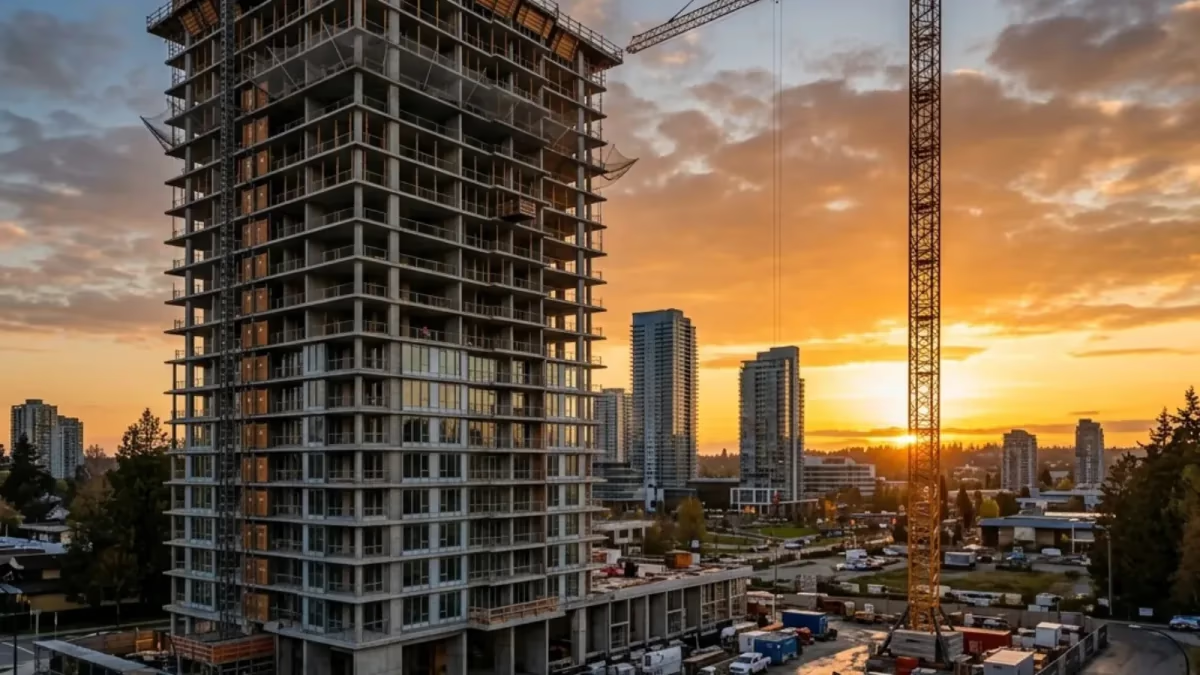

The appeal of buying a pre-sale condo in Surrey City Centre or a townhouse in Willoughby is something the FRIVE team hears often. You get a brand-new home with the latest finishes, a modern layout, and a full home warranty. Even better for first-time buyers, you don't need all your down payment cash upfront. You pay your deposit in structured increments over several months or years while construction takes place, giving you time to save more before completion.
However, a pre-sale contract is very different from a standard resale purchase agreement. You are buying a promise to build, not a physical structure. This makes pre-sales a higher-risk option. The legal contracts are written by the developer's lawyers to protect the developer, and the time gap between signing the contract and getting your keys, often two to four years, introduces significant financial variables.
If you are considering walking into a presentation centre in the Fraser Valley, here is the FRIVE team's breakdown of the legal protections, deposit rules, and completion risks you must navigate.
The Legal Shield: REDMA and the 7-Day Rescission Period
In British Columbia, developers marketing pre-sale homes must comply with the Real Estate Development Marketing Act (REDMA). This legislation is designed to protect consumers by enforcing strict disclosure requirements.
1. The Disclosure Statement
Before a developer can legally sell a pre-sale unit, they must file a comprehensive Disclosure Statement with the BC Financial Services Authority (BCFSA). This document outlines everything you need to know about the development:
- The developer’s corporate history and financial backing.
- The exact legal description and boundaries of the land.
- The construction schedule and anticipated completion dates.
- The layout of the complex, parking arrangements, and common facilities.
- The initial draft budget and estimated strata fees.
- The types of materials and finishes that will be used.
The developer is legally required to provide you with a copy of this Disclosure Statement before you sign a contract.
2. The 7-Day Right of Rescission
Under REDMA, buyers have a statutory seven-day right of rescission to cancel their contract for any reason.
This cooling-off period is absolute and cannot be waived. The seven-day countdown begins on the later of two dates:
- The date you signed the purchase agreement.
- The date you signed a written acknowledgment confirming that you received and read the developer's Disclosure Statement.
If you decide to cancel within this seven-day window, you must deliver a written notice of rescission to the developer. Once received, the contract is nullified, and your deposit must be returned in full without deduction or penalty.
We always recommend that our clients use these seven days to have a real estate lawyer review the disclosure statement and a mortgage specialist run their numbers.
The Deposit Structure: How Your Money is Held
Pre-sale deposit structures vary depending on the developer and the project size, but they generally run between 10% and 20% of the purchase price. Instead of paying this all at once, you pay in stages:
- Initial Deposit: Typically $5,000 to $10,000 paid upon signing the contract.
- Second Deposit: The remainder of the first 5% or 10% instalment, due at the end of the 7-day rescission period.
- Subsequent Deposits: Additional 5% increments due at specific project milestones, such as when construction begins (breaking ground) or when the structure reaches the roof (topping off).
Deposit Trust Protection
REDMA mandates that all deposit funds paid by a purchaser must be held in a lawyer's or brokerage's trust account in British Columbia.
Your deposit does not go directly to the developer to fund construction. It remains in trust, protecting you in case the developer faces financial trouble or defaults before the project is built. The funds are only released from trust to the developer upon completion of the transaction, or if you default on your contractual obligations.
The Appraisal Gap: The Biggest Risk to Pre-Sale Buyers
The single most dangerous threat to a pre-sale buyer is the appraisal shortfall (or appraisal gap).
When you buy a resale home, your mortgage lender orders an appraisal immediately to confirm the property is worth what you agreed to pay.
With a pre-sale, your lender cannot conduct a final appraisal until the building is nearly finished, which might be three years after you signed the contract.
If the real estate market declines during those three years, the home’s value at completion may be lower than the purchase price you committed to.
For example:
- In June 2024, you sign a contract to buy a pre-sale condo in Surrey for $600,000 with a 10% deposit ($60,000).
- The condo completes in June 2026. The lender's appraiser visits the finished building and values the unit at $540,000 due to a market correction.
- The bank’s loan-to-value (LTV) ratio is calculated against the appraised value, not your contract price. If you qualify for an 80% mortgage, the bank will lend you 80% of $540,000 ($432,000), not 80% of $600,000 ($480,000).
- Your total financing is now: $60,000 (deposit) + $432,000 (mortgage) = $492,000.
- You still owe the developer the full contract price of $600,000. You must bridge the $108,000 shortfall in cash before completion.
The Consequences of Default
If you cannot raise the cash to cover the appraisal gap, you will default on the contract.
- Loss of Deposit: The developer will seize your entire deposit (often $60,000 to $120,000+).
- Legal Liability: In BC, developers have the legal right to sue defaulting buyers for damages. If they resell your unit to another buyer for $500,000, they can sue you to recover the $100,000 difference, plus legal fees.
To mitigate this risk, we advise pre-sale buyers to maintain a conservative buffer of extra savings and avoid stretching their borrowing capacity to the absolute limit.
The Mortgage Rate Gamble
When you purchase a pre-sale, you cannot secure a fixed mortgage rate for the entire construction period. Standard bank rate holds are typically capped at 120 days.
While some major lenders offer "pre-sale rate holds" that extend up to 24 or 36 months, these holds are usually set at higher rates than current market pricing. They only serve as a worst-case safety net.
If interest rates rise significantly during construction, the monthly payment you qualified for when you signed the contract will increase. This can cause your debt servicing ratios, specifically your Gross Debt Service (GDS) and Total Debt Service (TDS) ratios, to exceed lending limits.
On completion day, your pre-approval could be revoked, leaving you unable to secure a mortgage.
Construction Delays and Sunset Clauses
Developers face labor shortages, material supply delays, and permitting bottlenecks. Consequently, pre-sale projects are rarely completed on the exact date quoted in the initial marketing brochure.
To protect themselves, developers include a Sunset Clause in the contract. This clause establishes an outer deadline for the completion of the project.
If the developer fails to register the strata plan and complete the building by the sunset date, the contract is terminated. The buyer’s deposit is returned, but the buyer has lost years of market appreciation and must start their search over in a higher-priced environment.
Conversely, the contract will also state that the developer has the right to push back the estimated completion date by several months without penalty.
If you are renting or selling your current home, this floating completion timeline makes it difficult to coordinate your move. You must be prepared for your completion date to shift repeatedly.
Hidden Closing Costs on Brand-New Homes
First-time buyers often budget for closing costs based on resale standards, but brand-new homes carry unique expenses:
1. Goods and Services Tax (GST)
Unlike resale homes, newly constructed homes in BC are subject to a 5% federal GST.
- On a $700,000 townhouse, the GST adds $35,000 to your purchase price.
- The federal GST New Housing Rebate offers a partial refund of the GST for homes priced under $450,000, but because benchmark prices in Surrey and Langley sit well above this ceiling, most Fraser Valley buyers must pay the full 5% GST.
2. Strata Setup and Working Capital Fees
Strata developments require advance funding. When you complete a pre-sale, you are typically billed a one-time "working capital contribution" or "strata start-up fee", usually equivalent to two or three months of strata fees, to fund the corporation's initial bank account.
3. Appliance and Utility Connection Fees
Read the fine print. Some developer contracts pass utility hook-up fees, water meter installation charges, and appliance installation costs directly to the buyer on the statement of adjustments, adding $1,000 to $3,000 to your legal bill.
Summary Checklist for Pre-Sale Buyers
- Review the Disclosure: Never sign a contract without reading the developer's disclosure statement and checking their corporate track record.
- Protect the Rescission Window: Use the 7-day cooling-off period to have a real estate lawyer review the contract.
- Run Worst-Case Scenarios: Work with a mortgage broker to verify you can still qualify if mortgage rates rise by 2% during construction.
- Budget for GST: Add the 5% GST to your cash requirements, and confirm whether you qualify for any rebate.
- Prepare for Shifting Timelines: Ensure your living arrangements are flexible enough to accommodate construction delays of six to twelve months.
Frequently Asked Questions
What is the 7-day rescission period for pre-sales in BC?
Under the Real Estate Development Marketing Act (REDMA), a pre-sale buyer has a statutory right to cancel their purchase agreement for any reason within seven days of signing the contract or acknowledging receipt of the developer's Disclosure Statement, whichever is later.
What is a disclosure statement in BC real estate?
A disclosure statement is a legal document filed by a developer that details the construction plans, developer background, materials, budget, and estimated completion dates of a pre-sale project. Developers must provide this to buyers before selling a unit.
Is the deposit safe if a pre-sale developer goes bankrupt?
Yes, under REDMA, all buyer deposits must be held in a lawyer's or notary's trust account. The developer cannot use these funds to finance construction, protecting your capital if the developer defaults.
What is an appraisal shortfall on a pre-sale home?
An appraisal shortfall occurs when your mortgage lender values the completed home at a price lower than your original contract price. Because the lender bases the mortgage on the appraised value, you must cover the difference in cash to complete the purchase.
Can interest rates be locked in for a pre-sale purchase?
Standard bank rate holds are capped at 120 days. While some lenders offer specialty pre-sale rate holds for up to 36 months, they often carry higher interest rates and strict conditions.
What is a sunset clause in a pre-sale contract?
A sunset clause is an outer deadline in the contract by which the developer must complete the building. If the developer fails to complete the project by the sunset date, the contract is terminated, and your deposit is returned.
Do I pay GST on a pre-sale condo in BC?
Yes, newly built properties in BC are subject to a 5% federal GST. This tax is payable at the time of completion and is calculated on the final purchase price.
What is the GST New Housing Rebate in BC?
The GST New Housing Rebate recovers a portion of the 5% GST paid on a new home, but it is phased out for homes priced between $350,000 and $450,000. Properties priced above $450,000 do not qualify for the rebate.
Can I sell my pre-sale contract before completion?
Selling your contract before the building is complete is called an "assignment sale." This is only permitted if the developer’s contract allows it, and it typically requires the developer's written consent and the payment of an assignment fee (usually 1% to 3% of the purchase price).
What are the extra closing costs for a new-build condo?
In addition to standard legal fees, new-build buyers must pay 5% GST, a strata start-up contribution (often 2 to 3 months of strata fees), utility hook-up fees, and potentially property transfer tax if they do not qualify for an exemption.
Sources
- BC Financial Services Authority (BCFSA) - REDMA developer requirements and consumer protection
- Government of Canada - GST New Housing Rebate guidelines
- Real Estate Board of Greater Vancouver & FVREB - Pre-sale market contract practices
- Province of British Columbia - Property Transfer Tax and new construction exemptions
Data verified May 28, 2026. Real estate regulations, tax rules, and mortgage criteria are subject to change. Consult a qualified BC real estate lawyer and mortgage broker before signing a pre-sale agreement.
Next Steps: Work with FRIVE
The FRIVE team helps buyers evaluate pre-sale opportunities objectively across the Fraser Valley. We know the local developers, the construction histories of Willoughby and Surrey City Centre, and how to negotiate terms that protect your deposit.
If you want to explore pre-sale options without the high-pressure sales tactics of the presentation centre, get in touch with the FRIVE team, start a conversation or browse current Fraser Valley listings. We represent you, not the developer.
Sources
- REDMA developer requirements and consumer protection, BC Financial Services Authority (BCFSA)
- GST New Housing Rebate guidelines, Government of Canada
- Pre-sale market contract practices, Real Estate Board of Greater Vancouver / FVREB
- Property Transfer Tax and new construction exemptions, Province of British Columbia
Related guides
- First-Time BuyersLeasehold vs Freehold in BC: The Ownership Difference That Changes Everything
- First-Time BuyersWood-Frame vs Concrete Condos: What the Construction Type Means for Fraser Valley Buyers
- First-Time BuyersCondo or Half-Duplex? The First-Time Buyer Comparison Nobody Explains
- First-Time BuyersEV Charging in BC Strata: What Condo and Townhouse Buyers Must Check
Found this useful? Share it.
A neighbour, a partner, a friend who's two FHSA contributions away, send it their way.