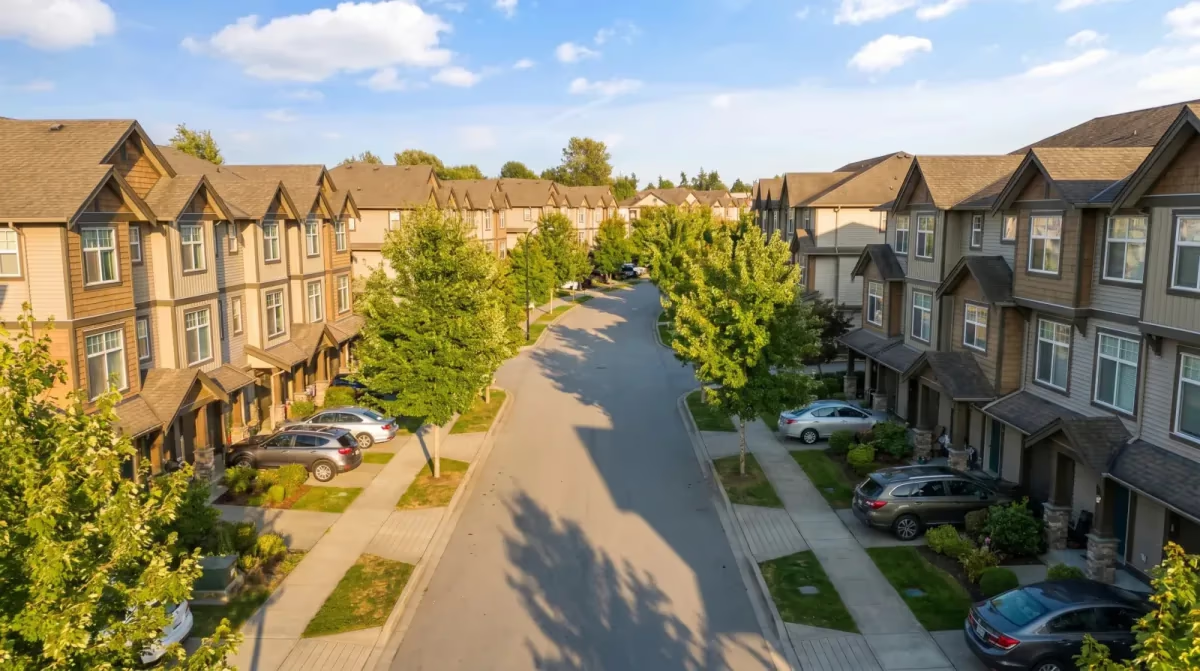

Langley is the Fraser Valley's dominant townhouse market, and buying here involves a set of BC-specific steps that vary depending on which part of Langley you're buying in. Whether you're looking at a condo in Langley City or a three-bedroom townhouse in Willoughby, this guide walks you through each stage, from checking your finances to getting the keys, with Langley-specific context at every step.
The eight steps, in order:
- Check your finances before anything else.
- Get a proper mortgage pre-approval.
- Sign a buyer representation agreement before touring.
- Get clear on which part of Langley you're buying in.
- Tour properties and write an offer.
- Use the subject removal period properly.
- Complete and take possession.
- Apply every first-time buyer program available to you.
Each step is broken down below.
Step 1: Check your finances before anything else
The first thing the FRIVE team asks any new buyer is: do you know what you can actually qualify for? Not what you think you can afford, what a lender will approve.
Start with three numbers. Your credit score (anything below 680 will limit your lender options and rate options; pull a free report at Equifax or TransUnion before you talk to a broker). Your gross household income, including employment income, rental income if applicable, and any bonuses your lender will count. And your saved down payment, including FHSA and RRSP balances you plan to use, plus whatever is in a savings account.
The Langley context matters here. Townhouses are the dominant first-time buyer product in Langley Township, and they cost more than condos. The FVREB June 2026 statistics put the Fraser Valley-wide townhome benchmark at $764,100. Langley townhouses, particularly newer three-bedroom units in Willoughby, often run in the $800K to $950K band. Langley City condos, by comparison, can come in closer to the Fraser Valley apartment benchmark of $476,400. Knowing your budget range early tells you which side of that gap you're shopping on.
Minimum down payment in Canada: 5% on the first $500,000, 10% on the portion above $500,000 (up to $1.5M for an insured mortgage). On an $850,000 Willoughby townhouse, that works out to a minimum of $60,000 before closing costs. Most buyers we work with are aiming for 10% or more to reduce CMHC insurance premiums. See the down payment breakdown for how the numbers layer together.
Step 2: Get a proper mortgage pre-approval
A pre-approval is not an online calculator estimate. It's a document from an actual lender or mortgage broker who has looked at your income verification, your credit, your debt load, and given you a rate hold, typically 90 to 120 days.
The difference matters because online calculators assume best-case everything. A real pre-approval will surface problems: a debt-to-income ratio that's too high, a credit inquiry you didn't know about, employment income that a lender counts differently than you do. Finding those out before you fall in love with a townhouse is far less painful than finding out after an accepted offer.
What you'll need: two years of T4s or NOAs (Notice of Assessment), recent pay stubs, three months of bank statements showing your down payment, and a list of debts. Self-employed buyers generally need two years of tax returns and sometimes a letter from an accountant confirming income.
The Bank of Canada held its overnight rate at 2.25% as of April 29, 2026. For context, variable mortgage rates track this rate with a spread, while fixed rates follow bond yields, most first-time buyers are seeing insured 5-year fixed rates in the high-3% to low-4% range depending on the week and their file. The federal stress test still qualifies you at the higher of your contract rate plus 2% or 5.25%, so even at a 4% contract rate you're qualifying at roughly 6%, plan your numbers at the stress-tested level. The stress test page has the current details.
In Langley specifically, knowing your pre-approval ceiling is important because there's a meaningful price gap between Langley City condos and Willoughby townhouses. A $550K budget puts you firmly in Langley City condo territory. An $850K budget opens up most of Willoughby and Walnut Grove. The pre-approval tells you which conversation you're having.
Step 3: Sign a buyer representation agreement before touring
Since the BC Financial Services Authority (BCFSA) updated its rules in March 2023, a licensed BC real estate agent is required to have a signed buyer representation agreement (BRA) in place before showing you properties. This isn't optional paperwork, it's a regulatory requirement.
The BRA sets out what the agent is obligated to do for you, the services included, and how they're compensated. It's a contract, and you should read it carefully before signing. In most BRAs, the agent's commission is paid by the seller through the listing, so you aren't typically paying out of pocket, but the agreement will specify the terms.
What to look for: the term of the agreement (how long it lasts), the geographic area it covers, the compensation structure, and the circumstances under which you can end the agreement. Most reputable agents will explain every section before asking you to sign. If someone rushes you past it, slow down.
The FRIVE team always walks buyers through the BRA before we start touring. It protects both sides, and an informed buyer makes better decisions throughout the process.
Step 4: Get clear on which part of Langley you're buying in
This step gets skipped more often than any other, and it's the one that causes the most confusion. Langley is not one place. It's two separate municipalities with distinct housing stock, planning cultures, and buyer profiles.
Langley City is a small, older municipality at the centre, roughly bounded by 200 Street and the Nicomekl River. It has more condo supply, higher density zoning in its Official Community Plan, and a planned SkyTrain station as part of the Surrey-Langley SkyTrain extension along the Fraser Highway corridor (anticipated completion 2028 to 2029). For first-time buyers whose budget sits closer to the condo end of the spectrum, Langley City often offers the best value per square foot with the most transit upside.
Langley Township surrounds the City and includes most of the addresses people picture when they say "Langley":
- Willoughby Heights, the dominant first-time townhouse market. Master-planned, predominantly newer wood-frame townhouses and stacked townhouses built since 2005, family-oriented, with the Carvolth Transit Exchange for express bus service toward Surrey and Metro Vancouver. Our full Willoughby guide covers it in depth.
- Walnut Grove, an established neighbourhood with older townhouse and condo inventory, strong school reputation, and generally lower prices than Willoughby for similar square footage. More resale character, less new-build energy.
- Brookswood, lower density, more detached homes, quieter. Less relevant for first-time condo and townhouse buyers.
- Murrayville, older, quieter, a mix of housing types. Good value if you don't need the Willoughby vibe.
- Fort Langley, heritage character area, higher prices, limited condo and townhouse supply. Typically more of a move-up or luxury market.
- Aldergrove, further east, more affordable, limited transit. Relevant for buyers who prioritize space over commute.
Being clear about sub-area before you start touring saves weeks of wasted showings. In our experience, buyers who say "anywhere in Langley" early in the process often end up choosing between Willoughby and Walnut Grove anyway, but they've spent time looking at listings in Murrayville and Fort Langley that were never going to feel right. Narrow it early. See the Langley neighbourhoods guide and the Willoughby Heights community page for street-level breakdowns.
Step 5: Tour properties and write an offer
Once you have a pre-approval and a signed BRA, you can start touring in earnest. In the Fraser Valley market as of spring 2026, you have more time to think than buyers did in 2022 to 2023. The FVREB June 2026 data showed townhouses averaging 33 days on market across the Valley, with a sales-to-active-listings ratio of 11%, technically a buyer's market, where balanced is 12 to 20%.
That said, well-priced Willoughby townhouses in the $750K to $870K range have been moving faster than the overall average in our experience. If something fits your needs and is priced fairly, don't sit on it for three weeks. If something has been sitting for 45 days, there's usually a reason worth investigating, price, strata issues, or layout problems that photos don't reveal.
When you're ready to write, the vehicle is the standard BC Contract of Purchase and Sale. Key elements to understand:
The purchase price and deposit. The deposit is typically 5% of the purchase price, payable within 24 to 48 hours of subject removal. This is not the same as your down payment, it's an earnest money payment that forms part of your down payment at completion. Have it liquid and accessible.
Subjects (conditions). In a normal Langley purchase right now, you'll include a subject to financing and a subject to strata document review. Most sellers expect this; a clean offer with reasonable subjects is a reasonable offer. For resale townhouses, we also recommend a subject to home inspection, especially in Willoughby's older complexes from the mid-2000s, where the building envelope and roofing systems are reaching an age where an inspector's eye matters.
Completion and possession dates. In BC, "completion" is the day title transfers and funds move. "Possession" is the day you get the keys. They are often different dates, usually one or two days apart. Make sure your moving plans align with possession, not completion.
See our guide on how to write a competitive offer in a buyer's market in BC for more on structuring subjects and price.
Step 6: Use the subject removal period properly
After an offer is accepted, you typically have five to seven business days to remove your subjects. This window is the most important work week of the entire purchase. Don't coast through it.
Financing confirmation. Send your accepted offer, property details, and strata documents to your mortgage broker immediately on day one. The lender needs to confirm the property meets their criteria, appraisal may be ordered, and some lenders will flag buildings with high strata fees, pending special assessments, or low owner-occupancy rates. Five business days is genuinely tight for a complex strata file.
Home inspection. Budget $400 to $700 for a qualified BC home inspector (look for CAHPI or NACHI members). For a wood-frame stacked townhouse or attached townhouse in Willoughby, the inspector will pay particular attention to the building envelope, roof, and any signs of moisture intrusion or deferred maintenance. The inspection is your last clear look at the physical condition before you commit.
Strata document review. This is especially important in Langley, where the dominant product is wood-frame strata, 3-storey townhouse complexes, 4 to 6 storey apartment buildings, and stacked townhouses. These buildings age, and the strata corporation's financial health is the clearest indicator of whether your ownership experience will be smooth or expensive.
The documents you need: the Form B Information Certificate (discloses strata fees, any amounts owing, approved levies, CRF balance, insurance summary, and attached rules and budget), the registered bylaws, the depreciation report, and the last two years of council and AGM minutes. The strata documents review checklist walks through exactly what to look for.
Red flags in Langley's predominantly wood-frame strata inventory: a depreciation report showing large unfunded repairs in the near term, meeting minutes that reference water damage or envelope issues repeatedly, a contingency reserve fund (CRF) balance that looks thin relative to the building's age, rental and pet restrictions that don't match how you plan to live (or rent), and special levies approved or proposed. A $5,000 special levy in a building of 60 units can appear almost overnight, it's not unusual, but it's worth knowing about before you remove subjects.
Step 7: Complete and take possession
Once you remove subjects, the deposit goes firm and the file moves to your lawyer or notary. In BC, a notary public can handle a residential purchase, you don't need a lawyer, though some buyers prefer one for added legal advice.
Your lawyer or notary will:
- Review the title and ensure there are no encumbrances that weren't disclosed
- Calculate the property transfer tax (PTT) and confirm whether you qualify for the first-time buyer exemption
- Prepare the Statement of Adjustments, which settles property taxes, strata fees, and any other prorated amounts between buyer and seller
- Register the transfer of title with the Land Title Office
Property Transfer Tax. The Province of BC's first-time home buyers' program (rules effective April 1, 2024) waives PTT entirely on qualifying purchases at or below $835,000 fair market value. A partial exemption applies between $835,000 and $860,000. The maximum saving is roughly $8,000. For a Langley City condo in the $490K to $550K range, that's the full $8,000 in your pocket. For a Willoughby townhouse at $900K, you're above the threshold and owe the full PTT. Keeping your price under $835,000 is worth doing the math on. See the PTT exemption page for the qualification checklist.
On completion day, the funds move and title registers. On possession day (usually one to two days later), you pick up the keys. Bring your photo ID. Do a walk-through before you accept the keys, confirm the property is in the same condition as when you wrote the offer, and that any agreed-upon inclusions are still there.
Step 8: Apply every first-time buyer program available to you
These programs apply anywhere in BC, including Langley. They're worth knowing in detail because they can meaningfully shift your down payment math.
BC Property Transfer Tax, first-time buyer exemption. Covered above. Worth up to $8,000 if your purchase price is $835,000 or under.
First Home Savings Account (FHSA). The CRA's FHSA lets you contribute up to $8,000 per year and $40,000 lifetime. Contributions are tax-deductible, and withdrawals for a qualifying first home are completely tax-free, no repayment required. A couple can each hold their own FHSA, so $80,000 of tax-advantaged down payment is accessible over five years. If you don't have an FHSA open yet, open one this week. Even one year of contributions before closing pays off. The FHSA guide has the setup details.
RRSP Home Buyers' Plan (HBP). Up to $60,000 per person can be withdrawn from an RRSP tax-free for a first home. For a couple, that's $120,000. The amount has to be repaid back into your RRSP over 15 years. The HBP and FHSA can be stacked, a couple using both could access up to $200,000 from registered accounts, though in practice most first-time buyers are working with smaller RRSP balances. The FHSA's terms are better (no repayment), so use FHSA first and treat HBP as a top-up if needed.
GST new home rebate. If you're buying a newly built home, a brand new townhouse in a new Willoughby development, for example, you may qualify for the GST/HST new housing rebate. This partially offsets the GST charged on new construction. The rebate phases out as the price increases; your lawyer or notary will typically handle the paperwork at closing. Talk to your accountant about whether your specific purchase qualifies.
The full first-time buyer programs overview covers all BC and federal programs with current thresholds.
How the process fits together
Here's the sequence again, tightened into a timeline most Langley buyers can follow:
Weeks 1 to 2. Pull your credit, estimate your down payment, open an FHSA if you haven't. Meet with a mortgage broker for a real pre-approval.
Weeks 2 to 4. Talk to a realtor, sign a BRA, narrow your Langley sub-area, and start touring.
Weeks 4 to 10. Tour, make an offer when you find the right property, negotiate terms.
Days 1 to 7 after accepted offer. Subject removal period, confirm financing, complete inspection, review strata documents.
Day 7 to completion (typically 30 to 90 days out). File moves to lawyer or notary. They handle title review, PTT, and funds.
Completion day. Title registers, money moves.
Possession day. Keys in hand.
The buyers we've seen move most smoothly through this process in Langley are the ones who did the first two steps, financing and sub-area clarity, before they started booking showings. Showing up pre-approved and knowing whether you want Willoughby or Walnut Grove compresses weeks of back-and-forth into a clean, direct search.
Frequently Asked Questions
How many steps does it take to buy a home in Langley, BC?
There are eight main stages: checking your finances, getting a mortgage pre-approval, signing a buyer representation agreement, choosing your Langley sub-area, touring and writing an offer, completing subject removal (financing, inspection, strata documents), closing with a lawyer or notary, and applying any first-time buyer programs. The strata document review and the property transfer tax exemption are the two steps that catch most first-time buyers off guard.
What income do you need to buy a townhouse in Langley?
The Fraser Valley-wide townhome benchmark was $764,100 in June 2026 (FVREB). Langley townhouses, especially newer three-bedroom units in Willoughby, often price in the $800K to $950K range. Using a stress-tested qualifying rate around 6.6%, a 10% down payment on an $850K townhouse typically requires roughly $150,000 to $165,000 in household qualifying income. These are illustrative, your lender will run exact numbers based on your debt, credit, and the property's strata fees.
Do I need a buyer representation agreement to view homes in Langley?
Yes. BCFSA rules require a signed buyer representation agreement before an agent shows you properties. The agreement sets out what your agent must do for you and how they're compensated. Read it before signing.
What is the difference between Langley City and Langley Township?
They are two separate municipalities. Langley City is small, denser, with more condo supply and the future SkyTrain station (anticipated 2028 to 2029). Langley Township surrounds it and includes Willoughby, Walnut Grove, Brookswood, Murrayville, Fort Langley, and Aldergrove. Most first-time townhouse buyers end up in the Township; first-time condo buyers sometimes find better value and transit upside in the City.
What is subject removal in a BC real estate purchase?
Subject removal is the period after an accepted offer when you confirm your financing, complete a home inspection, and review strata documents. The standard window is five to seven business days. At the end, you either remove subjects and commit, or cancel and get your deposit back.
How much are closing costs when buying in Langley?
Budget 1.5 to 4% of the purchase price above your down payment. The main items: legal fees ($1,200 to $2,500), property transfer tax (zero if under $835,000 and you qualify for the first-time exemption), home inspection ($400 to $700), strata document review ($300 to $600 for a professional review), and moving costs. PTT is the biggest variable, saving up to $8,000 is a real incentive to stay under the exemption ceiling.
What is the BC first-time home buyer PTT exemption in Langley?
The Province of BC waives property transfer tax for qualifying first-time buyers on purchases at or below $835,000 fair market value (effective April 1, 2024), with a partial exemption up to $860,000. The maximum saving is roughly $8,000. Many Langley City condos and a portion of Willoughby townhouses fall under that threshold, but newer Willoughby three-bedrooms can exceed it.
Is Langley a buyer's market right now?
The Fraser Valley was in buyer's market territory in June 2026, with a sales-to-active-listings ratio of 11% (FVREB). Townhouses averaged 33 days on market; condos averaged 38. Buyers have room to include financing and strata conditions without losing deals, which is a different dynamic than 2022.
Should I get an FHSA before buying in Langley?
Open one now if you haven't. Even contributing $8,000 before your purchase gives you a tax deduction and tax-free growth on that portion of your down payment. If you're more than a year out, building toward the $40,000 lifetime limit is one of the best financial moves available to a Canadian first-time buyer. The FHSA and RRSP Home Buyers' Plan can be stacked.
How long does it take to buy a home in Langley from pre-approval to possession?
Eight to twelve weeks is typical once you have a pre-approval. The search phase varies, some buyers write an offer on their fifth showing, others tour for three months. Once an offer is accepted, completion typically happens 30 to 90 days later, with possession one to two days after.
Sources
- Fraser Valley Real Estate Board, June 2026 statistics package
- Province of British Columbia, First Time Home Buyers' Program (Property Transfer Tax)
- Bank of Canada, Policy rate decision, April 29, 2026
- BC Financial Services Authority
- Canada Revenue Agency, First Home Savings Account (FHSA)
- Canada Revenue Agency, Home Buyers' Plan (HBP)
- TransLink, Surrey-Langley SkyTrain
Related guides
- Best Langley neighbourhoods for first-time buyers, before you buy, here's how each Langley sub-market compares for price, transit, and community
- First-time buyers hub, the full FRIVE first-time buyer resource
- First-time buyer timeline, week-by-week from pre-approval to possession
- Townhomes for sale in Langley, current Langley townhouse listings
- Willoughby Heights neighbourhood guide, deep dive into Langley's busiest first-time buyer neighbourhood
- Walnut Grove community page, the established alternative to Willoughby
- Otter District community page, agricultural Langley for buyers wanting acreage and rural character
- County Line Glen Valley community page, quiet border community for buyers comparing Langley to Abbotsford
- Strata documents review checklist, what to read and what to flag during subject removal
- How to write a competitive offer in a buyer's market, structuring subjects and price in today's Langley market
- BC first-time buyer PTT exemption, keeping under $835K and why it matters
- FHSA guide for BC buyers, how to open and maximize your account before you buy
- Mortgage stress test, how the qualifying rate affects your buying power
Data updated July 7, 2026 (June 2026 FVREB data). Prices, program thresholds, and transit timelines change. Verify current figures with FVREB, the Province of BC, CRA, Bank of Canada, and TransLink before making decisions. Mortgage qualifying examples are illustrative, confirm with a licensed mortgage broker or lender. This is not legal or tax advice; consult your lawyer, notary, or accountant for advice specific to your situation.
Next steps with FRIVE
The FRIVE team is a BC-licensed Fraser Valley real estate team. We've helped first-time buyers navigate Langley's neighbourhoods and the BC buying process across the full range, from Langley City condos to Willoughby three-bedrooms, and we're happy to walk through it without pressure.
Start a conversation with the FRIVE team whenever you're ready, whether you're six months out or six weeks out, the earlier you understand the process, the smoother the purchase goes.
Sources
- FVREB June 2026 statistics package, Fraser Valley Real Estate Board (via GlobeNewswire) (2026-05-04)
- First time home buyers' program, Property Transfer Tax, Province of British Columbia
- Bank of Canada maintains policy rate at 2¼%, Bank of Canada (2026-04-29)
- BC Financial Services Authority, Real Estate, BC Financial Services Authority
- First Home Savings Account (FHSA), Canada Revenue Agency
- The Home Buyers' Plan (HBP), Canada Revenue Agency
- Surrey-Langley SkyTrain, TransLink
Related guides
- Buyers GuideBC Home Buyer Rescission Period: The 3-Day Rule First-Time Buyers Need to Know
- Buyers GuideSubject Removal in BC Real Estate: What It Is and How It Works
- Buyers GuideRealtor Fees and Buyer Representation in BC: What You Actually Pay in 2026
- Buyers GuideHow to Buy a Home in Surrey, BC: A Step-by-Step Guide for First-Time Buyers
Found this useful? Share it.
A neighbour, a partner, a friend who's two FHSA contributions away, send it their way.