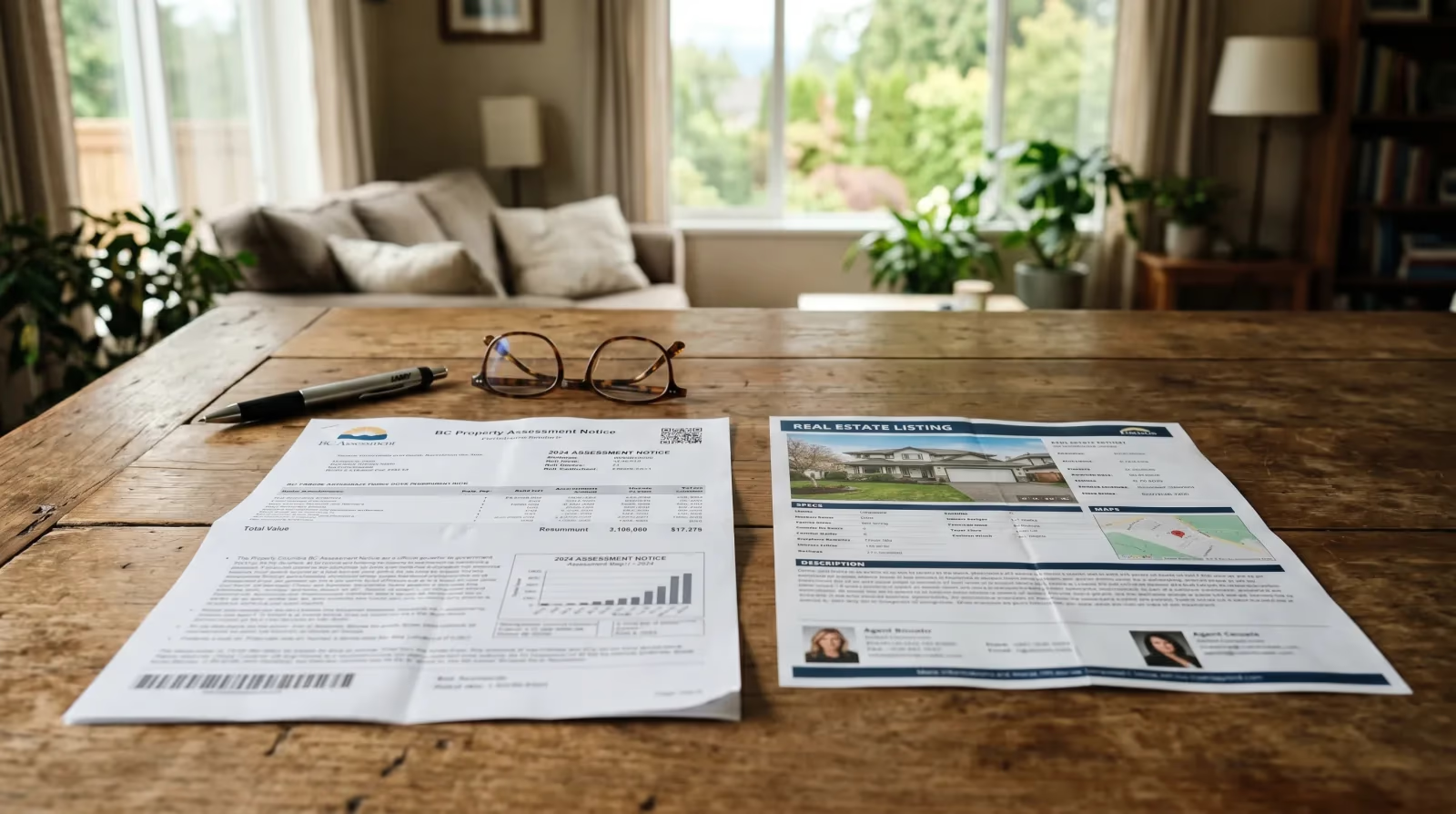

"The BC Assessment says it's worth $620,000, so why are they asking $710,000?" We hear versions of this question constantly at FRIVE from first-time buyers, and it comes from one understandable but costly misunderstanding: that the assessed value is the market value. It isn't, and treating it as if it were leads buyers to misjudge list prices, make offers that miss, and feel cheated by perfectly normal pricing. Understanding what BC Assessment actually is, and isn't, clears all that up.
This is a plain-English guide to BC Assessment versus market value for a first-time buyer.
What BC Assessment is for
BC Assessment is the provincial authority that values every property in the province each year, and it does so for one purpose: to help distribute property taxes fairly (BC Assessment). Local governments use the assessed values to apportion property taxes among owners. That's the job. The assessed value is a mass-appraisal estimate produced for taxation, not a market appraisal of what your specific home would fetch in a sale.
That distinction is everything. A mass appraisal values many properties at once using broad methods and data, aiming for fairness across a tax base, not pinpoint accuracy on any single home's current sale price. So while it's a real, official number, it's answering a different question than "what would this sell for?"
Why assessed value lags the market
Here's the mechanical reason the assessed value and the asking price so often diverge: timing. BC Assessment values properties as of July 1 of the year before the assessment is issued, then mails the notices in January. So the assessed value you're looking at reflects market conditions from roughly six months to a year and a half ago.
In a flat market, that lag barely matters. In a market that's moving, up or down, it matters a lot. If prices have risen since that July 1 valuation date, current asking and selling prices will sit above the assessed value, sometimes well above. If prices have softened, the reverse. Either way, the gap isn't evidence that a seller is greedy or that a deal is amazing. It's the predictable result of comparing today's market against a snapshot from the past.
When assessed value can mislead a buyer
Because of all this, a home can, and frequently does, sell for more than its assessed value, especially in a rising market or for a particularly desirable property. It can also sell below, in a softening market or for a less appealing home. The assessment is neither a ceiling nor a floor on price.
This is the part that trips up first-time buyers most. Anchoring hard on the assessed value, a buyer sees a list price above it and concludes the home is overpriced, or sees one below it and assumes a steal. Both conclusions can be wrong, because the assessed value was never the market price to begin with. We've watched buyers lose homes they wanted by lowballing to "the assessment," and others get excited about a "deal" that was simply a stale number.
Using assessed value to check for structural outliers
While BC Assessment isn't a substitute for market analysis, a large gap between a property's assessed value and its list price can be worth exploring, not as a pricing judgment, but as a prompt to ask better questions.
If a condo lists at a price significantly above its assessed value, the first question is: has the market moved substantially since the July 1 assessment date? In an active market that answer is often yes, and the gap is completely normal. But if the assessed value also looks low compared to other similar units assessed at the same time, that's worth understanding. Your agent can compare assessed values on comparable units in the same building, if one unit assesses meaningfully lower than its neighbours, it's worth asking why. Sometimes there's a sensible explanation (a lower floor, a parking-stall difference, a storage-locker discrepancy); occasionally there's something more substantive.
The reverse can apply too. A list price noticeably below the assessed value in a flat market is not automatically a bargain. It could reflect a well-priced property, or it could mean something has changed since the assessment that would be worth uncovering, a deficiency, a dispute, a strata problem, or simply an overbuilt assessed value that other properties in the building share. Either way, the gap is a prompt to look more carefully, not a conclusion in itself.
The takeaway: don't use the assessed value to set your offer, but do use a large, unexplained gap as a reason to dig deeper before you write one.
For strata properties specifically, the comparison across units in the same building can be particularly useful. All units in a building are assessed by the same provincial authority at the same time, using the same methodology. If two two-bedroom units on similar floors assess at materially different values, there's usually a documented reason in the strata plan, unit entitlement, extra storage, a parking stall count difference. If your agent can't find a clear reason, it's a question worth putting to the seller or investigating before subjects come off. BC Assessment publishes assessed values publicly, so your agent can look up comparable units in the same building as a reference point. This is one of the few ways assessed value genuinely adds something to the analysis that a straight comparable-sales comparison doesn't automatically surface.
How property taxes flow from assessment
Because the assessment exists to support property taxes, understanding the connection helps you estimate one of your ongoing ownership costs, and helps you avoid a common first-year budgeting mistake.
Property taxes are calculated by multiplying the assessed value by the municipality's mill rate, the rate set to raise the revenue the local government needs each year. Each municipality publishes its mill rate, and BC Assessment publishes assessed values publicly. If you're trying to estimate the annual property tax on a home you're considering, you can do a rough calculation: look up the assessed value on the BC Assessment website, look up the municipality's current mill rate on the city's website, and multiply. That gives you a directional estimate.
The important caveat: because the assessed value reflects a past date, it may understate what taxes will look like once assessments catch up. A buyer who estimates taxes from a low assessed value and then sees the next year's notice, reflecting a higher, updated assessment, can be caught off guard. Our guide to BC property tax and the home owner grant explains the full calculation and what the grant offsets for qualifying owners.
We've seen this catch first-time buyers in a specific way. A buyer checks the assessed value on a home, estimates the tax, and plans the monthly budget accordingly. Then the next annual assessment arrives, reflecting a valuation closer to what the buyer actually paid than to the older assessed value, and the tax bill is higher than expected. The home owner grant can help offset some of it for qualifying owners, but the lesson is to budget with some room above the current assessed value rather than treating it as a locked-in tax basis.
One more practical note: assessed values in BC are published as of January 1 each year, and the assessment you see when you're buying may already be the one being used for the current year's taxes. The assessment that will apply to next year's taxes is still being prepared. If the home you're buying sold well above its current assessed value, you can reasonably expect the next assessment to move toward the sale price, and budget the property tax accordingly, using the purchase price as a rough proxy for the direction of the next assessment rather than assuming taxes stay at today's level.
What to use instead
So what should you use to judge whether a list price is reasonable and to build your offer? Recent comparable sales, what similar homes in the same area actually sold for in current conditions. That's the real basis for pricing an offer. Your agent can prepare a comparison of recent sales of comparable properties, which reflects the market now rather than a tax valuation from the past. Our guide to writing a competitive offer covers how to use that analysis well.
Use BC Assessment as one rough background data point if you like, it's not useless, and it can offer a sanity check or a sense of relative value between properties assessed the same year. But it should never be the basis for your offer. It's too lagging and too generalized for that job.
The takeaway
BC Assessment gives you an official, useful, but tax-purposes-and-lagging number. Market value is what a buyer will pay today, set by current conditions and recent comparable sales. They're different things measured at different times, and a gap between them is normal. Judge a list price and build your offer on recent comparable sales with your agent's help, and treat the assessed value as background, not as the price.
A large, unexplained gap between assessed value and list price is worth a question, not a conclusion. And when estimating property taxes for your budget, build in some room above the current assessed value, because assessments tend to catch up.
If you'd like help understanding what a home is really worth in today's market versus its assessed value, reach out to the FRIVE team, we'll pull the recent comparable sales for you, or browse current Fraser Valley listings to start.
Frequently asked questions
What is BC Assessment?
- BC Assessment is the provincial authority that values properties across British Columbia each year for property tax purposes. Every property owner receives an assessment notice with an assessed value, which local governments use to help determine property taxes. The assessed value is a mass-appraisal estimate for taxation, not a market appraisal of what the home would sell for.
Is BC Assessment value the same as market value?
- No. The assessed value is an estimate for tax purposes and is based on a valuation date in the past, using mass-appraisal methods. Market value is what a buyer will actually pay in current conditions. The two can differ significantly, a home can sell above or below its assessed value depending on the market and the specific property.
Sources
- BC Assessment, About property assessments, BC Assessment
- Property Transfer Tax, Province of British Columbia, Government of British Columbia
Related guides
- Buyers GuideThe Property Disclosure Statement in BC: How to Read What the Seller Tells You
- Buyers GuideTitle Insurance in BC: The One-Time Premium That Protects Your Ownership
- Buyers GuideAssignment Sales in BC: What First-Time Buyers Should Know Before Buying One
- Buyers GuideCompletion, Possession, and Adjustment: What Closing Actually Looks Like in BC
Found this useful? Share it.
A neighbour, a partner, a friend who's two FHSA contributions away, send it their way.