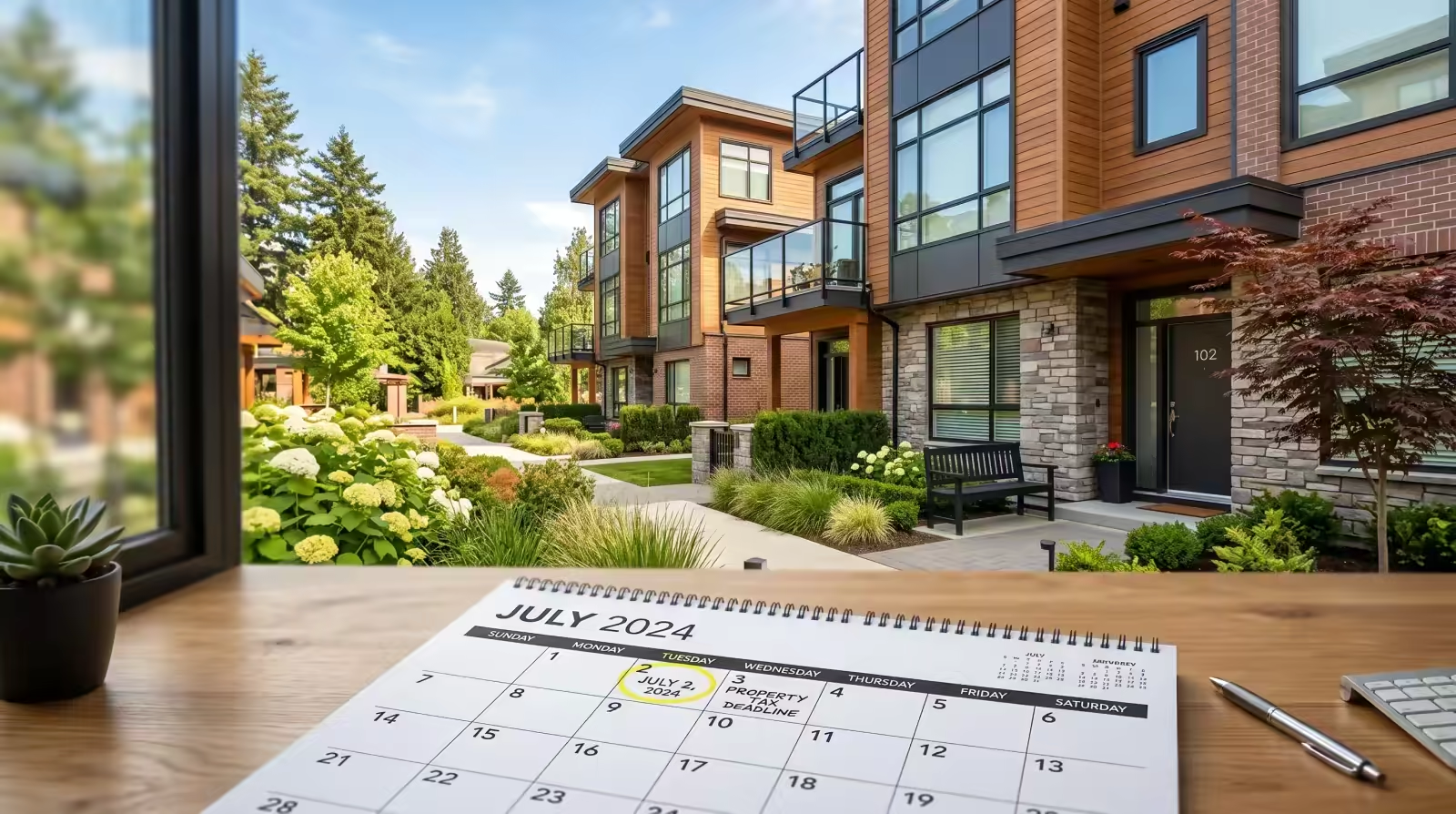

Most first-time buyer cost surprises the FRIVE team sees happen at closing, PTT, legal fees, title insurance. Property tax is different. It's the bill that arrives every year after you move in, and it catches people off guard because renting didn't train you to think about it. The Home Owner Grant helps, but only if you apply for it, and most new homeowners have no idea the application doesn't happen automatically.
How BC property tax is calculated
Property tax in BC is based on two numbers multiplied together: your property's assessed value and the tax rate set by your municipality.
Assessed value is determined annually by BC Assessment, the provincial Crown corporation that appraises every property in the province. The assessment reflects the estimated market value as of the previous July 1, so your January 2026 assessment reflects what your property would have sold for in July 2025. Assessments for most property types in the Fraser Valley declined in 2026 relative to 2025, following the softening market. Lower assessed values generally mean a lower tax bill, but the relationship isn't perfectly linear, municipalities adjust their tax rates in response to assessment changes to maintain their revenue.
Tax rate is set annually by your municipality, school district, regional district, and a handful of other provincial and local taxing authorities. The rate is expressed as a dollar amount per $1,000 of assessed value. Surrey's total 2025 residential tax rate, including all authorities, was approximately $3.11 per $1,000 of assessed value (WOWA.ca, Surrey property tax). Langley City approved a tax rate increase for 2026, per local reporting, this translated to an average increase of roughly $83 per year for attached homes. Confirm the current rate at langleycity.ca. The Township of Langley approved a 3.97% increase for 2026.
To get the 2026 confirmed rate for your municipality, check their property tax page directly, rates are published in spring after tax bylaws are passed.
What first-time buyers in Fraser Valley cities typically pay
Using Surrey's 2025 rate of $3.11 per $1,000 as an illustration (verify the 2026 rate at surrey.ca before relying on this):
| Property type | Approximate assessed value | Estimated tax bill (before grant) |
|---|---|---|
| Surrey condo | $450,000 | ~$1,400/year |
| Surrey condo | $550,000 | ~$1,710/year |
| Surrey townhouse | $750,000 | ~$2,333/year |
| Surrey townhouse | $850,000 | ~$2,644/year |
These are rough estimates. Your actual bill depends on the 2026 municipal rate and your property's specific assessed value, both numbers you'll find on your January tax assessment notice and your July tax notice respectively.
The Home Owner Grant: how it works and what it's worth
The BC Home Owner Grant (gov.bc.ca) is a provincial program that reduces your property tax bill each year. The basic grant for properties in the Fraser Valley Regional District is $570 in 2026. For seniors (65+), veterans, and people with disabilities, or those living with a qualifying relative, the total grant is $845 in 2026.
The grant applies to properties assessed at $2,075,000 or less (the 2026 threshold). Above that, the grant is reduced by $5 for every $1,000 over the threshold. For a typical first-time buyer condo or townhouse in the Fraser Valley, you're well below that ceiling, a $570 reduction is the full picture.
The grant is not automatic. This is the part that trips up new homeowners. You must apply for it yourself, every single year, through the provincial portal at homeownerbenefits.gov.bc.ca. The municipality does not apply it on your behalf, and it does not carry forward from the previous year if the prior owner claimed it.
To qualify, you must be:
- A registered owner of the property
- A Canadian citizen or permanent resident
- Living in BC
- Occupying the property as your principal residence
If you have a rental property or a recreational property, it doesn't qualify. The grant is specifically for your home.
The July 2, 2026 deadline
Property taxes for most Fraser Valley municipalities are due on the first business day of July. In 2026, that's July 2. Your property tax notice will arrive by mail in late May or early June.
Missing the deadline triggers a 10% penalty on the unpaid balance under the Community Charter. There's no grace period and no warning notice after the fact, the penalty applies automatically on July 3.
You can still apply for the Home Owner Grant after July 2, but the penalty will have already been charged. The grant reduces what you owe, but it doesn't reverse the penalty on the amount you didn't pay. Apply before July 2 to avoid that cost.
The application takes about five minutes online. You'll need:
- Your property's roll number and folio number (on your tax notice)
- Your Social Insurance Number
Apply at homeownerbenefits.gov.bc.ca.
Your first year: the property tax adjustment at closing
When you buy a home mid-year, the annual property taxes get split between you and the seller based on how many days each of you owned the property during the tax year.
Your lawyer or notary calculates this adjustment on the completion statement. If the seller has already paid the full year's taxes before closing, you reimburse them for the portion covering your ownership period. If taxes haven't been paid yet, they're credited to the seller for their portion and you take on the full bill at your tax deadline.
This adjustment typically shows up as a debit or credit on your completion statement under the line "Property tax adjustment." It's part of your closing costs to budget for.
In your first year, you'll also need to set up payment for the next year's taxes. Most buyers either pay in a lump sum in July or set up a pre-authorized payment plan with their municipality. Some lenders also offer a property tax payment option through your mortgage, ask your broker if that's something they handle.
Deferring property taxes in BC
BC offers a property tax deferral program for qualifying homeowners, primarily seniors, people with disabilities, and homeowners with dependent children. Deferral means the province pays your tax on your behalf (secured as a lien against the property) and you repay with interest when you sell.
For most first-time buyers in the Fraser Valley, deferral isn't the right tool, it's aimed at owners with limited income who have significant equity. But if affordability becomes a pressure point after purchase, it's worth knowing the program exists. More information at gov.bc.ca.
Strata properties and property tax: what condo and townhouse buyers need to know
This is one of the questions we hear most often from first-time buyers buying a condo or townhouse in the Fraser Valley, and the answer surprises people almost every time.
Property tax in BC applies to the individual strata lot, which is your unit. It is not charged against the entire building and then split by the strata corporation. Each owner in a strata building receives their own property tax notice and is responsible for paying their own property tax directly to the municipality. The strata corporation does not pay property tax on your behalf, and that cost is not folded into your monthly strata fees.
Your assessed value reflects the value of your specific unit, your strata lot share of the building, not the building as a whole. A 35-unit building with an overall value of $20 million does not mean each owner's assessed value is $20 million divided by 35. Each unit is assessed individually by BC Assessment, based on its own characteristics and comparable sales.
The Home Owner Grant also applies per unit, per qualifying owner. If you own a strata unit, occupy it as your principal residence, and meet the other eligibility criteria, you apply for the grant on your unit the same way a detached-home owner would. You don't share the grant with other owners in the building. Each owner applies for their own.
We had a first-time buyer ask us, right after closing, whether they needed to do anything about property tax or whether the strata handled it. They'd assumed, reasonably, it turned out, given how strata fees cover so many things, that property tax was one of the things the strata paid out of the monthly fees. It isn't. The notice of assessment arrived in January in their name, for their unit, and they needed to apply for the Home Owner Grant themselves before July 2 and pay the balance by the deadline.
Understanding this upfront means you budget for it correctly from the day you take possession, rather than being surprised in January. Our guide to strata fees in BC covers what strata fees do and don't include, property tax is in the "don't" column.
What property tax looks like inside your full annual budget
Property tax is one of the annual costs first-time buyers most consistently underestimate, alongside strata fees and home insurance. Renters don't track these because they're folded into rent or don't exist. Owners do.
A rough annual housing cost picture for a Fraser Valley townhouse buyer:
| Cost category | Approximate annual amount |
|---|---|
| Mortgage payments | Depends on rate, term, and purchase price |
| Property tax (Surrey $750K assessed) | ~$2,333 (before grant) |
| Home Owner Grant reduction | −$570 |
| Net property tax | |
| Strata fees | $250 to $450/month (varies widely by building) |
| Home insurance (condo contents) | $60 to $100/month |
These strata fee and insurance figures are illustrative ranges from our experience, your specific building and coverage will vary.
Budget property tax monthly rather than as an annual lump sum. $147 per month for a Surrey townhouse is just another line item. $1,763 showing up in a single July invoice is a shock if you haven't been setting it aside since closing day.
Our property tax calculator lets you run the numbers for different assessed values and rate scenarios. Pair it with the closing costs calculator to get the full picture of what your first year looks like.
The city you buy in changes the property tax math, Surrey, Langley, and Abbotsford all have different rates and assessment trajectories. If you want to run the numbers for a specific city and property type, reach out to the FRIVE team. We go through the full annual cost picture with every buyer, not just the purchase price.
Frequently asked questions
Do first-time buyers get a property tax discount in BC?
- Not a permanent one. The FHSA and PTT exemption help with your purchase, but don't reduce annual property taxes. What does is the BC Home Owner Grant, which gives qualifying homeowners $570 off their tax bill in the Fraser Valley each year ($845 for seniors, veterans, and people with disabilities). You apply for it yourself every year, it's not automatic.
What is the BC Home Owner Grant and who qualifies?
- The BC Home Owner Grant reduces the annual property tax bill for eligible homeowners who occupy the property as their principal residence. The basic grant is $570 in the Fraser Valley Regional District. To qualify, you must be a registered owner and a Canadian citizen or permanent resident living in BC. Properties above $2,075,000 get a reduced grant in 2026.
Sources
- Home owner grant, Province of British Columbia, Province of British Columbia
- Important dates for your property taxes, Province of British Columbia, Province of British Columbia
- B.C.'s homeowner grant threshold set at $2.075M for 2026, Today in BC (2026-01-02)
- Surrey property tax 2024 and 2025, WOWA.ca, WOWA.ca
- City of Langley, Property Tax, City of Langley
Related guides
- Taxes & ProgramsBC Home Flipping Tax: What First-Time Buyers Need to Know Before They Close
- Buyers GuideBC Home Buyer Rescission Period: The 3-Day Rule First-Time Buyers Need to Know
- Neighbourhood GuidesBest Neighbourhoods in Langley for First-Time Buyers (2026)
- Neighbourhood GuidesBest Neighbourhoods in Surrey for First-Time Buyers (2026)
Found this useful? Share it.
A neighbour, a partner, a friend who's two FHSA contributions away, send it their way.