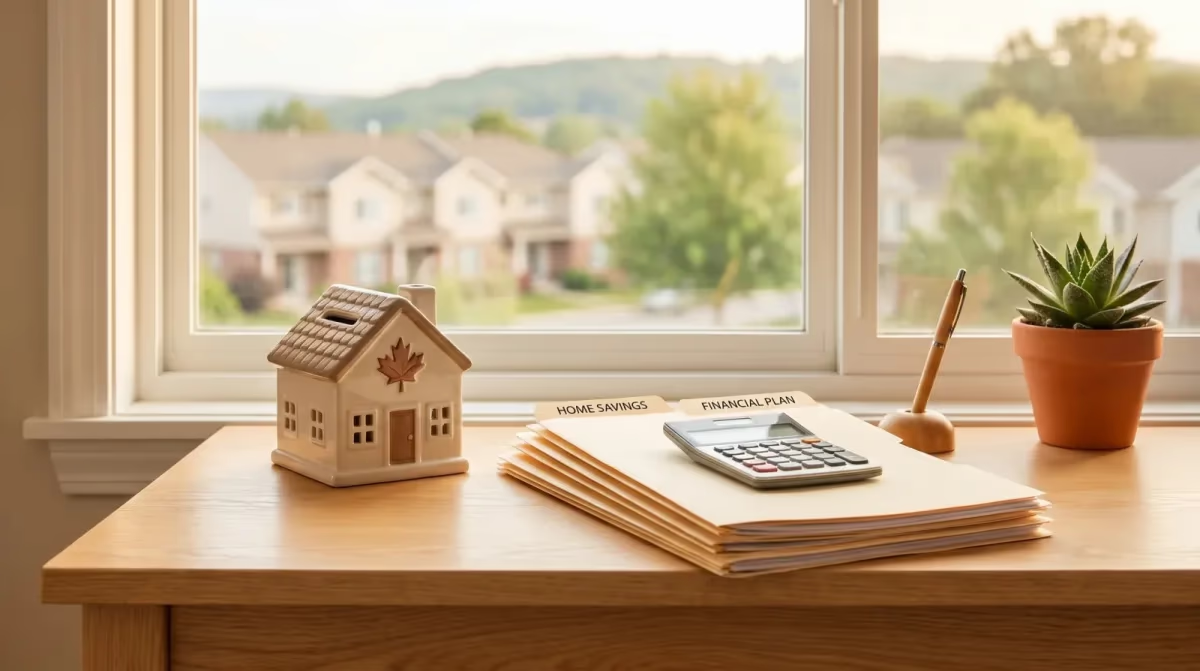

The First Home Savings Account is the most useful account the federal government has built for first-time buyers in a long time, and the FRIVE team tells buyers to open one even if they're a year or more out from buying. It does something neither the RRSP nor the TFSA on their own can do: you get the tax deduction going in and the tax-free withdrawal coming out, as long as the withdrawal is for a qualifying first home.
It's been around since April 1, 2023. Most first-time buyers we work with in the Fraser Valley either have one and aren't using it well, or don't have one and should.
This page is the FRIVE team's plain-English map of the rules, eligibility, contribution mechanics, withdrawal mechanics, the FHSA-vs-HBP interaction, and the timing rules that quietly cost buyers real money.
What the FHSA actually does
Think of the FHSA as a registered account that's gated on the back end rather than the front. You can put money in if you're a first-time buyer at the time you open it. The CRA gives you a tax deduction for the contribution, exactly like an RRSP. The money grows tax-free inside the account, exactly like a TFSA. And then, when you buy a qualifying home and take a qualifying withdrawal, the whole balance, contributions plus growth, comes out tax-free.
That last part is what makes it special. The TFSA also allows tax-free withdrawals, but contributions to a TFSA aren't tax-deductible. The RRSP allows tax-deductible contributions, but most withdrawals are fully taxable as income. The FHSA combines the deduction on the way in with the tax-free exit. For a first-time buyer in a middle marginal tax bracket, that's roughly a 20 to 30% boost to every dollar that goes through the account.
The contribution mechanics
The CRA's FHSA contribution rules define the structure:
$8,000 per year of new participation room, starting the year you open the account. The room does not accrue before you open. This is the rule that quietly costs late starters the most money.
$40,000 lifetime cap. Once you've contributed $40,000 in total, you cannot contribute more, even if you have unused room left.
Carry-forward up to $8,000. Unused annual room carries forward, but only up to $8,000 at a time. So the largest contribution you can make in any single year is $16,000, last year's unused $8,000 plus this year's $8,000.
For a buyer who opens the account in 2026 and contributes nothing, they enter 2027 with $8,000 of unused room. They can contribute the full $16,000 in 2027 if they have it. But waiting until 2029 to open the account doesn't bank three years of room, you still start with $8,000.
The deduction works like an RRSP. Contributions made in 2026 or in the first 60 days of 2027 can be claimed on your 2026 tax return. Unclaimed deductions can be carried forward to a higher-income year, which is often the move for younger buyers whose income is still climbing.
The eligibility test (read this twice)
The CRA's definitions page is precise. To open an FHSA you must be:
- At least 18 years old (or the age of majority in your province).
- A Canadian resident.
- A first-time home buyer, meaning at no time in the current calendar year before the account was opened, nor at any time in the previous four calendar years, did you live in a qualifying home that you owned, or jointly with a spouse or common-law partner.
That four-year lookback is the part to read twice. If you owned and lived in your last home and moved out in, say, January 2022, you'd be eligible to open an FHSA in January 2027, the year four full calendar years have passed. The CRA's clock counts whole calendar years.
The eligibility test runs at the moment you open the account. Once it's open, you stay eligible to contribute even if your life circumstances change. The eligibility test at the moment of withdrawal is what controls whether the withdrawal is tax-free, and the rules at withdrawal are slightly different (see below).
The withdrawal mechanics
A qualifying withdrawal from your FHSA is tax-free if all the conditions are met. The CRA's withdrawal rules require:
- You must be a first-time home buyer at the time of the withdrawal.
- You must have a written agreement to buy or build a qualifying home with an acquisition or completion date before October 1 of the year following the withdrawal.
- You must intend to occupy the qualifying home as your principal residence within one year of buying or building it.
- You must be a Canadian resident from when you make the withdrawal until you buy or build.
The CRA lets you withdraw any amount up to your full FHSA balance in one or several qualifying withdrawals. There's no minimum, no maximum beyond your balance, and no requirement to use a specific RRSP-style form, your FHSA issuer handles it.
If the withdrawal isn't qualifying, for instance, you take money out without a written agreement to buy, it's taxable as income for the year. That's an expensive mistake. If you've changed your mind about buying, the right move is usually to transfer the FHSA tax-free into an RRSP or RRIF, not to withdraw it.
How the FHSA stacks with the HBP
This is the most common confusion we see in Fraser Valley first-time buyers. The short answer: both, on the same home, full amount, for each spouse.
The CRA explicitly states an eligible buyer can withdraw from an FHSA and an RRSP under the Home Buyers' Plan for the same qualifying home, as long as each program's conditions are met at the time of withdrawal. The two programs don't share rooms, they share a buyer.
For a qualifying couple where both partners qualify under each program, the combined tax-advantaged headroom is:
- FHSA: $40,000 lifetime × 2 = $80,000
- HBP: $60,000 × 2 = $120,000
- Combined per couple: $200,000
The full $200,000 is more headroom than most first-time buyers actually need, but the existence of it is the reason we tell people to open the FHSA early. Even using a quarter of that envelope can swing a Fraser Valley down-payment plan.
There's a deeper walk-through on the HBP side, including the new 5-year repayment grace period, in the Home Buyers' Plan sub-page.
The timing rules that cost late starters
We mentioned this above, but it's worth saying clearly because we see it constantly.
The annual $8,000 only accrues once the account is open. Opening the account is the trigger. Opening in 2026 starts the clock; not opening until 2028 means you've forfeited two years of room you can never get back.
There is essentially no downside to opening early. Most institutions let you open an FHSA with a small or zero opening balance; a cash account inside the FHSA can sit at zero interest for years without consequence. The upside of having room available the year you decide to buy is what matters.
Our shorthand to first-time buyers: if you're a year or more away from buying, open the FHSA this month. If you're a few months away, open it and put the down-payment cash you already have in it, the tax deduction in your buying year may be worth several thousand dollars.
The exit ramp if you don't buy
The FHSA has a maximum 15-year participation period. The clock runs from the year you open the account and ends on December 31 of the year in which the earliest of three events happens:
- The 15th anniversary of the account being opened.
- You turn 71.
- The year following a qualifying withdrawal, so once you've taken your first qualifying withdrawal, you've got until December 31 of the following year before the account must close.
If you don't buy a home before the participation period ends, your FHSA balance can be transferred tax-free into an RRSP or RRIF. This does not consume RRSP contribution room, it's an extra rollover that sits on top of whatever RRSP room you'd otherwise have. For a first-time buyer who opens the account "just in case" and later decides to rent for life, the FHSA effectively becomes another RRSP. The deduction you took going in is preserved.
Common mistakes we see
Opening it too late. The single biggest one. We talked to a Surrey buyer last spring who was eight months from purchase and only just heard about the FHSA. The contribution room they'd already missed wasn't recoverable.
Treating it like a TFSA. Some buyers open the account, transfer money in, and then withdraw it later without a written agreement, assuming a tax-free withdrawal because the money was already after-tax going in. That doesn't work; without the qualifying-withdrawal conditions, the withdrawal is taxable as income. If the plan has changed, transfer to an RRSP instead.
Holding the wrong investments inside the account. This isn't an FHSA-specific rule but it matters here. A buyer who opens an FHSA in 2026 to buy in 2026 probably wants the money in a high-interest savings vehicle, not a stock fund, the time horizon is too short to absorb a market drop. A buyer five years out can sit further along the risk spectrum. This is an accountant or financial advisor's call, not ours, but worth raising at the kitchen table.
Forgetting to claim the deduction. Some buyers contribute to the FHSA but skip claiming the deduction on their tax return that year. The deduction can be carried forward, but it's worth noting on the contribution slip when it arrives so a future tax return doesn't accidentally miss it.
How this fits with the rest of the hub
The FHSA is the down-payment savings leg of the program stack. The HBP is the RRSP-borrowing leg. The PTT exemptions are the closing-day legs. The GST rebate is the new-build leg. None of them interfere with each other, they all test different things.
For a typical Fraser Valley first-time buyer the FHSA is the program we tell people to start with, because it's the one whose advantage compounds with time. The PTT exemption is the same whether you start preparing for it the day before completion or three years out; the FHSA is meaningfully more powerful if you start three years out.
More in this hub
- Pillar, BC Buyer Programs and Taxes (2026)
- RRSP Home Buyers' Plan, the sibling federal program.
- PTT first-time-buyer exemption
- Newly Built Home PTT exemption
- GST rebate on a new home
- How much house can you actually afford in the Fraser Valley?
Talk to an accountant about the deduction timing
Whether to claim the FHSA deduction this year or carry it forward to a higher-income year is an accountant's call. We can tell you the room exists; the optimal year to claim it depends on your full picture and isn't something we can model from outside.
Browse Fraser Valley listings on FRIVE or book a 20-minute chat with us, we'll never push you to buy before you're ready, and when you are, we'll help you stack the programs you've earned the right to claim.
Frequently asked questions
What is the First Home Savings Account?
- The FHSA is a registered account introduced in 2023 that lets eligible first-time home buyers contribute money toward a first home with both the tax-deduction benefit of an RRSP and the tax-free-growth and tax-free-withdrawal benefit of a TFSA. Contributions are tax-deductible the year you contribute (or carried forward). Growth is tax-sheltered. A qualifying withdrawal for a first home is tax-free.
How much can you contribute to an FHSA?
- The annual participation room is $8,000, accruing only after you open the account. The lifetime contribution limit is $40,000. Unused annual room carries forward up to $8,000, so the maximum any single year contribution can reach is $16,000.
Sources
- First Home Savings Account (FHSA), Canada Revenue Agency
- Participating in your FHSAs, Canada Revenue Agency
- Withdrawals and transfers out of your FHSAs, Canada Revenue Agency
- Definitions for FHSAs, Canada Revenue Agency
BC buyer programs and taxes
8 pieces that fit together. Read them in order, or jump to the one you need.
- Start hereBC Buyer Programs and Taxes: A First-Time Buyer's Map for the Fraser Valley in 2026
- GuideThe BC Property Transfer Tax First-Time Buyer Exemption: How It Actually Works
- GuideThe BC Newly Built Home PTT Exemption: What Counts as New, and What It Saves
- Guide · you are hereThe First Home Savings Account (FHSA) for BC Buyers: How to Use the Best Account the Government Has Ever Built
- GuideThe RRSP Home Buyers' Plan for BC First-Time Buyers: $60,000, 15 Years, and the New 5-Year Grace
- GuideGST on a New Home in BC: The Old Rebate, and the New 2026 First-Time Buyer Rebate That Changes Everything
- GuideIs There a First-Time Home Buyer Grant in BC? What Actually Exists in 2026
- GuideWhat Happened to the First-Time Home Buyer Incentive? (Discontinued 2024)
Related guides
- Hub - BC Buyer ProgramsThe BC Newly Built Home PTT Exemption: What Counts as New, and What It Saves
- Hub - BC Buyer ProgramsThe BC Property Transfer Tax First-Time Buyer Exemption: How It Actually Works
- Hub - BC Buyer ProgramsBC Buyer Programs and Taxes: A First-Time Buyer's Map for the Fraser Valley in 2026
- Hub - Mortgage & AffordabilityPre-Approval vs Approval: The Difference That Costs Fraser Valley Buyers Their Deposit
Found this useful? Share it.
A neighbour, a partner, a friend who's two FHSA contributions away, send it their way.